US-Portugal Tax Treaty: Articles, Residence and Credits
The US-Portugal tax treaty determines residence under Article 4 and limits source-state tax on dividends to 15%. Each country keeps its own filing system, so treaty relief must be reconciled with domestic tax rules.

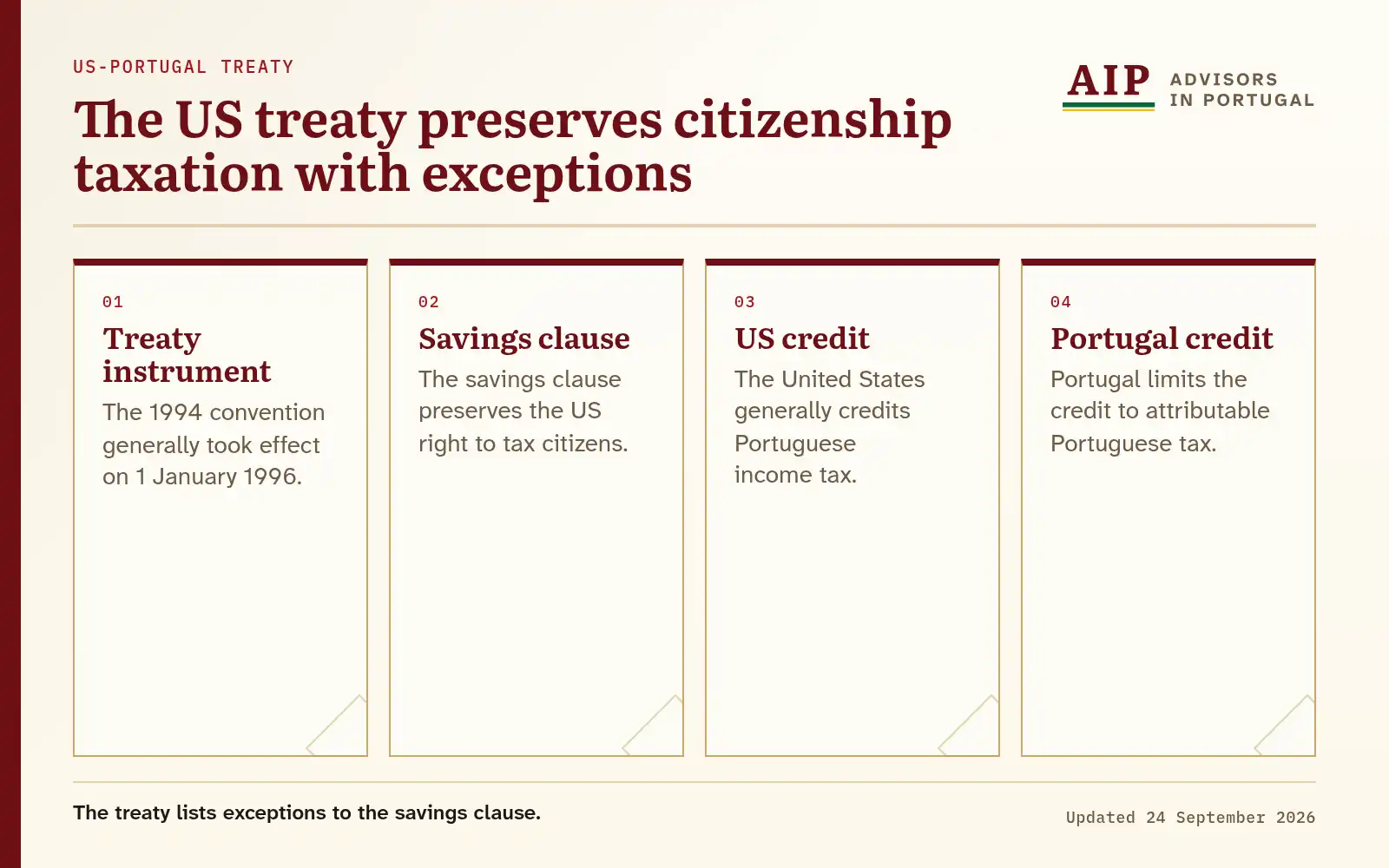
Diagram text version
The 1994 convention generally took effect on 1 January 1996. The savings clause preserves the US right to tax citizens. The United States generally credits Portuguese income tax. Portugal limits the credit to attributable Portuguese tax.
The 1994 convention and its protocol have applied generally since 1 January 1996 under Article 30. Residence is settled by Article 4, dividends by Article 10, services and employment by Articles 15 and 16, relief by Article 25 and disputes by Article 27. Each country keeps its own domestic filing system.
Which US-Portugal Tax Treaty Applies?
The 1994 convention is the income-tax treaty generally effective from 1 January 1996, as recorded in the IRS treaty text. Its protocol forms part of the treaty analysis. The convention applies to the facts and tax year covered by its effective provisions.
Check the treaty version before relying on a rate. The analysis identifies the taxpayer, income, residence year and protocol paragraph, then reconciles the result to current US and Portuguese law.
Which Taxes Fall Within the US Convention?
Article 2 covers Portuguese IRS, IRC and Derrama and US federal income taxes plus the specified private-foundation excise taxes. Article 2(1)(b)(i) excludes US social-security contributions from the covered US income taxes; Protocol paragraph 2(a) concerns Portuguese social-security contributions.
Income tax, payroll tax and social contributions are therefore classified separately, and any separate contribution rule is checked.
How Does Article 4 Resolve Dual Residence?
Article 4 first follows domestic liability to tax, then uses a permanent home, closer personal and economic relations, habitual abode, nationality and finally competent-authority agreement for dual residents. Article 1 covers residents of one or both contracting states, subject to the limitation on benefits in Article 17.
Gather both countries’ residence notices and certificates. Each tie-breaker is documented in order, and competent-authority consultation can be requested if the facts remain unresolved.
How Does the US Savings Clause Work?
Protocol paragraph 1(b)-(c) preserves a US right to tax its citizens as if the convention were not in force, subject to the listed exceptions. Protocol paragraph 1(b)-(c) extends that right to a former citizen whose loss of citizenship had tax avoidance as one of its principal purposes, for 10 years after the loss.
US citizenship therefore remains central even when Article 4 assigns treaty residence to Portugal. The savings-clause exceptions are run alongside the US return, foreign tax credit and Portuguese assessment.
How Are Dividends Taxed?
Article 10 limits source-state tax on dividends to 15%. Article 10(3) caps dividends paid after 31 December 1999 at the rate Portugal applies to recipients resident in EU member states, with 5% as the minimum, when the recipient directly holds at least 25% of the payer’s capital for an uninterrupted period of 2 years before payment.
The payer, beneficial owner, holding period and residence certificate affect the rate. Treaty forms are verified before payment, and withholding is reconciled to the US and Portuguese returns.
How Do the 183-Day Service Rules Differ?
Article 15 applies to independent services and uses residence, a fixed base and a 183-day condition measured in any 12-month period. Article 16 applies separately to employment and tests 183 days, the employer’s residence and whether remuneration is borne by a permanent establishment or fixed base.
Do not copy the employment test into an independent-contractor analysis. The work is classified, the relevant period is counted, the payer is identified and the place where the service is physically performed is checked.
How Does Article 25 Relieve Double Tax?
Article 25 generally permits the United States to credit Portuguese income tax against US tax on the same income. Portugal generally deducts or credits US income tax against Portuguese tax attributable to that income, subject to Article 25 and CIRS Article 81.
The Portuguese credit cannot exceed the applicable treaty or domestic limit. The same income, tax year and evidence appear in both calculations, and withholding certificates and assessments are preserved.
Can You Ask for Competent-Authority Relief?
Article 27 permits a taxpayer to present a competent-authority case within 5 years from the first notification of the action that produces taxation contrary to the convention. The authorities can consult to resolve double taxation or interpretation issues.
The 5-year period limits when you can present the case. The first notification is identified, the filing record is preserved and the facts are presented under the relevant article.
What Records Support a US Treaty Position?
You should gather residence certificates, travel dates, leases or home records, employment or services contracts, dividend statements, Portuguese assessments, US returns and foreign-tax payment evidence for the treaty analysis. Keep the Article 4, 10, 15, 16 or 25 link for each item.
Form 1040 reporting, Portuguese IRS reporting, withholding and credits can then be reconciled. A complete evidence file supports each treaty position.
A US citizen generally continues to file a US return, and a Portuguese resident reports worldwide income under Portuguese law. The treaty then limits source taxation or grants relief where its article and conditions apply.
The analysis identifies the relevant day count and the homes available during that period. Keep a calendar for each 12-month period, lease and utility evidence, and records showing where personal and economic relations were concentrated. Those facts support Article 4 and any competent-authority discussion.
You should plan Article 10 withholding before payment. A payer may need a residence certificate, beneficial-owner statement or ownership evidence to apply the treaty cap. Documents are aligned with the payer, and the withheld amount is then verified in both returns.
Independent services and employment can also produce different social-security results. Social contributions follow their own rules outside the Article 15 and 16 income tests. Income-tax, payroll and social-contribution analyses stay distinct, and any separate rule is documented.
The credit calculation needs a currency and timing policy. Match the US tax, Portuguese tax and payment date to the same income item, then apply each country’s ordering and limitation rules. Keep the evidence for the credit with both returns.
You should preserve the date of relinquishment and the protocol analysis, including evidence relevant to the tax-avoidance-purpose condition and the 10-year period that runs from that date. The exception list and any later treaty amendment are checked before a position is filed.
Common questions
What is the treaty dividend withholding cap?
How does Portugal credit US tax?
Which state can receive my treaty dispute?
Does the treaty cover someone resident in either country?
Can the US savings clause affect a former citizen?
Can both Portugal and the United States treat me as resident?
The information on this page is checked against official sources and reviewed regularly. It is corrected when the law or official guidance changes, as the Editorial Standards describe.