Bookkeeping and Business Accounting Services in Portugal
Bookkeeping services in Portugal form part of our business accounting for commercial companies, which must keep organised accounts under Article 123 of the CIRC. We record the agreed transactions, reconcile the supporting ledgers and statements, and prepare the annual tax filings from those accounts.
First conversation free Reply within one business day

Who Needs Business Accounting in Portugal
- Your company must maintain organised accounts under Portuguese law.
- The finance team needs Portuguese bookkeeping and SNC reporting applied to the entity's facts.
- Your company needs invoicing, VAT records and SAF-T obligations reviewed together.
- Your group wants Portuguese accounting work supported from the opening declaration through annual filings.
Your company needs a one-off corporate-tax opinion without recurring accounting work; the service covers recurring business accounting.
What's Included in Portuguese Accounting Support
You get a quote in writing before any work starts.
- Organised accounts. A certified accountant maintains the accounting records required for the Portuguese company.
- Bookkeeping and reconciliations. The agreed transactions are recorded and the supporting ledgers and statements are reconciled.
- SNC reporting review. A certified accountant reviews how SNC reporting requirements apply to the entity's facts.
- Invoicing and SAF-T review. The agreed invoicing records and current SAF-T obligations are checked against the taxpayer and period.
- VAT accounting. A certified accountant reviews the VAT records and prepares the agreed periodic work for the company's regime.
- Annual tax filings. A certified accountant prepares the agreed Modelo 22 and IES/DA work from the closed accounting records.
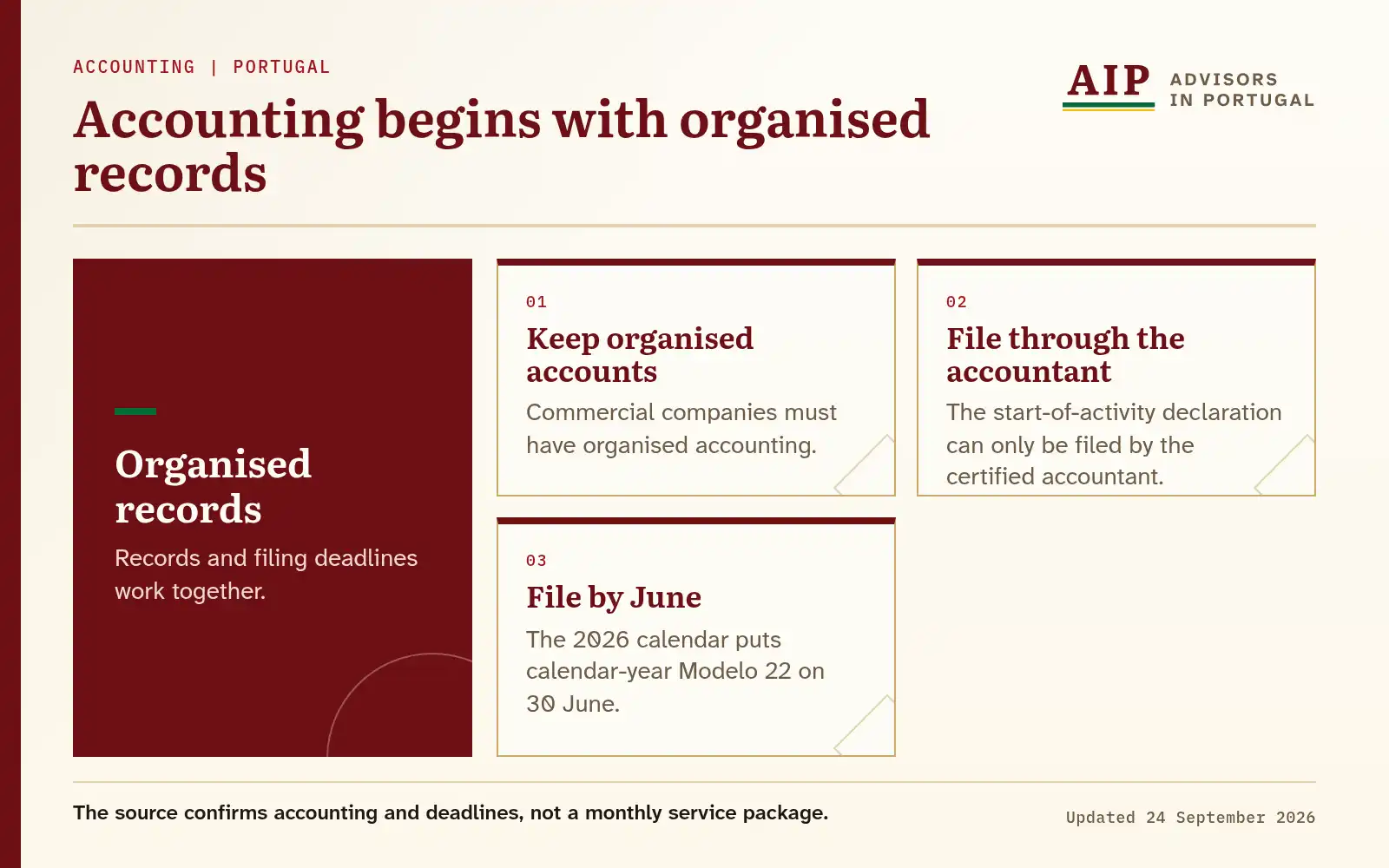
Diagram text version
Keep organised accounts. Use the certified accountant for the start declaration. File the calendar-year Modelo 22 by 30 June.
What Your Company Needs to Provide
- Company and tax details
- The company registration, NIF, activity codes, tax registrations and current accounting position.
- Sales records
- Issued invoices, credit notes, sales reports and payment records for the accounting period.
- Purchase and expense records
- Supplier invoices, receipts, expense claims and the business purpose of material costs.
- Bank and payment statements
- Portuguese and foreign bank, card and payment-platform statements used by the company.
- Payroll and asset information
- Payroll summaries, employment costs, asset purchases, financing and shareholder transactions.
- Existing accounting files
- Prior ledgers, returns, SAF-T files, annual accounts and correspondence from the tax authority.
How Business Accounting Is Handled in Portugal
Every engagement starts with the form below. Describe your company, activity, transaction volume and current records, and a certified accountant who handles that type of work replies in English or Portuguese.
A certified accountant handles the start-of-activity declaration and the other filings included in the engagement and flags VAT, payroll and corporate-tax questions along the way.
-
Company and accounting-position review
A certified accountant reviews the company, registrations, activity, records and prior filings.
-
Portuguese chart and SNC setup
The records and reporting approach are mapped to the company's facts under the SNC.
-
Bookkeeping and ledger reconciliation
The agreed transactions are recorded and bank, customer, supplier and tax balances are reconciled.
-
Invoice and SAF-T validation
A certified accountant checks the invoicing data and current SAF-T requirements for the taxpayer and period.
-
VAT return and periodic reporting preparation
The agreed VAT and periodic accounting work is prepared from the reconciled records.
-
Year-end close and annual filings
A certified accountant closes the agreed records and prepares the applicable Modelo 22 and IES/DA work.
Timing and Possible Delays
Set by the accounting period and filing calendar
The work is planned around the accounting period, transaction volume, record quality and applicable tax calendar.
What delays it
The work takes longer when invoices, bank statements, payroll records, prior ledgers or transaction explanations are incomplete.
What to prepare now
Your company gathers its registration, accounting, sales, purchase, bank, payroll and prior-filing records before the work begins.
Records, SAF-T and Year-End Considerations
Source records and the monthly close
Sales, purchases, payroll, financing and shareholder records are separated before the bank and tax balances are reconciled. Your company keeps the supporting invoice or explanation with each material correction so the year-end file preserves the reason for the entry.
SAF-T and invoice-data validation
Your company retains the source invoice data and software export together so a later correction can be traced to the original transaction.
Year-end filing sequence
Your company resolves outstanding customer, supplier, payroll and shareholder balances before the final accounting records are used for the agreed filings.
Set out your company's accounting needs
Describe the company, activity, transaction volume, accounting period and current records.
Common questions
Must a Portuguese company keep organised accounts?
Does a company need a certified accountant?
Which accounting framework applies in Portugal?
Does accounting support include SAF-T?
Which invoicing rules apply?
When are Modelo 22 and IES/DA due in 2026?
Is there one 2026 e-invoicing deadline for every company?
Can incomplete accounting records be taken over?
How is a company's accounting handled?
What to Expect From the Service
-
One team for the whole case.
The accounting, VAT, payroll and corporate-tax questions all run through one team.
-
English or Portuguese.
English or Portuguese, whichever you are most comfortable in.
-
A quote in writing before work starts.
You get a quote in writing before any work starts. You are told plainly if a case falls outside the service.
Contact us
Your request is in
Every request is read in house. The requirements are assessed, and a reply by email sets out the appropriate next steps.
Every enquiry is read in house, and the aim is a reply within one business day.
The information on this page is checked against official sources and reviewed regularly. It is corrected when the law or official guidance changes, as the Editorial Standards describe.