VAT Number in Portugal Guide
A VAT number in Portugal is issued by the Autoridade Tributária e Aduaneira, and Article 31 of the Código do IVA requires an activity declaration before VAT-subject activity starts. Entities subject to commercial registration must submit it within 15 days of the registration filing.

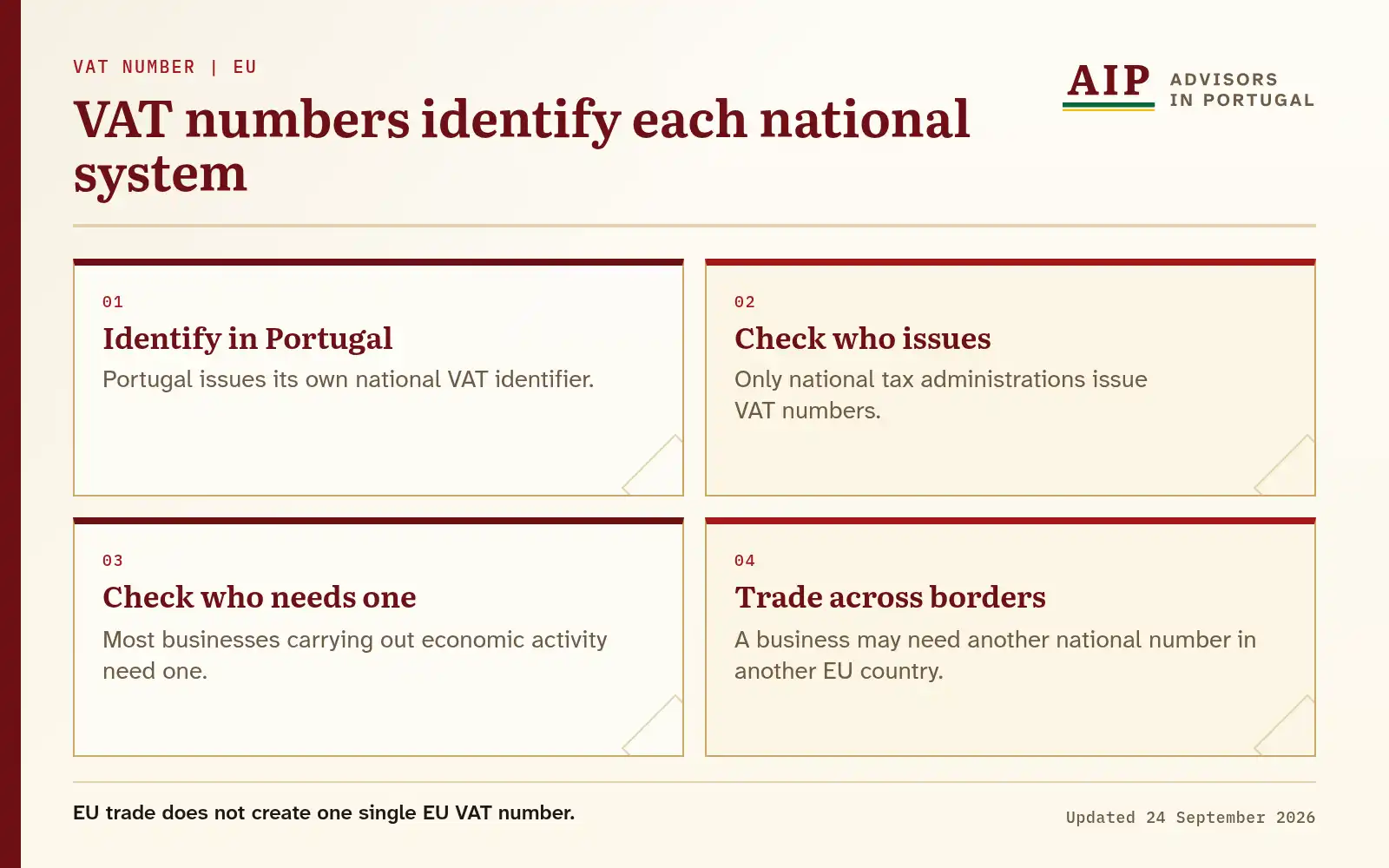
Diagram text version
Identify in Portugal. Check the issuer. Check whether the business needs a number. Review other national numbers for cross-border trade.
Article 214 of the EU VAT Directive provides for identification of taxable persons by individual VAT numbers. In Portugal, Article 31 of the Código do IVA requires a declaration of activity before a VAT-subject activity starts, subject to its stated single-operation exception. The transaction and the business activity come before the number.
What is a Portuguese VAT number?
Article 214 of the EU VAT Directive requires Member States to identify taxable persons and specified non-taxable legal entities by an individual number for VAT purposes. The European Commission describes that number as the unique identifier for a person or entity registered for VAT. Your company should distinguish the identifier from the rules that determine whether a particular supply bears VAT.
A national VAT number identifies the registered person in the issuing country’s system. The identifier alone does not establish the VAT treatment of every invoice or transaction. The number relates to the business, the activity declaration and the supplies the company actually makes. The company’s finance team should retain the registration record and the documents explaining the relevant activity. Each entity in a group has its own facts, and they matter before an invoice or filing uses a particular number.
Who issues a VAT number?
The European Commission’s VAT identification guidance states that only national tax administrations issue VAT numbers. In Portugal, the Autoridade Tributária e Aduaneira administers the VAT system and the declaration of activity under the Código do IVA. Your company should identify the jurisdiction whose number a transaction requires.
The official number comes from the national administration. The declaration rests on the company’s identity, activity and expected transactions. You should keep the authority’s confirmation with the company’s tax records. The company’s finance team should record the issuing Member State for each number used across a border. The company’s finance team should record which entity and country each identifier belongs to.
Who may need a VAT identification number?
Article 214 of the VAT Directive covers taxable persons in circumstances that include taxable supplies, intra-EU acquisitions and specified cross-border services. The European Commission says most businesses and other persons carrying on economic activity need VAT identification. Your company should map what it supplies, where and to whom before concluding which registration is required.
You should distinguish a Portuguese domestic sale from an intra-EU acquisition or a service involving a customer in another Member State. The contractual party, place of supply and transaction records are tested against the applicable identification rule. You should preserve the first expected invoice, contracts and supply-chain details. A company with more than one activity may need to assess each activity’s VAT treatment, even though the company itself receives one national identifier for the relevant registration.
When must activity be declared in Portugal?
Article 31 of the Código do IVA gives an entity subject to commercial registration a maximum of 15 days after the registration filing to submit its activity declaration, and the declaration must still precede activity. You should identify both dates before the first transaction.
Your company should preserve its commercial registration filing date and planned activity start. The activity information is compared with the contracts and invoices already contemplated. The deadline measured from commercial registration does not give the company permission to begin VAT-subject activity before making the declaration. You should record the official submission and confirmation. The company’s finance team should ensure that the declared activity reflects the actual supplies if the business plan changes before trading starts.
What does Article 31 say about a single operation?
Article 31 of the Código do IVA contains a statutory exception for an isolated act, or ato isolado, within the activity-declaration rule. The current provision reflects changes that apply from 1 July 2025. You should identify whether the facts concern a continuing activity or an individual operation before relying on that exception.
The transaction history and the planned future supplies bear on that question. You should provide the contract, invoice proposal and any earlier activity record. The contracts and transaction history show the underlying pattern of work. Your company should record why it treated the operation as isolated if that treatment is relevant. You should separate the question of declaring an activity from the VAT treatment of the actual supply; Article 31 addresses the declaration step.
When does an invoice show the supplier’s VAT number?
The European Commission’s VAT identification guidance says the supplier’s VAT number normally appears on transactions requiring an invoice. Your company should identify the invoice rules governing the specific transaction before issuing or accepting the document.
The company’s finance team should compare the supplier name, number and transaction with the contract and purchase records. A simplified invoice rule or cross-border rule can change the fields required. You should retain the invoice version that was sent or received, together with any correction. An identifier printed on a document identifies a registered person, but the amount charged and the applicable VAT treatment follow the transaction rules. The finance team should review those questions when a supplier or customer is outside Portugal.
What is VIES used for?
The European Commission describes VIES as the VAT Information Exchange System used to check VAT-number validity. You should identify the Member State and the number that the transaction record uses before interpreting a result.
Your company may need to verify a counterparty’s identifier for an intra-EU transaction. The validity information relates to the counterparty and the transaction date. A validity response concerns the number in the national system; the VAT result for the supply still follows the governing substantive rules. You should keep the supplier and customer information together with the invoice and contract. The company’s finance team should identify which period and invoices the older number covered when a number changes.
Can one EU VAT number cover several countries?
The European Commission’s VAT identification guidance says every EU country issues its own national VAT number. A business supplying goods or services in several EU countries may therefore need a national number in each. The same guidance describes OSS as a simplification for qualifying cross-border business-to-consumer supplies.
Your company should identify each destination, customer type and supply. The transactions are compared with national registration duties and any OSS or IOSS route that applies. You should not assume that holding a Portuguese number answers a separate country’s registration question. The company’s finance team should keep a country-by-country transaction record and the registration or scheme confirmation for each relevant period. The imported distance-sale route covers only the transactions it describes. Spain is a common second registration for businesses based in Portugal. A business that sells goods or services there needs a Spanish VAT number, the NIF-IVA, before its first invoice, and Spain sets no turnover threshold for that registration.
What does the €15,000 exemption threshold mean?
Article 53 of the Código do IVA, in the version applicable from 1 July 2025, sets a €15,000 previous-calendar-year Portuguese turnover threshold for its national small-business exemption, subject to its other conditions. The provision refers to persons with a seat or domicile in Portuguese territory. Your company should test all of those conditions before treating the threshold as an exemption.
The relevant figure is Portuguese turnover from the prior calendar year, together with the activity and export position. You should retain sales records supporting that calculation. The figure concerns eligibility for a specified VAT exemption; it does not replace the separate identification and declaration rules in Article 31 or the VAT Directive. The company’s finance team should check the consequence for invoices and returns if the business uses an exemption, because the accounting treatment follows the actual regime.
Which VAT return dates matter after registration?
Article 41(1)(a) of the Código do IVA requires monthly returns by the 20th day of the second month after the month of the operations. Article 41(1)(b) requires quarterly returns by the 20th day of the second month after the calendar quarter of the operations. Your company should identify whether it files monthly or quarterly before putting the applicable date into its calendar.
The company’s finance team should reconcile issued invoices, received invoices and any cross-border supplies for the period. The facts decide which transactions belong on the Portuguese return and whether another EU reporting obligation arises. A registration confirmation is the beginning of ongoing VAT compliance. You should retain submission receipts and payment evidence for each period. The 1 July 2025 changes to Articles 31 and 53 apply alongside the current Article 41 rules when the activity begins after that date.
Common questions
Can a non-taxable legal entity receive a VAT identifier?
What is the limit after commercial registration?
Do all EU invoices use the same fields?
Where does VIES obtain the validity information?
What is the IOSS limit for specified imported distance sales?
Can an exporter use the Article 53 national small-business exemption?
Your request is in
Your submission has been received.
Every enquiry is read in house, and the aim is a reply within one business day.
The information on this page is checked against official sources and reviewed regularly. It is corrected when the law or official guidance changes, as the Editorial Standards describe.