Portuguese Citizenship: Routes, Requirements and Documents
Portuguese citizenship requirements depend on the route: naturalisation requires seven years of legal residence for EU and Portuguese-language nationals and ten years for others. Naturalisation also requires Portuguese knowledge, and the family routes rest on birth, marriage and civil-status records.

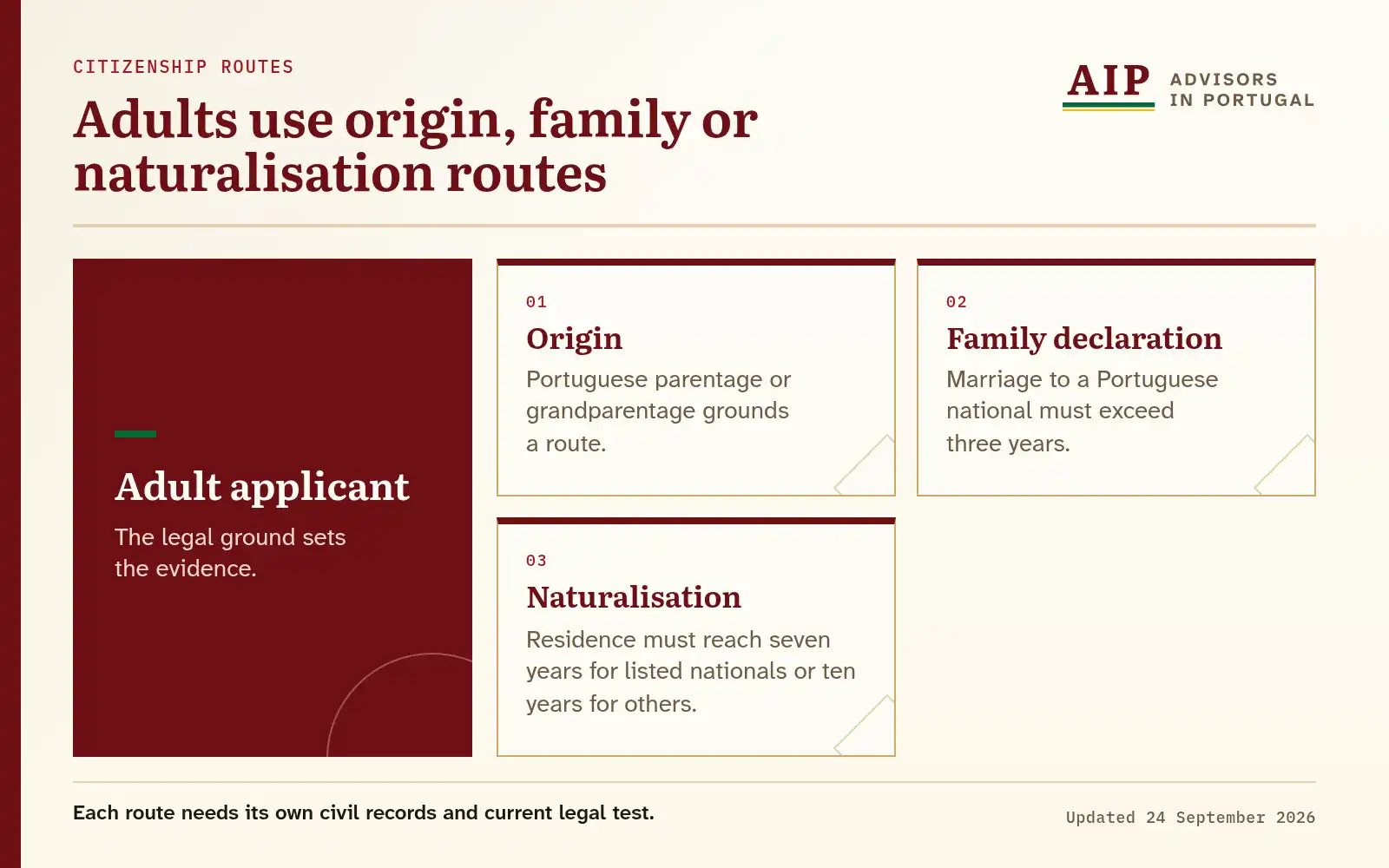
Diagram text version
Portuguese parentage or grandparentage grounds a route. Marriage to a Portuguese national must exceed three years. Residence must reach seven years for listed nationals or ten years for others.
Which routes lead to Portuguese nationality?
Lei n.º 37/81 includes nationality by origin, acquisition by declaration in specified family situations and naturalisation. The ground depends on the parentage, marriage and legal-residence facts of the person concerned, so the first step is to identify which of the three applies.
- Nationality by origin and family grounds. A Portuguese parent or grandparent raises the question of the correct ground before any filing.
- Acquisition by declaration. Marriage or a recognised union with a Portuguese national is the declaration route covered below.
- Naturalisation. The ordinary route rests on legal residence, knowledge of Portuguese and the absence of statutory exclusions.
What does naturalisation require?
Article 6(1)(b) of Lei n.º 37/81, as amended by Lei Orgânica n.º 1/2026 in force from 19 May 2026, sets the residence condition at seven years of legal residence for nationals of Portuguese-official-language countries and EU Member States, and ten years for other nationals. The same article requires sufficient knowledge of Portuguese language, culture, history and national symbols. Statutory conviction, security and other exclusions also apply.
Reconstruct the legal-residence record
Portuguese permits and records show the periods of legal residence relevant to naturalisation. Each permit has an issue date, and any gap in the sequence needs a record that explains it. The dates are compared before a period of legal residence is counted in a naturalisation application.
Evidence of Portuguese knowledge
Available Portuguese-language evidence and the information needed to assess the statutory exclusions form part of the naturalisation file.
How does nationality by marriage or union work?
Article 3 of Lei n.º 37/81 lets a foreign national who has been married to a Portuguese national for more than three years acquire nationality by declaration during the marriage. A union of fact needs the statutory period and judicial recognition. Articles 3 and 9 provide exclusion and opposition grounds, including effective-connection questions, with statutory exceptions.
The relationship period, the declaration requirements and any opposition ground are the points the declaration route turns on. The citizenship by marriage guide covers this route in detail.
Compare marriage and civil-status records
The marriage or union evidence is compared with the identities and names recorded in the Portuguese and foreign civil registers. An earlier correction or registration decision explains a difference between the records when one exists.
How do family-based grounds work?
A Portuguese parent or grandparent raises the family-based question, and the correct nationality ground has to be identified before filing. The Portuguese relative’s civil record and any intervening birth or marriage records are the records relevant when parentage matters. The citizenship by descent guide covers the parent and grandparent routes.
Documents the authority asks for
Article 37(9) of the Regulamento da Nacionalidade Portuguesa generally requires legalisation of foreign civil-registry certificates under the procedural rules, subject to conventions and special laws. The issuing state of a certificate decides which convention or exception applies.
Who submits a nationality request and where?
The Justiça nationality service reserves its online channel for lawyers and solicitadores using professional authentication. An applicant without a representative may use the postal or in-person channels the service lists. The IRN nationality service and the Justiça pages are the official references for the channel.
The official cost depends on the type of application under the registry-fee regulation. Article 7(2) of Lei n.º 37/81 removes Stamp Duty from a naturalisation process and its supporting documents, and other registry charges remain.
What happens when a preliminary refusal arrives?
Article 27(3) of the Regulamento da Nacionalidade Portuguesa gives the interested person 30 days to respond to the stated grounds for a proposed summary refusal. A document request or preliminary refusal sets out the grounds and the response period.
Keep the registry response file complete
The response file holds the full preliminary-refusal notice, its delivery record and any earlier request for documents. A response addresses the grounds stated in the notice with the supporting records relevant to it.
What affects timing and delays?
The time a nationality matter takes depends on the ground, the civil records and the filing channel available for it. A foreign certificate that must be obtained, residence periods that must be reconciled and a registry request for further evidence each add time.
Common questions
Which routes can lead to Portuguese nationality?
How long must I reside in Portugal for ordinary naturalisation?
Is Portuguese knowledge required for naturalisation?
Can marriage to a Portuguese citizen support an application?
Can the authorities oppose a marriage-based application?
Do foreign birth and marriage certificates need legalisation?
Who can submit the nationality request online?
Is there one official fee for every citizenship application?
What happens if naturalisation faces a preliminary refusal?
The information on this page is checked against official sources and reviewed regularly. It is corrected when the law or official guidance changes, as the Editorial Standards describe.