Portuguese Citizenship by Marriage: Rules and Documents
Portuguese citizenship by marriage can be declared to IRN after more than three years of marriage to a Portuguese national. Your declaration should identify the same two people as every supporting certificate, so differing names, dates or civil status should be resolved before filing.

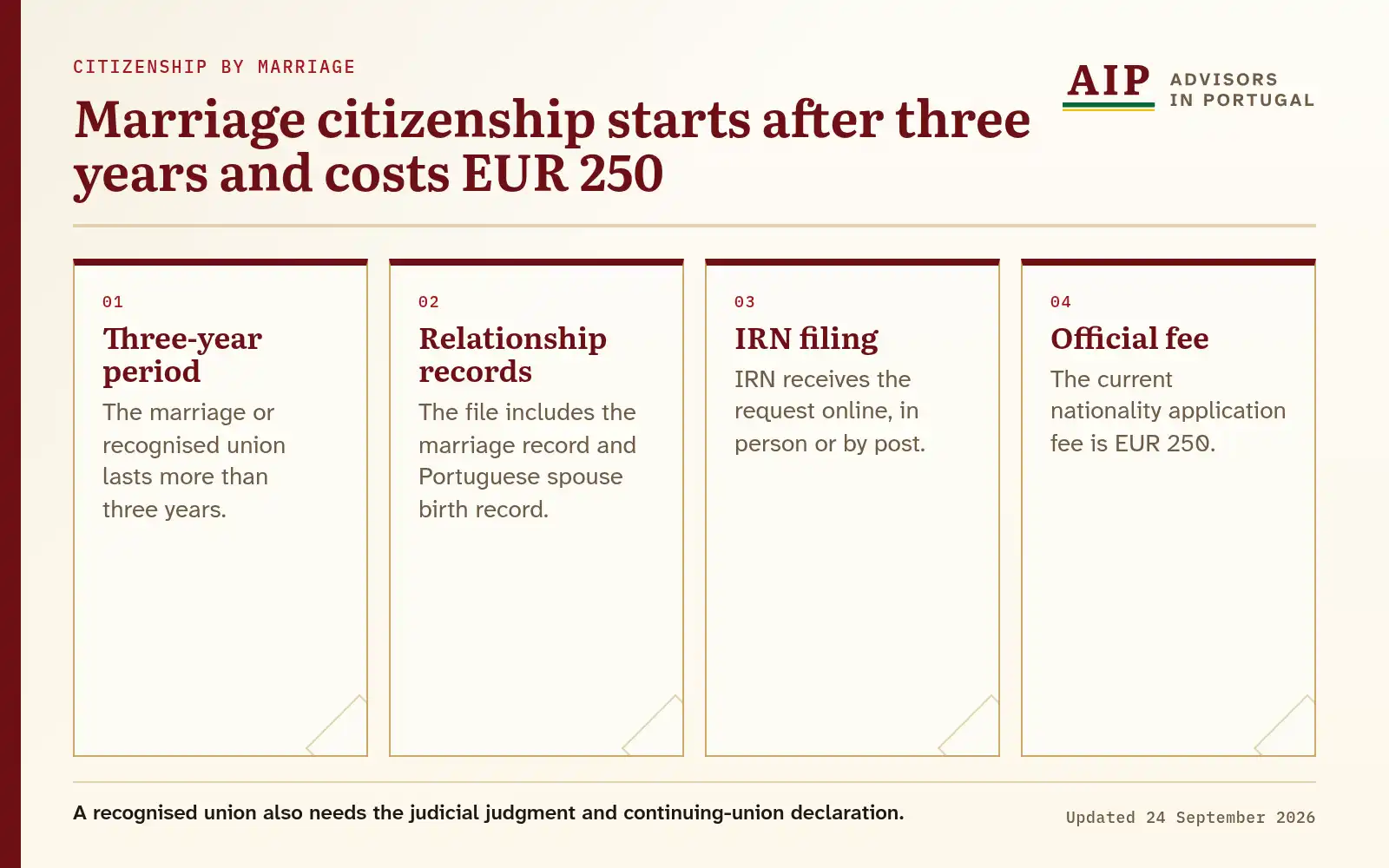
Diagram text version
The marriage or recognised union lasts more than three years. The file includes the marriage record and Portuguese spouse birth record. IRN receives the request online, in person or by post. The current nationality application fee is EUR 250.
Lei n.º 37/81 Article 3 allows a foreign national married to a Portuguese national for more than three years to request nationality by declaration. A judicially recognised união de facto lasting more than three years can provide a parallel route. The current Article 9 limits opposition based on lack of effective links after more than six years or where the couple has a Portuguese-national child, while other grounds remain. You should establish the relationship route and documentary chain before filing.
When Can a Spouse Request Portuguese Nationality?
Article 3(1) of Lei n.º 37/81 requires more than three years of marriage to a Portuguese national and a declaration made during that marriage. The three-year condition concerns the relationship period, not a general residence period for the applicant. You should compare the marriage date, current civil record and Portuguese spouse’s nationality before deciding whether the route fits your case. A missing registration or inconsistency in those records should be identified before the declaration is prepared.
You should check the relationship recorded in Portugal and any foreign marriage record used to establish it. Names, dates and previous civil status can appear differently across certificates. The records should be compared in the order they arose so the declaration identifies the same two people as the supporting certificates. Article 3 establishes the route; Article 14 of the Regulamento da Nacionalidade Portuguesa identifies the core relationship documents for the application.
You should keep the declaration and evidence tied to the current legal position. A past marriage to a Portuguese person is not the same as a declaration made during a qualifying marriage under Article 3(1). Another nationality basis may need to be considered when the present route does not fit. A long relationship does not replace the statutory form and evidence. The Instituto dos Registos e do Notariado handles the nationality procedure after a valid request is lodged.
How Does a Recognised União de Facto Qualify?
Article 3(3) of Lei n.º 37/81 permits acquisition after more than three years of união de facto with a Portuguese national when a court has recognised that relationship. The current article refers to a judicial decision by the competent court. You should obtain the judgment and establish the period of cohabitation before preparing the nationality declaration. The judgment and civil records should describe the same partner and relationship period.
Article 14(4) of the Regulamento da Nacionalidade Portuguesa requires the judicial judgment and the Portuguese partner’s birth record. You should gather these documents as a group. A shared address or joint account may support the history. Article 3(3) requires judicial recognition, so informal cohabitation evidence cannot replace the court decision.
You should compare the date when the court recognised the union with the underlying relationship history. Article 3(3) requires more than three years of the union, and Article 14 concerns the documents filed with the declaration. The judgment should establish the necessary facts, and any intervening change should be checked against the current declaration. The union route shares the nationality question with marriage, while its core relationship evidence differs.
Which Relationship Documents Must You Provide?
Article 14(3)-(4) of the Regulamento da Nacionalidade Portuguesa identifies the relationship documents. For marriage, the request uses the marriage-record certificate and the Portuguese spouse’s birth-record certificate. For recognised união de facto, the request uses the judicial judgment and the Portuguese partner’s birth record. You should collect the available entries before ordering replacement certificates.
You should identify the exact civil record for each person. A later correction, name change or registration in another country can make two documents appear inconsistent even when they describe the same relationship. The document sequence should run from the Portuguese national’s birth entry through the marriage or judgment to the applicant’s identity. You should confirm which record the registry requires in your case.
The current IRN checklist may also require identity and criminal-record evidence; confirm the current list before filing. You should use the current IRN list for your applicant and relationship route. You should compare the current service checklist with your citizenship and residence history. That comparison shows which foreign civil-status or criminal record belongs to the specific declaration.
When Does the Effective-Link Exception Apply?
Article 9(2) of Lei n.º 37/81 removes opposition based on lack of effective links to the Portuguese national community when the marriage or recognised união de facto has lasted more than six years, or the couple has common children with Portuguese nationality. You should establish the qualifying duration or the child’s Portuguese-national status with civil records. The rule addresses one opposition ground; it does not remove the separate statutory grounds in Articles 3 and 9.
You should distinguish the date the relationship began from the date a certificate was issued. The six-year condition concerns the relationship period under Article 9(2), so a recent copy of an older record need not be confused with a new relationship. The chronology should show which entry proves the Portuguese nationality of a common child. That evidence should be linked to both parents in the application file.
You may qualify under Article 3 after more than three years without meeting either Article 9(2) exception. Any effective-link question is then assessed under the current law and the evidence available. You should not assume that the six-year or common-child exception is a separate grant of nationality: the declaration, relationship documents and remaining legal conditions still need attention.
What Other Grounds Can Prevent Acquisition?
Article 9(1) of Lei n.º 37/81 lists opposition grounds for acquisition by an act of will, including lack of effective connection, specified non-technical public functions or non-compulsory foreign military service, and serious criminal or security grounds cross-referenced in the statute. Article 3(4), as amended in 2026, separately excludes the situations in Article 6(1)(f)-(h) for marriage and recognised-union acquisitions. You should assess the current wording against the applicant’s actual history before declaring eligibility.
You should record accurate information about public roles, service, criminal matters and any previous nationality decision. A generic statement that you have lived with a Portuguese partner does not address every Article 9 ground. These facts determine which supporting documents are needed and which statutory exception applies. The Article 9(2) effective-link exception does not erase Article 3(4) or the other opposition grounds.
You should keep the criminal-record and identity material requested by the current IRN service with the relationship evidence. The 2026 amendment changed the statutory text, so an older checklist may omit a current condition. The law applicable to the new declaration determines which fact is material. You should not treat an absence of an immediate registry objection as a final answer to the statutory opposition question.
Where and How Do You File the Declaration?
The Instituto dos Registos e do Notariado handles nationality applications. The current Justiça marriage service offers online, in-person and postal filing routes. You should decide the channel after the relationship and document file is assembled.
You should keep the application copy, payment evidence and filing acknowledgment together. You should use the submission acknowledgment to identify the registry case after filing. A postal filing has a different delivery and payment trail; an in-person filing produces its own receipt. The acknowledgment identifies the exact request and attached documents.
You should check the representative’s authority and the contact details used for registry communications. A request for more evidence after filing must be answered in the same case record. You should track what the registry actually asks for. The channel used gives no guarantee about processing speed.
What Does the Nationality Request Cost?
The current Justiça service lists EUR 250 as the official charge for a nationality request through marriage or recognised união de facto. Article 18(2.2.1) of the Regulamento Emolumentar dos Registos e do Notariado supplies the tariff basis. You should separate that government charge from certificate costs, translation work and professional fees. The payment route depends on the way the application is lodged.
You should select the payment route for the channel used and keep its receipt. You should keep the transaction evidence with the submitted declaration. A payment record should identify the right request, because a later query from the registry may require you to show what was paid and when. The official EUR 250 amount is not an estimate of the total cost of preparing foreign records.
You should keep the fee separate from any estimate of registry processing time. You should plan for any case-specific request for further evidence from the registry. You should retain the final registry communication as well as the initial receipt.
How Long Can the Public Prosecutor Oppose Acquisition?
Article 10(1) of Lei n.º 37/81 gives the Ministério Público two years from the registration of acquisition of nationality to bring opposition under Article 26. That is a statutory period for the Public Prosecutor’s action, not a two-year target for IRN to finish every application. You should distinguish the registration date from the day you submitted the declaration. A formal opposition notice should be examined against the current statutory ground and procedure.
You should preserve the registry record and any notice served after the acquisition is entered. The Article 10 period begins from the registered acquisition according to the current law. The regulation’s Article 56 procedure must be read with the current statute and the applicable court route. A response and any case-specific procedural date depend on the actual notice.
You should not use the two-year opposition period as a substitute for the eligibility checks before filing. Articles 3 and 9 still set the conditions and opposition grounds. You should review these facts before you file the declaration. The Article 9(2) exception narrows one type of opposition but does not eliminate all grounds.
What Changed on 19 May 2026?
Lei Orgânica n.º 1/2026 amended the Lei da Nacionalidade and took effect in May 2026. The current Article 3(4) expressly makes acquisition by marriage or recognised união de facto depend on the absence of the Article 6(1)(f)-(h) situations. You should use that current article for a new declaration and identify whether your case was already pending when the law changed.
You should distinguish the amendment from the separate relationship periods. Article 3 still uses more than three years for the marriage or recognised-union route, while Article 9(2) addresses the effective-link opposition exception after more than six years or with a common Portuguese-national child. Each provision should be read for its own function with the dates documented by the civil records. An older summary of nationality law may omit Article 3(4).
The 2022 republication of the Regulamento da Nacionalidade Portuguesa remains the operational source for the Article 14 document categories. You should compare the current statute and regulation for each form attachment. A later document request from IRN should be assessed against the actual route and current official instructions.
Common questions
Can I file from outside Portugal?
Can the Portuguese partner's birth entry ever be dispensed with?
What shows that a recognised union still exists?
Can a solicitor submit the request online?
How can I pay for a postal application?
Which office receives an online nationality file?
The information on this page is checked against official sources and reviewed regularly. It is corrected when the law or official guidance changes, as the Editorial Standards describe.