Buying Property in Portugal: Contracts, Tax and Title
Buying property in Portugal requires title and contract checks against the land register before the deed. The buyer must file Modelo 1 do IMT before signing and pay IMT and the 0.8% Stamp Duty on the acquisition value.

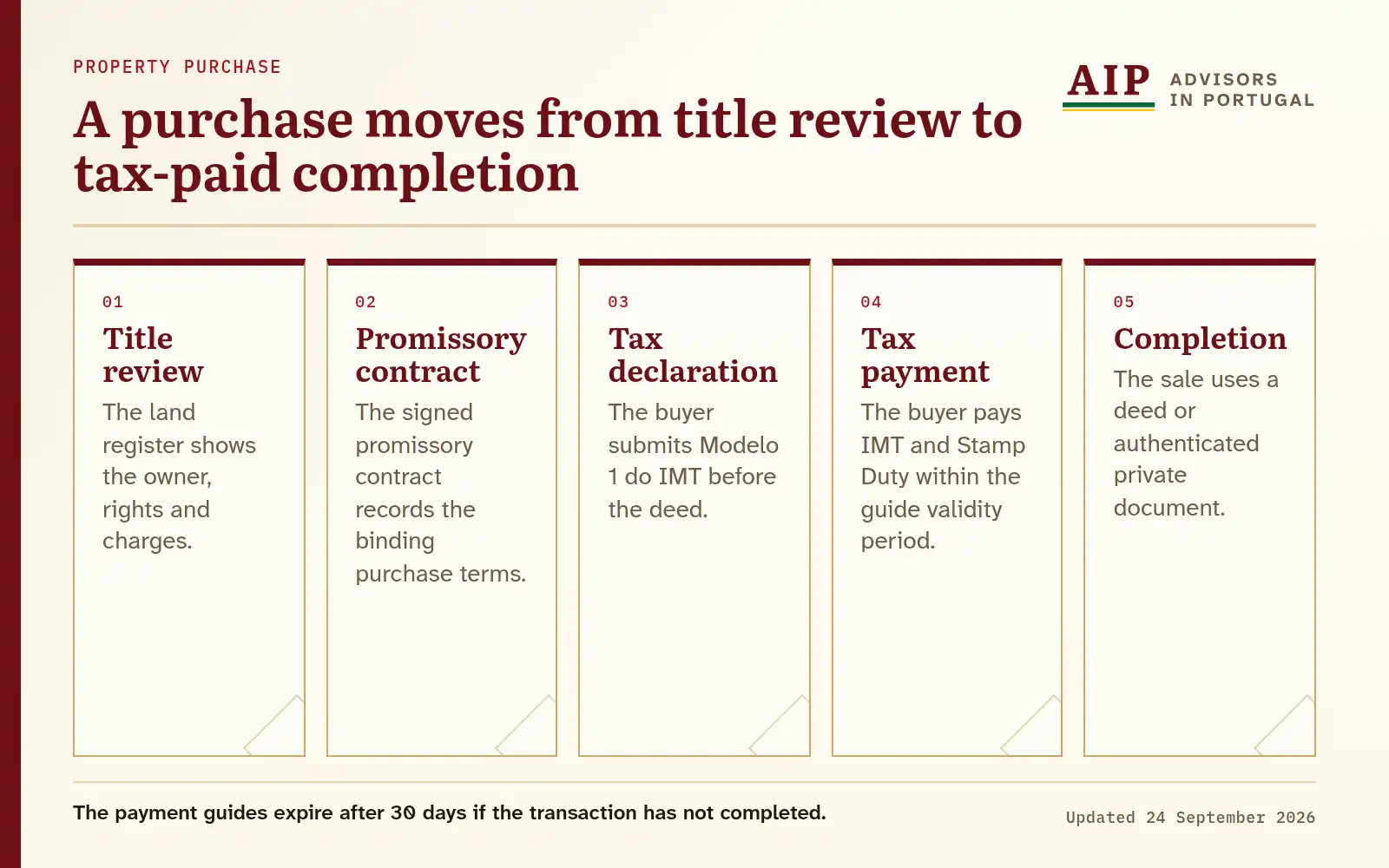
Diagram text version
The land register shows the owner, rights and charges. The signed promissory contract records the binding purchase terms. The buyer submits Modelo 1 do IMT before the deed. The buyer pays IMT and Stamp Duty within the guide validity period. The sale uses a deed or authenticated private document.
Código do Registo Predial Articles 1-2 make the Portuguese land register the starting point for legal title checks. The register’s owner, property description and charges are compared with the transaction papers before a purchase is committed. A promise agreement, tax calculation and final deed then need their own checks. The 0.8% acquisition Stamp Duty in TGIS item 1.1 is one known cost, and IMT and later IMI depend on the property’s use, value and the buyer’s circumstances.
Where Do You Check Legal Title to a Portuguese Property?
Código do Registo Predial Article 1 states that land registration publicises the legal situation of immovable property for security in real-estate transactions. Article 2 lists facts that can be registered, including those creating, recognising, acquiring or changing property rights. The relevant land-register information shows the named holder, description and charges, and a buyer compares them with the seller and the property visited. A discrepancy is easiest to resolve before a deposit is paid or a completion date is agreed.
The registry identifier should run consistently through the draft promise agreement, the tax record and the proposed sale instrument. Similar addresses or unit labels can conceal a difference between a physical unit and the registered parcel. Mortgages, other registered rights and any pending entry can affect the intended transfer. The public register shows the legal position recorded there, while building plans and municipal use documents answer different questions.
A broker’s description, a seller’s older deed and a recent registry certificate often arrive at different times. Any difference between them needs an explanation. Article 1 gives the register its public-law role, and the purchase file still needs the transaction instrument and tax identity to describe the same property consistently.
What Should You Compare With the Land Register?
Código do Registo Predial Articles 1-2 concern registered legal facts and do not cover every physical or planning attribute of a building. The owner and property description are compared with the seller’s identity and authority, the property-tax record, plans, use evidence and the building as presented. An area, fraction number or rights mismatch needs an explanation before the contract commits the buyer to a particular asset.
For each registered charge, the buyer establishes whether it will remain or whether the seller will discharge it at completion. The register can reveal a mortgage or another recorded right, and the proposed settlement documents show how the parties intend to deal with it. The final sale and any lender instrument should refer to the same registry description. The intended use may need a separate municipal inquiry even where the registered ownership is clear.
Copies of the register evidence used when the transaction terms were agreed are worth preserving. A later change to a registered right or property description may alter the answer to a question that appeared settled when the offer was made. Comparing the pre-contract record with the record available before signature shows whether a revised promise or completion document is needed.
What Must a Promise Agreement Contain?
Código Civil Article 410(2)-(3) governs the form of a promissory contract. A promise to transfer a real right over a building or an autonomous unit requires notarised recognition of the relevant signatures and certification that a use or construction licence exists under Article 410(3). The text that will bind the parties identifies the property, the parties, the price, the obligations and the planned completion date.
The promise’s seller is compared with the registered owner and the person authorised to sign. A company seller or a person acting under a power of attorney requires an authority check in addition to an identity check. Conditions involving finance, missing municipal evidence or discharge of a registered charge each carry their own consequences if they are missed. The form requirements in Article 410 do not describe those economic consequences, which come from the particular draft.
The signed version and its deposit receipt belong together. A later negotiation may alter the price, deadline or documents due at completion, and any amendment follows the agreed form. The final sale still needs the separate instrument required by Article 875, because a promise is a commitment to a later transfer on its terms.
How Must the Final Sale Be Documented?
Código Civil Article 875 requires an immovable-property sale to be concluded by public deed or authenticated private document. The proposed instrument and signing professional are confirmed before the appointment. The final property description, buyer and seller details, price, tax references and authority to sign are compared with the earlier promise and the current register.
The treatment of a seller’s existing charge is resolved before the transfer instrument is executed. The purchase price and lender funds may pass through several accounts or parties, and the signed document must accurately identify the property and transaction. The discharge and financing documents are kept with the sale papers so that the subsequent registry request can be prepared from the acts actually completed.
After signing, the authenticated document or deed, the tax-payment evidence and the registration acknowledgment are retained. Article 875 establishes the valid sale form, and the Código do Registo Predial addresses the public record of the resulting right. The filed registration act can be compared with the instrument, and the resulting record is kept for a later loan, sale or succession question.
How Is IMT Chosen for a Purchase?
Código do IMT Article 1 subjects an onerous acquisition of Portuguese immovable property to IMT. Article 17 selects the applicable rate by property use, taxable value and buyer circumstances, including the current non-resident provision. The 2026 tables differ by the property’s location and use. The mainland own-permanent-home table checked on 18 September 2026 begins at 0% up to EUR 106,346 and then uses marginal bands before the higher single rates. The acquisition is classified as a permanent home, another dwelling, a rural property or a different urban acquisition before any rate table is used, and the declared consideration is compared with the property record and the buyer’s actual position.
A headline bracket from another property cannot be carried into the calculation. The legal classification and taxable base can alter the amount even when two homes have the same asking price. Any exemption or reduction is tested against the specific transaction and use. Article 17 requires the current table to be applied to the property and buyer facts.
Article 9 of the Código do IMT provides an exemption for a qualifying first own-permanent-home acquisition by a buyer aged 35 or under when the taxable base does not exceed the first-band maximum. The exemption is subject to its other conditions, including the three-year property-ownership exclusion, and every condition has to be met before it is relied on.
The IMT position is completed before the final instrument is signed. Autoridade Tributária guidance requires Modelo 1 do IMT and its payment or exemption evidence in the pre-deed file. A later rate question is much harder to resolve when the contract and tax declaration describe the property or buyer differently, so those descriptions are reconciled while the terms can still be corrected.
What Stamp Duty Applies to the Acquisition?
Item 1.1 of the Tabela Geral do Imposto do Selo sets a 0.8% charge on the value of an onerous acquisition or donation of ownership or a partial real right in immovable property. Acquisition Stamp Duty belongs in the pre-signing tax calculation beside IMT, and the 0.8% item applies to the value and right transferred in the transaction.
Separate finance documents, property services or registration acts may also exist. Item 1.1 identifies the acquisition charge, and any mortgage instrument and its tax treatment form a distinct question. The assessment for the final sale is obtained separately. The fee to register a combined acquisition and mortgage is another item again under the registry-fee regulation.
The Stamp Duty payment proof is kept with the IMT evidence and the sale instrument. A tax guide can expire if it remains unpaid beyond its validity period under the Autoridade Tributária guidance discussed below. The documents presented for signing should correspond to the agreed right and value, because a tax payment tied to another transaction description will not solve a mismatch in the deed.
What Annual IMI Follows Ownership?
Código do IMI Articles 1, 8 and 113 provide for annual municipal property tax on the taxable value of a Portuguese property. Article 8 makes the owner on 31 December liable for that year’s IMI, with separate rules for usufruct, superficies and other stated situations. The tax-matrix position is compared with the completed transfer after registration. IMI is a recurring tax and differs from IMT and acquisition Stamp Duty, which concern the transfer. The property’s taxable value and the municipal rate for the relevant year determine the amount.
The tax-matrix identity and property description are compared with the completed registry entry. A legal transfer and an annual assessment can appear in different documents, and the records should identify the same parcel. The transaction facts show whether a matrix update or correction is needed. The municipality sets the annual rate for the property’s location. Código do IMI Article 112 governs the urban-property rate, and a municipality publishes the rate for the year in its editais, such as the Câmara Municipal de Cascais 2026 editais.
A property may be held for personal use, rented or sold later, and each of those choices can create separate tax questions after the purchase. The annual assessment and any property-use evidence are kept with the ownership file. Annual IMI follows its own ownership and assessment rules.
What Must You File and Pay Before the Deed?
Código do IMT Articles 19-20 and 22, with Autoridade Tributária home-purchase guidance, require Modelo 1 do IMT before the deed and the corresponding IMT and Stamp Duty payment documents. Under Article 36 and that guidance, IMT and Stamp Duty must be paid on the day of assessment or within the following 30 days, and the guides cease to have effect after that period. The tax assessment is therefore scheduled close enough to signing for its payment record to remain valid.
Modelo 1 identifies the buyer, property, right and declared value before submission. Those entries are compared with the promise agreement and the deed draft. The generated payment references and the proof of payment are kept. The official guidance treats these documents as part of the pre-deed sequence and not as papers to reconstruct after completion.
A contractual completion date can fall earlier than the outer tax-guide payment period. The contract’s date and the statutory tax rules apply separately. A paid guide for the wrong parcel or buyer can still create a signing problem, so the signing professional needs the correct assessment and receipts for the instrument that will actually be executed.
What Does Registration of a Purchase and Mortgage Cost?
Article 21(2.1) of the Regulamento Emolumentar dos Registos e Notariado lists EUR 500 for registration of an acquisition and one or more mortgages requested at the same time. The IRN costs page checked on 18 September 2026 also lists EUR 250 for specified facts registered by inscription or endorsement. Each is an act-specific registry charge. A budget uses the EUR 500 figure only when the transaction includes a mortgage in the same request, and the current tariff applies to any other combination of acts.
The registry charge is separate from IMT, Stamp Duty, the lender’s costs and professional fees. The EUR 500 item applies to the simultaneous filing described in Article 21(2.1). The property identifiers and the signed instrument support the requested entries after completion. The submission and the resulting record confirm that the rights described in the deed appear in the official register.
Article 21(2.1) supplies the EUR 500 amount only for the stated simultaneous acquisition and mortgage registration. The current tariff for any other registration act is published by the IRN. Decreto-Lei n.º 87/2026 amended the RERN provisions used for current registration charges, so the act and schedule in force when the filing is prepared determine the charge.
What Changed for Building Use Documents in 2024?
Article 62-A of the Regime Jurídico da Urbanização e da Edificação reflects the building-use change introduced by Decreto-Lei n.º 10/2024, effective 4 March 2024. For an operation subject to prior control, use for the intended purpose can begin immediately after the required completion documentation is submitted under the article. The municipal documents and dates for the property are the evidence of lawful use.
Decreto-Lei n.º 108/2026 republished the RJUE, and the current regime sets the route for an urban operation as a licence, prior communication, prior communication with a deadline or exemption. The current rule differs from an older use-licence checklist. Articles 62-A, 63 and 64 govern the relevant use process and related documents. The property’s work history and intended use are compared with the municipality’s file, because a construction project completed under an older procedure may carry a different document trail from a more recent one.
The municipal evidence is kept with the title and contract documents. The physical building, the land register and the tax matrices are compared to identify which record needs correction before a purchase commitment or later property works.
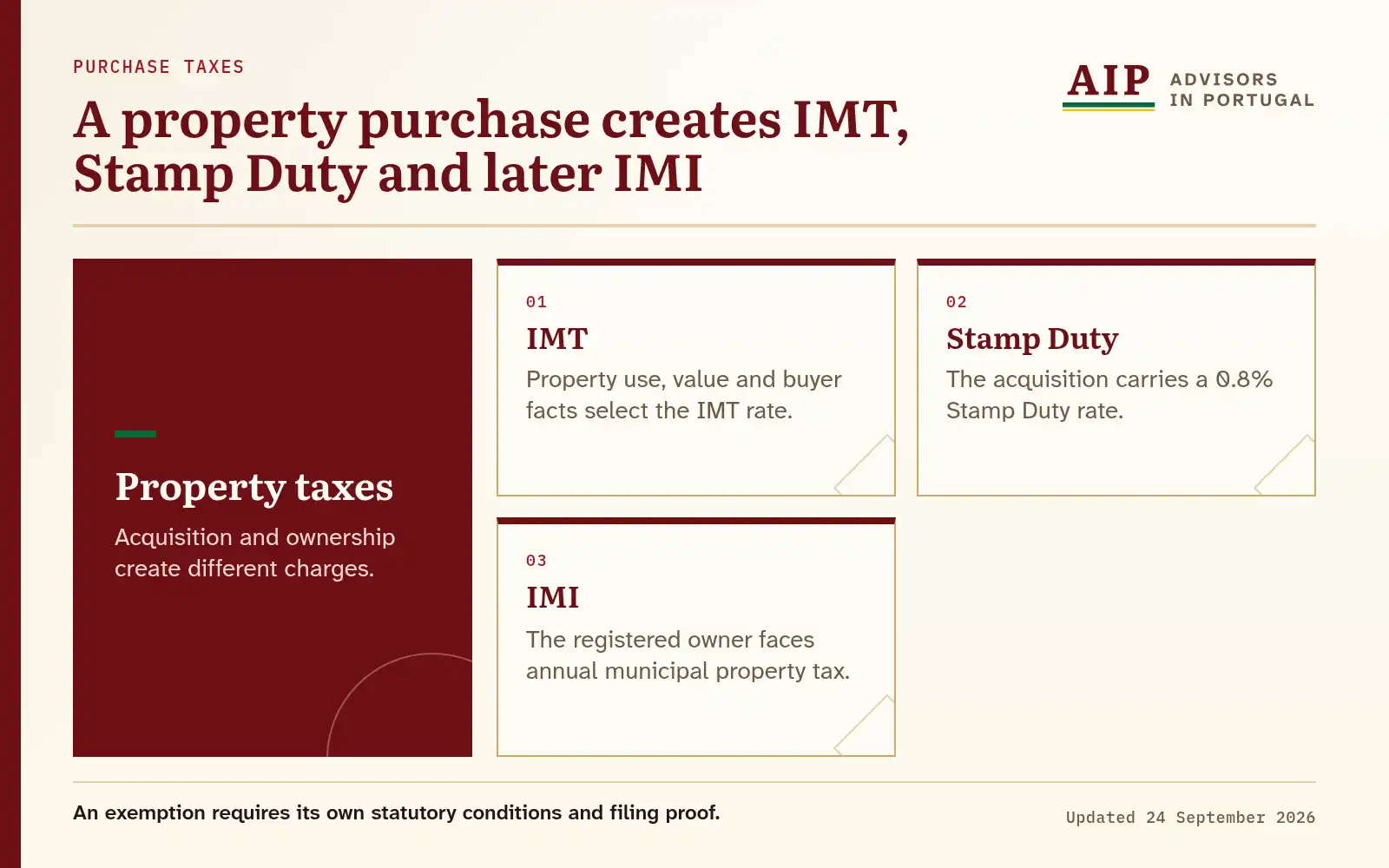
Diagram text version
Property use, value and buyer facts select the IMT rate. The acquisition carries a 0.8% Stamp Duty rate. The registered owner faces annual municipal property tax.
Common questions
Does an estate-agent listing establish the legal owner?
Who signs a property promise agreement?
Can I submit the IMT declaration online?
Who is liable for annual IMI after a purchase?
Does former RJUE Article 62 still set the building-use procedure?
Does the 0.8% Stamp Duty item cover only full ownership?
The information on this page is checked against official sources and reviewed regularly. It is corrected when the law or official guidance changes, as the Editorial Standards describe.