Property Due Diligence in Portugal: Records, Encumbrances and Planning Checks
Property due diligence in Portugal compares the tax record, land registration evidence, municipal file and transaction documents for one property. Registration evidence is checked for mortgages, other registered rights and pending matters relevant to the purchase.


Diagram text version
The matrix identifies owners, usufructuaries and superficiaries. The property use and value select the IMT table. The Câmara receives the statutory use documents. The land register records mortgages and property rights.
What does a property due diligence cover in Portugal?
A property due diligence in Portugal compares four sets of records for the same property: the tax records, the registration evidence from the Conservatória do Registo Predial, the municipal file from the Câmara Municipal and the transaction documents. IMT and Stamp Duty apply to the purchase, and IMI applies to the owner each year. The sections below set out what each record shows and the rule behind it.
What does the tax matrix record?
Article 12 of the Código do IMI says the matrix records the property’s characterisation, location, valor patrimonial tributário and the identity of owners, usufructuaries and superficiaries. The same article gives the matrix entry only a tax presumption of ownership.
The tax records compared are the property description, the caderneta predial, the ownership details and the valor patrimonial tributário. Article 12 requires the matrices to update annually as at 31 December, so the version used for the review is recorded and a material mismatch is investigated before the contract is finalised.
What do encumbrance and registration records show?
The available registration evidence is checked for mortgages, other registered rights and pending matters relevant to the transaction. Article 68 of the Código do Registo Predial requires the registrar to examine the submitted documents and prior registrations, including the property’s identity, the interested parties’ legitimacy and the formal regularity of the titles.
Registration evidence is refreshed when the transaction runs longer or a new request may affect the property.
How do planning and authorised use affect the checks?
The current RJUE requires specified documents to be delivered to the Câmara Municipal for use after an urban operation subject to prior control. The available use, construction and alteration records, the plans and the other municipal documents come from the Câmara Municipal or the seller. The municipal file is compared with the property’s history, its present use and the intended use.
The construction or alteration date determines which RJUE regime applies, so the records are arranged by date. Articles 62-A and 63 of the RJUE govern documents for use after certain urban operations and the responsibility term for use without a prior urban operation. Plans, responsibility terms and municipal documents already held by the seller belong in the file.
Which transaction documents form part of the file?
The file holds any offer, reservation, promissory agreement, deposit terms, completion draft or correspondence already prepared. It also records the agreed or proposed price, the deposit, the mortgage position and other financing conditions.
The intended use of the property (permanent home, second home, rental asset or another use) is recorded with the file.
Which property taxes apply?
Article 17 of the Código do IMT uses different tables according to the property’s location and use. The 2026 mainland own-permanent-home table checked on 18 September 2026 begins at 0% up to EUR 106,346, and the complete current table lists the later bands.
Article 9 of the Código do IMT provides an exemption for a qualifying first own-permanent-home acquisition by a buyer aged 35 or under within the statutory first band, subject to the remaining conditions of that article.
Item 1.1 of the official Stamp Duty table checked on 18 September 2026 applies 0.8% to an onerous acquisition or donation of ownership or partial real rights in immovable property.
Article 8 of the Código do IMI makes the owner on 31 December liable for that year’s IMI, subject to its rules for other real rights and undivided inheritances.
What affects how long the checks take?
The time depends on the documents available from the seller, the Conservatória do Registo Predial and the Câmara Municipal, and on the proposed signing date. Conflicting records, incomplete municipal documents, an encumbrance that needs investigation and a change to the contract during the review all extend the checks.
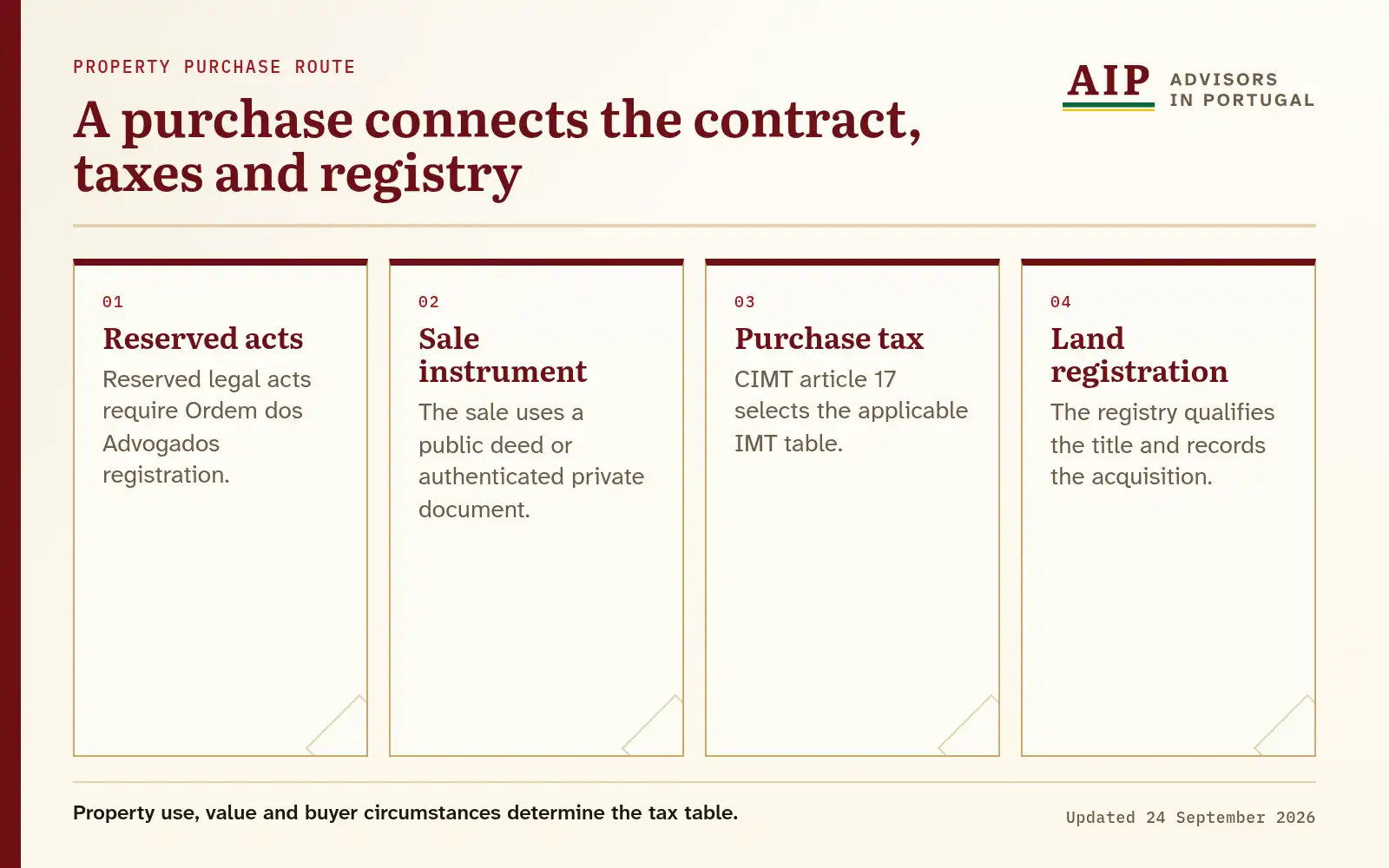
Diagram text version
Reserved legal acts require Ordem dos Advogados registration. The sale uses a public deed or authenticated private document. CIMT article 17 selects the applicable IMT table. The registry qualifies the title and records the acquisition.
Common questions
What does property due diligence in Portugal cover?
What does the Portuguese property tax matrix record?
Which IMT table applies to a Portuguese property purchase?
Can a buyer aged 35 or under qualify for an IMT exemption?
How much Stamp Duty applies to the purchase?
Who is liable for IMI after completion?
Why does the municipal file matter?
Which transaction documents form part of a property due diligence file?
The information on this page is checked against official sources and reviewed regularly. It is corrected when the law or official guidance changes, as the Editorial Standards describe.