Power of Attorney in Portugal: Form, Powers and Revocation
A power of attorney in Portugal, or procuração, must use the form required for the transaction it covers, unless a law provides otherwise. You should list each act your representative may perform, because acts within those powers bind you.

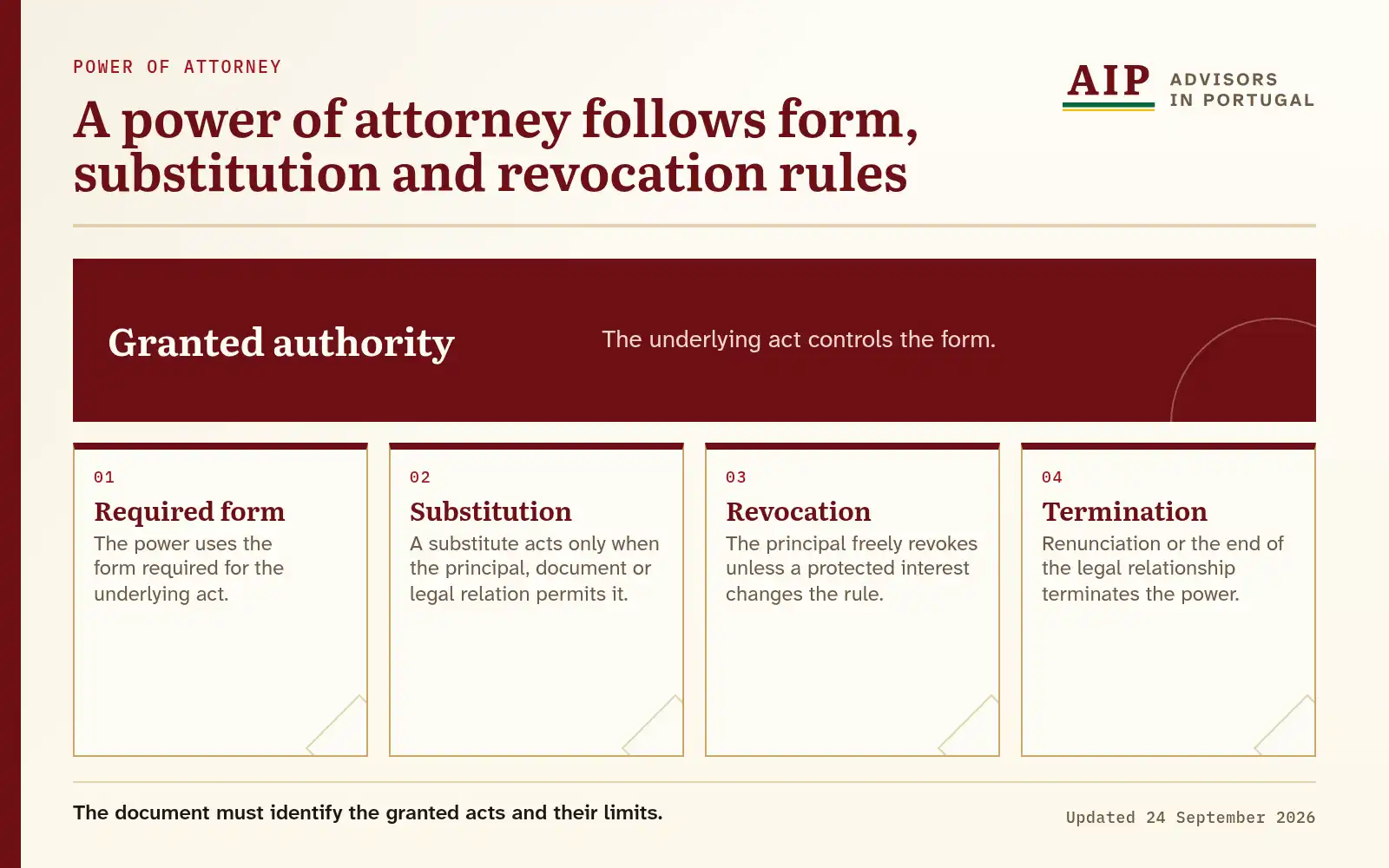
Diagram text version
The power uses the form required for the underlying act. A substitute acts only when the principal, document or legal relation permits it. The principal freely revokes unless a protected interest changes the rule. Renunciation or the end of the legal relationship terminates the power.
Código Civil rules for a procuração, substitution, revocation, third-party notice and transaction form.
What does a Portuguese procuração authorise?
Código Civil Article 262(1) defines a procuração as the act by which a person voluntarily gives another person representative powers. Article 258 makes an act carried out in the principal’s name and within those powers effective in the principal’s legal sphere. You should identify the precise acts the representative may perform and the person who grants the authority.
A property transaction may call for authority to negotiate, sign a promise contract, execute a deed or receive documents. You should list the acts that are actually intended and any limit on price, property or counterparties. The wording should match the transaction papers so the representative does only what the principal authorised.
The principal and procurador have different roles. The identification and the intended signature circumstances of each person should be recorded. The transaction, the proposed representative and the authority text must fit together under Articles 258 and 262. The instrument should show the scope clearly enough for the person receiving it to understand the permitted act.
Which form must the procuração use?
Código Civil Article 262(2) generally requires the procuração to use the form required for the legal act the representative will carry out, unless a law provides otherwise. The underlying transaction therefore determines whether a private document, authenticated document or public deed is required. You should identify the precise act before choosing the instrument’s form.
A property purchase, company transaction and court filing may follow different form and representation rules. Article 262(2) ties the form to the underlying act. The country of signature affects the authentication or apostille step covered below.
Article 262(2) links the power to the act, so a general label such as “property power” gives incomplete instructions for drafting. You should specify whether the representative will sign the final instrument, make an application or receive official notices. The signature and authentication method must match that act and any separate procedural requirement.
Who may act as procurador?
Código Civil Article 263 requires the procurador to have the capacity to understand and will the transaction according to its nature. You should select a person who can understand the instructions and carry out the specified acts. The representative’s role should match the decision and documents involved.
The procurador acts in the principal’s name within the granted powers under Article 258. You should tell the representative the limits and provide the instrument that records them. A bank, registry or other receiving entity may need identity evidence for the person signing. The identity of the representative should match the transaction record.
A representative may encounter a step outside the named acts. You should decide whether that step should be authorised in the instrument or reserved for a later instruction. Any proposed expansion should match the principal’s stated decision. The powers given in the document govern the effect of the representative’s act for the principal.
When may the procurador substitute someone else?
Código Civil Article 264(1) allows substitution only when the principal permits it, the procuração permits it or the underlying legal relationship permits it. You should decide expressly whether another person may act and for which acts. The wording should fit the transaction and the person likely to receive the authority.
Article 264 keeps the original procurador responsible for fault in selecting the substitute or giving that person instructions. You should identify the substitute and the proposed instructions before the authority is used. The permitted scope should make the substitute’s role visible to the registry, contracting party or other recipient.
A substitution can affect the transaction sequence and evidence of authority. You should keep the original instrument and the substitution record together. Signatures and powers should be compared across both documents. Article 264 controls when substitution is authorised; the original transaction’s form requirement remains relevant to the act performed by the substitute.
Can the principal revoke an apparently irrevocable power?
Código Civil Article 265(2) generally allows the principal to revoke a procuração despite a contrary agreement or a waiver of the right to revoke. Article 265(3) qualifies that rule where the power was also granted in the interest of the procurador or a third party: revocation then needs that interested person’s agreement unless there is just cause. You should identify any such interest in the underlying transaction.
The instrument, the agreement it supports and the people whose interests the power protects all bear on the question. You should keep the original signed power and any later revocation document. The word “irrevocable” in a heading cannot decide the Article 265(3) question by itself; the underlying interests and cause must be examined.
A revocation decision has a communication step under Article 266. You should identify the bank, registry, buyer or other person who received the power. Each recipient needs notice of the change, and the notice should be recorded. The statutory effect toward an unaware third party depends on the communication facts.
How does a procuração end or change?
Código Civil Article 265(1) ends a procuração when the underlying legal relationship ends, subject to the principal’s different intention in that case. Article 265(2) addresses revocation. You should identify the legal relationship that led to the authority and any document showing it has ended. That record should be compared with the wording of the power.
Article 266(1)-(2) deals with the effect of modification, revocation and other ending causes on third parties without knowledge. You should list all people or institutions that have received the instrument. A suitable communication should be sent and evidence of its delivery kept. A change known only to the principal may leave another recipient acting on the earlier instrument.
You should retain the original, any amendment and each communication in one transaction file. The date of a later act should be compared with the date the relevant recipient learned of the change. The person relying on the power needs a clear record of what authority existed at that time.
When are authentication or apostille steps relevant?
Código Civil Article 262(2) sends the form question to the underlying transaction, while Decreto-Lei n.º 86/2009 Article 1 governs Portuguese apostilles for documents used across borders. You should identify the country of signature and the authority that will receive the power before choosing a notarial or apostille route. The receiving authority’s document rules should be compared with the transaction form.
A property deed and a court filing may call for different formal instruments and representatives. You should provide the receiving entity’s requirements and the act the procurador will perform. The underlying act determines whether an authenticated document or public deed is required. An apostille concerns the document’s cross-border use and is a separate question from the breadth of the powers granted.
Decreto-Lei n.º 86/2009 Article 1 sets an apostille charge of one tenth of a unidade de conta for issue or verification. The official charge is separate from any professional drafting cost and from any underlying registry act. The document should match the authority’s current instructions before it is signed.
What should a property buyer specify in the power?
Código Civil Articles 258 and 262 require the act to be in the principal’s name and within the power granted, in the form required by the underlying transaction. The power should state the property identification, proposed parties, price instructions and the acts the procurador must perform, consistent with the purchase documents.
You should say whether the representative may sign a promise contract, final deed, tax declaration or registry application. The receiving bank or registry may ask for its own evidence of the representative’s identity and authority. The instrument should fit the exact act and receiving party. The property and person named in the power should be consistent with the later transaction record.
You should describe any limit on spending, substitution or receipt of money before signing. Each limit should appear in the operative clauses. A well-defined authority helps the principal and the receiving party see what the procurador can do and what remains reserved to the principal.
Which reserved-act rules and official charges apply?
Estatuto da Ordem dos Advogados Article 66(1) reserves the professional title of advogado and acts expressly reserved to lawyers to those registered with the Ordem dos Advogados. Reserved acts therefore require a lawyer registered in Portugal. Whether a court or property act requires representation depends on its own procedural rule.
IRN’s costs page directs readers to the Regulamento Emolumentar dos Registos e Notariado for registration-act tariffs. Decreto-Lei n.º 86/2009 Article 1 fixes the apostille charge at one tenth of a unidade de conta. The official charge for the actual act is a separate cost. The applicable tariff line depends on the receiving authority and the act.
The Código Civil’s current consolidated text includes Lei n.º 39/2025 and Lei n.º 29/2026 in its amendment history, while Articles 262 to 266 still state the operative procuração rules used here. You should keep the version used with the transaction file. Any later change should be related to the act being performed.
Common questions
Can a procurador be someone without full transaction capacity?
Does permission to substitute release the original procurador?
Can a procurador renounce the power?
What if a third party did not know a power was revoked?
Who handles Portuguese apostilles?
Does the Civil Code set one registration deadline for every procuração?
Related guides
The information on this page is checked against official sources and reviewed regularly. It is corrected when the law or official guidance changes, as the Editorial Standards describe.