Property Tax in Portugal: IMT, IMI, AIMI and Stamp Duty
Property tax in Portugal includes IMT and 0.8% Stamp Duty when you buy, and annual IMI then applies to urban property at 0.3% to 0.45%. Non-residents making specified residential acquisitions can face a 7.5% IMT rate, and its exceptions should be checked before you sign.

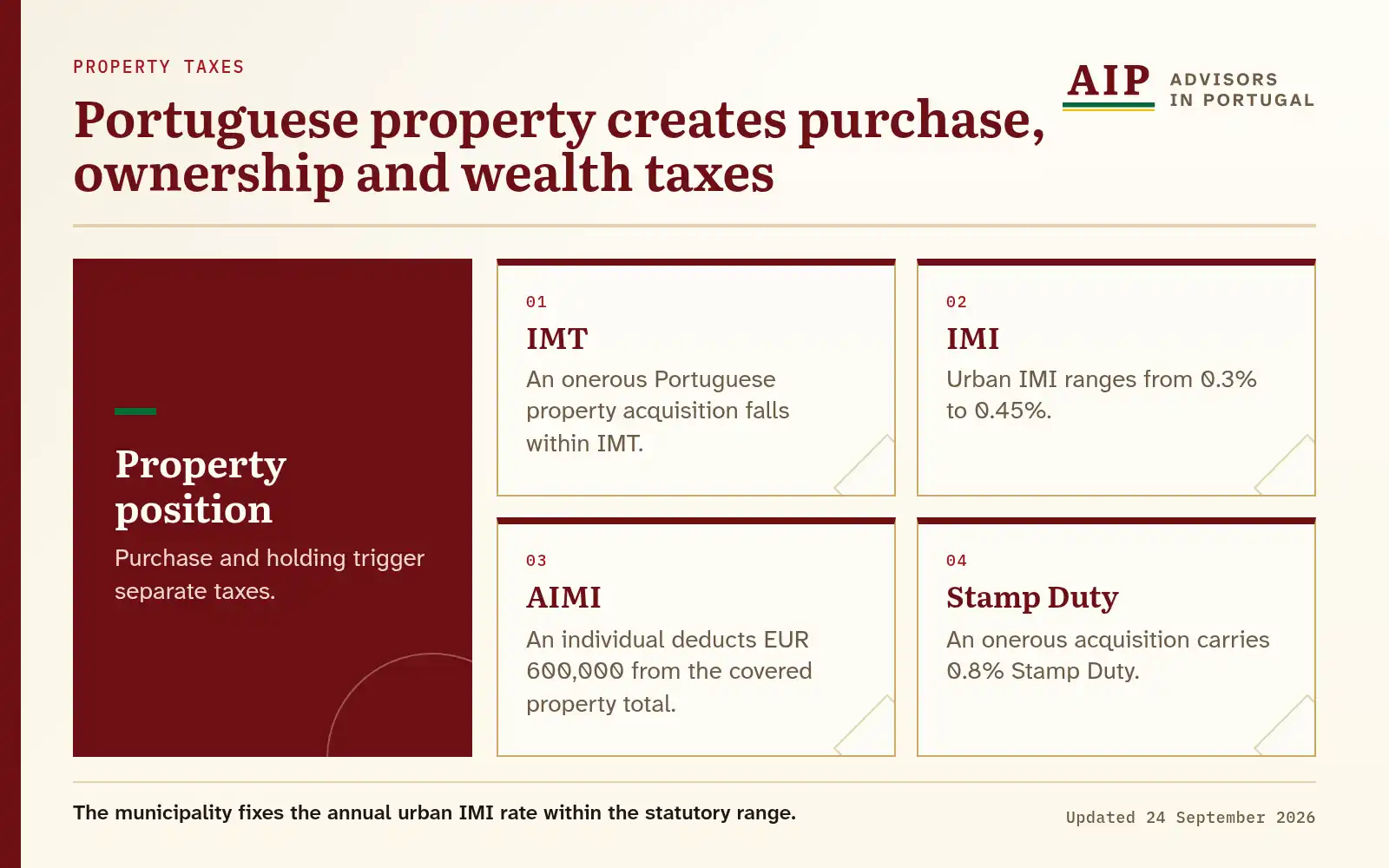
Diagram text version
An onerous Portuguese property acquisition falls within IMT. Urban IMI ranges from 0.3% to 0.45%. An individual deducts EUR 600,000 from the covered property total. An onerous acquisition carries 0.8% Stamp Duty.
Current Portuguese transfer, annual property, additional property and stamp-duty rules with verified thresholds.
Which property taxes arise in Portugal?
Código do IMT Article 1(1) taxes onerous transfers of Portuguese property rights, while Código do IMI Article 1(1) taxes the taxable value of rural and urban property each year. Tabela Geral do Imposto do Selo verba 1.1 adds a transaction charge on the stated acquisition value. You should identify whether you are buying, holding or transferring a right before calculating a tax.
Autoridade Tributária e Aduaneira administers the relevant tax records and notices. Municipalities choose the annual urban rate within the statutory band. You should collect the deed, property tax record and any assessed value before comparing amounts.
The same property can generate a transfer charge when acquired and annual ownership charges later. You should keep the buyer identity, intended use, price and tax record consistent across the deed and declarations.
What is IMT and when does it apply?
Código do IMT Article 1(1) defines Imposto Municipal sobre as Transmissões Onerosas de Imóveis (IMT) as tax on onerous transfers of ownership or partial ownership rights over immovable property situated in Portugal. You should identify the right being acquired and the consideration before calculating the transfer charge.
The tax concerns the transfer transaction and differs from the later annual ownership position. You should keep the acquisition date, parties and property description together. A transfer of a partial right needs the legal right identified in the contract, because the tax provision covers more than a simple full-ownership sale.
Article 17 supplies rate tables and special provisions for the calculation. You should collect the tax value and price shown in the documents as well as the intended use.
Which facts determine the IMT rate?
Código do IMT Article 17 uses property use, taxable value and purchaser circumstances to select a rate or table. The current Article 17(10)-(12) includes a 7.5% rule for specified residential acquisitions by non-residents, subject to its exceptions. You should identify the buyer’s status and the property’s intended residential use before using a published rate.
The tax record and acquisition instrument should describe the same property and legal right. You should provide the price, taxable value and any evidence relevant to the buyer exception. A headline percentage is useful only after the category of acquisition has been identified.
Article 17’s exceptions depend on facts such as existing Portuguese residence or qualifying subsequent residence and residential letting. You should document the facts that apply to your buyer before selecting the rule for an overseas purchase.
How is annual IMI calculated?
Código do IMI Article 1(1) levies Imposto Municipal sobre Imóveis (IMI) on the taxable property value of rural and urban properties in Portugal. Article 112 sets the rate categories. You should obtain the caderneta predial or relevant tax record showing the value and classification before estimating an annual bill.
The municipality selects the annual urban rate within Article 112’s band. You should identify the municipality and tax year, then compare the published rate with the property’s value.
The annual IMI figure differs from IMT on acquisition. You should keep a purchase-cost budget and a holding-cost budget separately. The assessed record is the starting point for the annual charge.
What urban IMI range does the law set?
Código do IMI Article 112(1) sets an urban-property rate band of 0.3% to 0.45%, with the municipality choosing its annual rate under Article 112(5). Special rules and surcharges may affect a particular property. You should identify the municipality and property classification before multiplying a rate by the taxable value.
You should use the municipality’s rate for the tax year in question. A buyer considering several municipalities should calculate each holding cost from the relevant property record, because the permitted band leaves room for different local rates.
An exemption or surcharge requires its own legal and factual test. You should retain the tax notice and any decision granting relief with the acquisition papers. Article 112 provides the ordinary rate framework, while the actual bill follows the recorded property.
When does AIMI need review?
Código do IMI Article 135-C begins Adicional ao IMI (AIMI) with the taxpayer’s total relevant property values on 1 January and applies its deductions and exclusions. Article 135-F sets rates of 0.7% for individuals and undivided estates, with marginal rates of 1% on an individual’s value above €1 million up to €2 million and 1.5% above €2 million; companies generally pay 0.4%. You should identify every property included in that total and the ownership position at the start of the year.
AIMI is an additional annual measure distinct from ordinary IMI. You should collect each property’s taxable value and the taxpayer status shown in the records. The calculation follows the taxpayer’s combined position, not only the value of a single newly acquired home.
You should keep the 1 January ownership evidence and later transfer records separately. A sale during the year may affect another period or transaction charge while the AIMI starting date remains relevant.
When is IMI paid?
Código do IMI Article 120(1) divides IMI instalments by the assessed amount: over €100 to €500 is payable in May and November; above €500 is payable in May, August and November. The AT 2026 calendar lists those payment months for the prior year’s charge. You should read the exact notice for your amount and reference.
An instalment schedule comes after assessment. You should retain the notice showing the taxable value, assessed amount and payment references. Payment should follow the official notice for the taxpayer and year concerned.
The due month and the number of instalments are different questions. You should use the Article 120 threshold to anticipate the number and the AT notice to pay the correct amount.
What stamp duty applies to a property acquisition?
Tabela Geral do Imposto do Selo verba 1.1 sets a 0.8% charge on an onerous acquisition or donation of ownership or partial rights over immovable property, calculated on the stated value. You should identify the legal right and value in the transaction document.
Stamp duty is a separate transaction charge from IMT. You should keep it as its own line in the acquisition budget. Other financing documents may raise their own stamp-duty question, so the verba 1.1 figure should be used for the property right it describes.
You should preserve the final deed and official payment reference. The acquisition record will later help explain the property’s tax ownership and any subsequent IMI notice.
Which exemption or 2026 rule may affect a buyer?
Código do IMT Article 9(2)-(3) exempts a qualifying first purchase of a permanent home by a buyer aged 35 or under when the value stays within the applicable first table threshold and the buyer meets the prior-ownership condition. You should identify the buyer, intended permanent residence and property history before assuming the exemption applies.
The current Article 17(10)-(12) contains the 7.5% non-resident residential-acquisition rule and its listed exceptions. You should compare the buyer’s residence status and intended use with that provision. The special rule concerns the transfer tax and should be assessed before the acquisition is completed.
You should keep proof of any qualifying first-home claim with the deed and tax calculation. The current 2026 text must be applied to the particular transaction date and buyer, while later annual IMI uses its own ownership record and municipal rate.
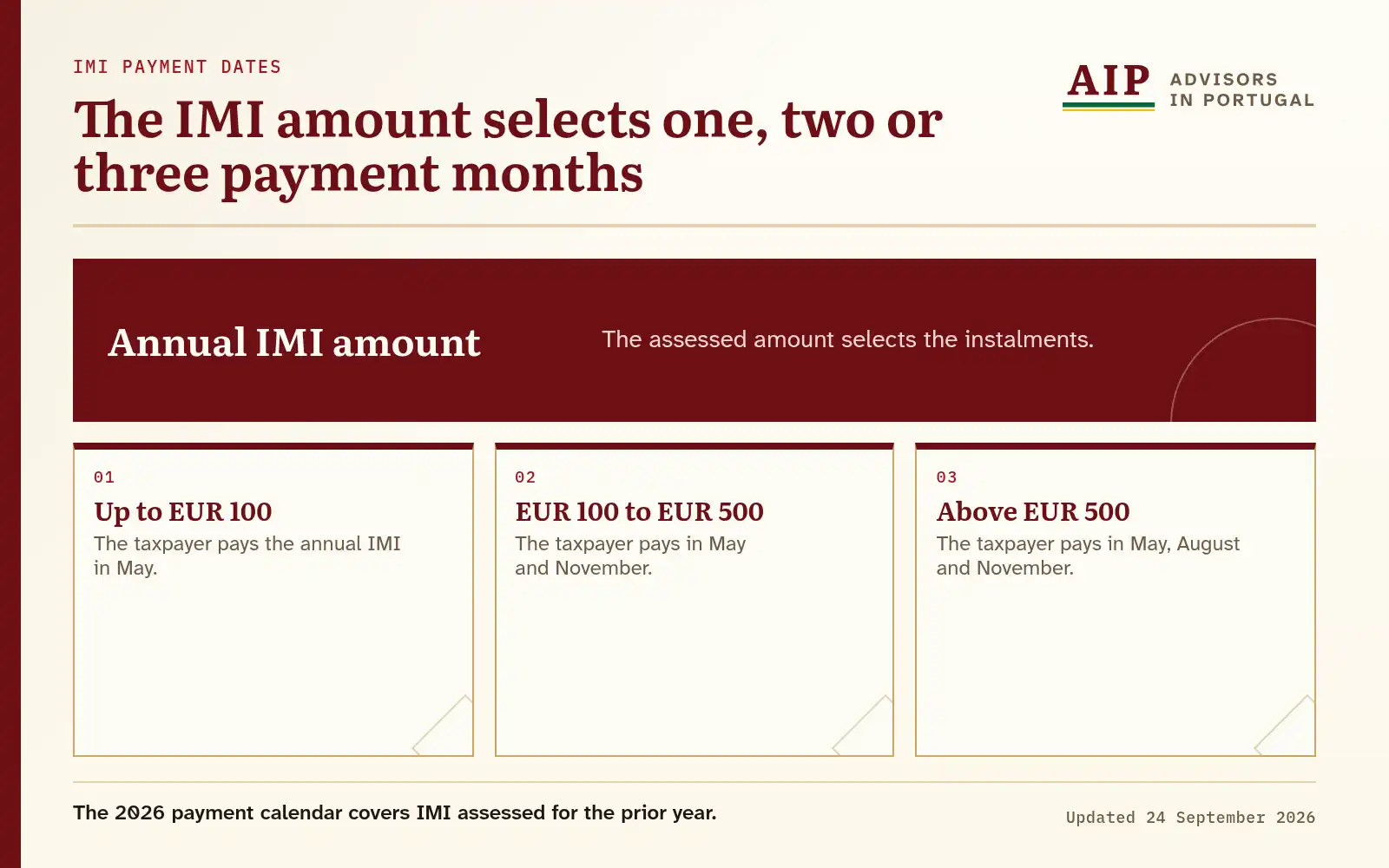
Diagram text version
The taxpayer pays the annual IMI in May. The taxpayer pays in May and November. The taxpayer pays in May, August and November.
Common questions
What is the rural IMI rate?
What is the lowest AIMI deduction for an individual?
What is the IMI schedule for a bill of €100 or less?
Can a buyer aged 35 or under qualify for a first-home IMT exemption?
Can later Portuguese residence affect the 7.5% non-resident rule?
Who receives IMI revenue?
Related guides
The information on this page is checked against official sources and reviewed regularly. It is corrected when the law or official guidance changes, as the Editorial Standards describe.