Alojamento Local Registration: Rules and Legal Steps
Alojamento Local registration is a prior communication through the Balcão Único Eletrónico to the competent Câmara Municipal under Decreto-Lei n.º 128/2014. The municipality has 60 days to oppose the communication, or 90 days in a containment area.

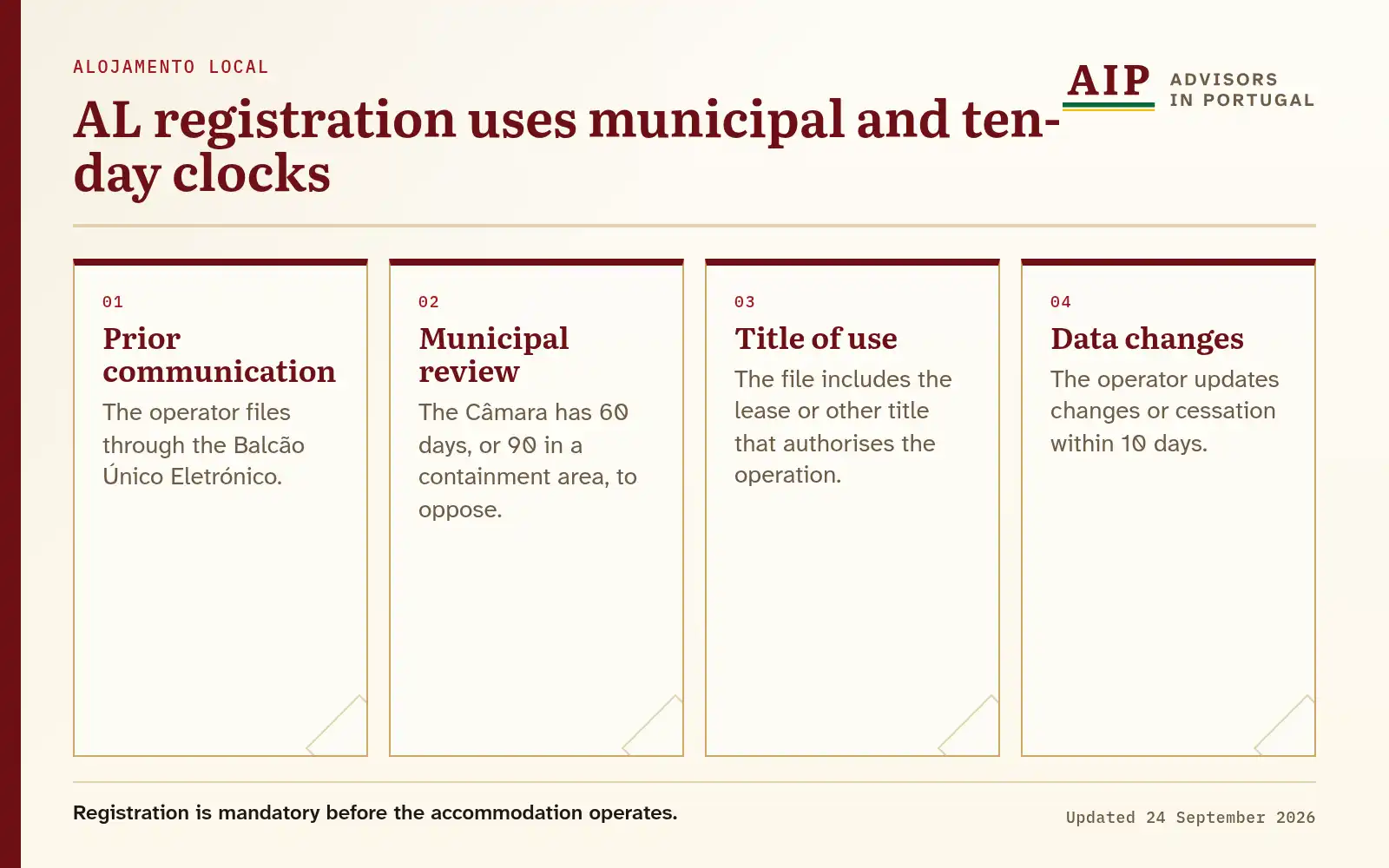
Diagram text version
The operator files through the Balcão Único Eletrónico. The Câmara has 60 days, or 90 in a containment area, to oppose. The file includes the lease or other title that authorises the operation. The operator updates changes or cessation within 10 days.
Decreto-Lei n.º 128/2014 governs paid temporary accommodation for tourists when the property meets the statutory Alojamento Local conditions. The 2024 republication controls the registration and operating questions in 2026. You should establish the property modality and municipality before preparing a communication, because the documents, capacity rule and municipal opposition period depend on those facts.
What Counts as Alojamento Local in Portugal?
Articles 2 and 3 of Decreto-Lei n.º 128/2014 cover temporary accommodation supplied to tourists for remuneration and distinguish it from a qualifying tourist development. The law recognises moradia, apartamento, estabelecimento de hospedagem and quartos. You should classify the actual premises and intended operation before using one of those labels in a registration. A house, apartment and rooms in an operator’s home raise different evidence questions even when guests book through the same platform.
Article 11(1) sets a general maximum of nine rooms and 27 guests, subject to the modality-specific rules and further calculations in that article. You should count the planned rooms and guests using the relevant modality, not a platform’s advertising limit. The floor plan, intended capacity and property title should agree before a declaration is submitted. You should examine other Article 11 paragraphs where the property’s configuration makes a simple room count misleading.
The classification matters to the later file. The municipality needs the establishment name, address and capacity under Article 6. Fire-safety duties depend in part on guest capacity under Article 13, while a proposed hostel may need condominium evidence under Article 6(2). You should therefore decide how the space will operate before ordering documents or buying insurance. An existing residential use may require a separate examination of the property and municipal record.
How Do You Register an Alojamento Local Property?
Article 5 of Decreto-Lei n.º 128/2014 requires a comunicação prévia com prazo through the Balcão Único Eletrónico to the president of the territorially competent Câmara Municipal. Registration is mandatory. Under Article 6(9), the municipal president may oppose within 60 days of submission, or within 90 days for a request in an area of containment, on the grounds allowed by the law. You should establish whether the address falls inside such an area before treating the ordinary period as applicable.
You should prepare the communication against the correct property and operator details. The online process records a request and, where the municipality does not oppose, confers a registration number for the establishment. The submitted address, modality and capacity should match the title and municipal records. You should retain the submitted communication and acknowledgment as evidence of the statutory submission. IRN’s cost schedule covers any registry act that the property separately requires, under the Regulamento Emolumentar dos Registos e Notariado. The competent municipality’s current tariff sets any local charge, and the insurer’s policy offer sets the premium for the actual property.
The 2024 reform strengthened municipal regulatory powers, so you should read the competent municipality’s current rules for the property’s address. You should assess local containment or sustainable-growth rules alongside the national 60- and 90-day periods. A local restriction and its legal basis should be identified before an opening date is fixed. You should keep any municipal response with the original submission so the registration history remains intelligible.
Which Documents Must Accompany the Communication?
Article 6(1)-(2) of Decreto-Lei n.º 128/2014 sets the communication data and supporting categories. The communication identifies the operator and tax number, the property’s address, establishment name, capacity, intended opening date and emergency contact, together with the applicable use authorisation or title. The supporting material includes identity or commercial-certificate access, a signed responsibility term and evidence of the legal basis for using the property.
You should provide the property tax booklet when you own the property. You should provide a lease or another title where you do not, with any accommodation authorisation the title lacks. Article 6(2) also calls for the corresponding tax-activity declaration and, for a hostel where applicable, a condominium resolution. The named operator on every document should be the person who will submit the communication and operate the accommodation.
You should check the actual property’s use status before assuming an older licence document is required or sufficient. A municipal planning record, lease term and condominium rule can raise separate questions about the use you propose. The statutory attachment list identifies the categories for the communication, and a discrepancy in a particular property can call for an additional document. You should keep the submitted version of each attachment, not only the later registration number.
What Insurance Must an Operator Hold?
Article 13-A of Decreto-Lei n.º 128/2014 requires valid third-party civil-liability insurance for property and non-property damage to guests and third parties caused by the accommodation activity. The minimum capital is EUR 75,000 per claim. The operator must contract and maintain that cover. Gov.pt’s current guide instructs operators to provide proof before activity starts and again when the policy is renewed or changed.
You should compare the insured operator, establishment address, covered activity and policy dates with the registration communication. You should confirm that the policy describes the accommodation activity whose risks Article 13-A addresses. An insurer determines the offered cover and premium. You should retain the policy, proof of delivery and later renewal records together with the registration history.
The municipality may demand documentary insurance proof under Article 13-A, and failure to maintain valid cover can lead to cancellation of the registration. You should treat the insurance obligation as continuing after the first guest arrives. The EUR 75,000 amount is insured capital per claim. The insurer sets the premium for the cover offered.
Which Safety and Building Conditions Apply?
Articles 12 and 13 of Decreto-Lei n.º 128/2014 require adequate conservation and functioning, controlled water supply, sewerage or a suitable septic system, running hot and cold water, ventilation, appropriate furnishings, light control, privacy locks and hygiene. Fire-safety rules apply to the establishment. You should inspect the proposed accommodation against these conditions before relying on a successful online communication as proof that the premises are ready to receive guests.
Article 13(2) provides a limited exception from the full fire-safety regime for establishments with capacity of 10 guests or fewer, subject to specified equipment: an accessible extinguisher and fire blanket, accessible first-aid equipment and a visible 112 notice. You should check the capacity declared to the municipality against the layout and the equipment actually available. The exception does not remove the listed safeguards or other applicable modality requirements.
You should compare building and use records with the rooms advertised to guests. An alteration of layout, capacity or use may affect both the municipal file and the AL communication. The operator remains responsible for operating conditions. You should retain inspection and maintenance evidence throughout the operation.
When Must You Update or End a Registration?
Article 6(3)-(4) of Decreto-Lei n.º 128/2014 requires the operator to update communicated data in the Balcão Único Eletrónico within 10 days after a change and to communicate cessation within 10 days after it occurs. You should update the relevant field when the operator, address details, capacity or another communicated item changes. You should keep the acknowledgment with the earlier version so a later enquiry can identify when the change occurred.
You should distinguish a change of registered data from a new property or a different operation. The original registration should still describe the accommodation that guests will occupy. The cessation rule concerns the end of the operation, while a temporary interdiction or cancellation can produce a separate duty to notify booking platforms under Article 6(5). You should record the event date before calculating the 10-day period.
The insurance file needs its own attention when the operator or establishment changes. Article 13-A requires valid cover for the activity, and the gov.pt guide calls for renewed proof after a policy renewal or change. You should align the registration record with the insurer’s documents before accepting bookings under changed facts. You should update the Balcão Único Eletrónico entry when communicated data changes.
Who Supervises an Alojamento Local Establishment?
Article 21(1)-(2) of Decreto-Lei n.º 128/2014 gives ASAE and the territorially competent municipality roles in supervising compliance, opening and instructing proceedings, and applying fines or ancillary sanctions. You should handle tax obligations through the Autoridade Tributária e Aduaneira as a separate matter. You should answer a notice from the authority that issued it and preserve both the notice and your response. The registered operator remains the person whose data and obligations the authorities examine.
You should distinguish a municipal planning question from a tax return or an ASAE inspection. The response should address the legal basis, deadline and documents identified in the notice. Article 66 of the Estatuto da Ordem dos Advogados requires Ordem registration for the lawyer title and legally reserved acts.
You should keep operational evidence with the legal file: registration details, insurance proof, safety records, guest-capacity information and municipal correspondence. These documents can address different questions raised by different authorities. The law allows sanctions for non-compliance, but the outcome depends on the specific duty and facts. The response should identify the contested requirement and the competent body.
What Tax Activity Must You Declare?
Article 6(2)(e) of Decreto-Lei n.º 128/2014 requires the corresponding declaration of commencement or alteration of accommodation-service activity to the Autoridade Tributária e Aduaneira as part of the registration material. Article 10 provides for AL registration information to reach AT through Turismo de Portugal on a semiannual basis. You should not treat that administrative data transfer as a substitute for the operator’s own activity declaration.
Article 8 of the Código do IRS treats rents from urban property as Category F income unless a taxpayer opts for Category B. The AL activity declaration and an individual’s income-tax classification need a review of the operator, legal relationship and actual receipts. The current tax route applies to those facts, and the filing calendar follows from the operator’s activity and tax position.
You should retain the activity declaration, invoices or receipts, tax registration and AL communication under the same operator name. A property owner who leases a unit to an operator and the operator who supplies accommodation may have different income and obligations. The category depends on which activity each person actually carries out.
What Changed Under the 2024 Reform?
Decreto-Lei n.º 76/2024 entered into force on the first day of the month following its publication and amended and republicated the regime in Decreto-Lei n.º 128/2014. It revised the registration, capacity, insurance, municipal supervision and area-of-containment framework that governs a 2026 application. The current gov.pt guide, updated on 8 September 2026, identifies that decree-law among the instruments for operators. You should apply the current republication to a new communication.
You should ask which municipal rule applies at the property’s address after the national reform. A municipality can adopt measures under the powers provided by the current regime, and the 90-day opposition period applies to a request in an area of containment. You should keep the date of each municipal decision because an older local notice may describe a different national framework.
You should check the continuing insurance and safety duties. You should check Article 13-A cover and Articles 12-13 premises conditions before operation. You should identify the operator and modality anew where an existing registration no longer matches the intended business. You should use the current national regime and the municipality’s rules for the address.
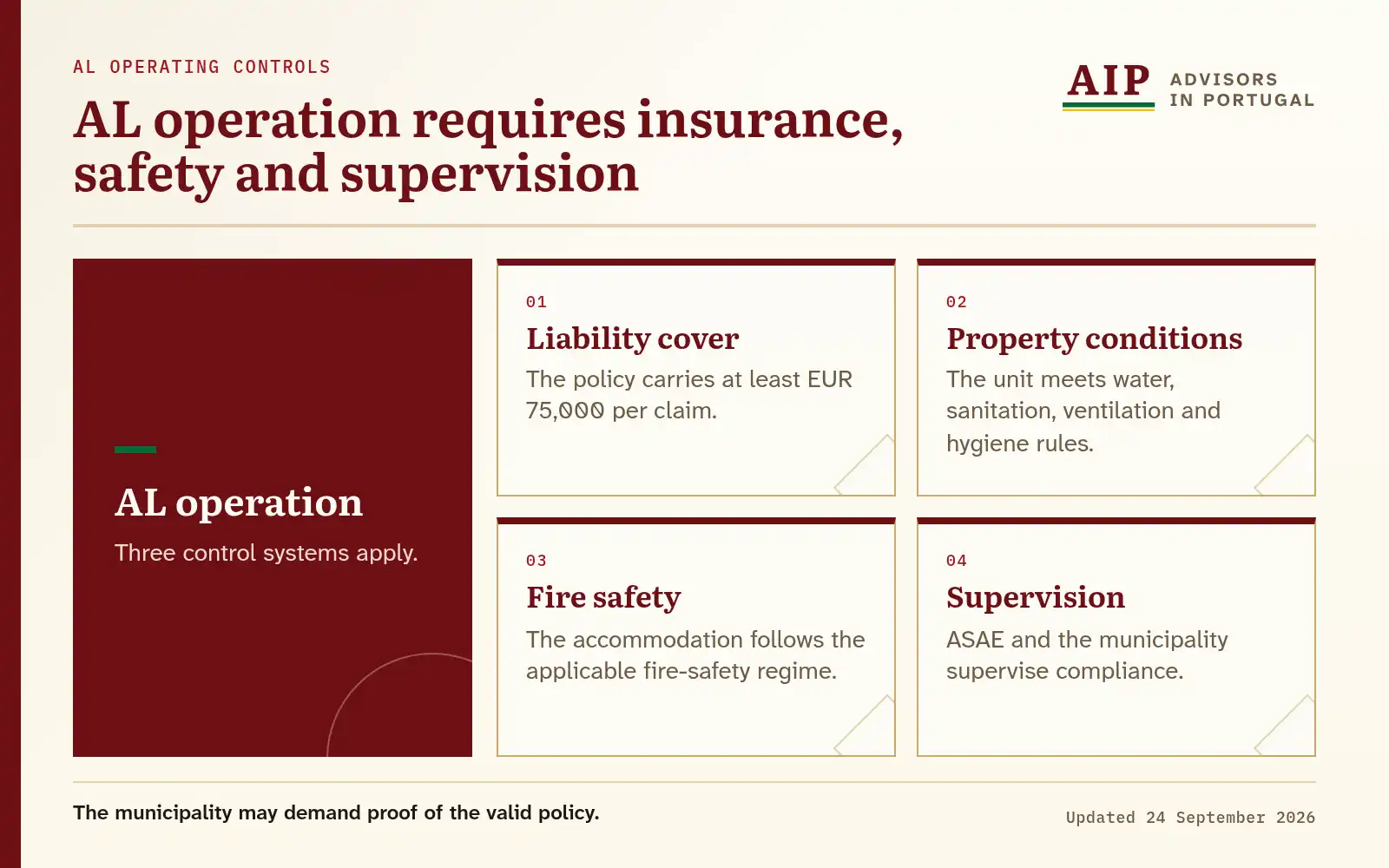
Diagram text version
The policy carries at least EUR 75,000 per claim. The unit meets water, sanitation, ventilation and hygiene rules. The accommodation follows the applicable fire-safety regime. ASAE and the municipality supervise compliance.
Common questions
When is an Alojamento Local establishment a hostel?
Does the nine-room limit apply to every modality?
Which tax activity code accompanies the registration?
How quickly must I provide insurance proof if asked?
Must I tell booking platforms if registration is cancelled?
Who may hold a lawyer's title in Portugal?
How soon must I update registration data after a change?
The information on this page is checked against official sources and reviewed regularly. It is corrected when the law or official guidance changes, as the Editorial Standards describe.