Family Reunification in Portugal: Rules and Deadlines
Family reunification in Portugal normally requires the holder to have a residence permit valid for at least two years under Article 98 of Lei n.º 23/2007. AIMA has nine months to decide a request and may extend that period once in exceptional circumstances.

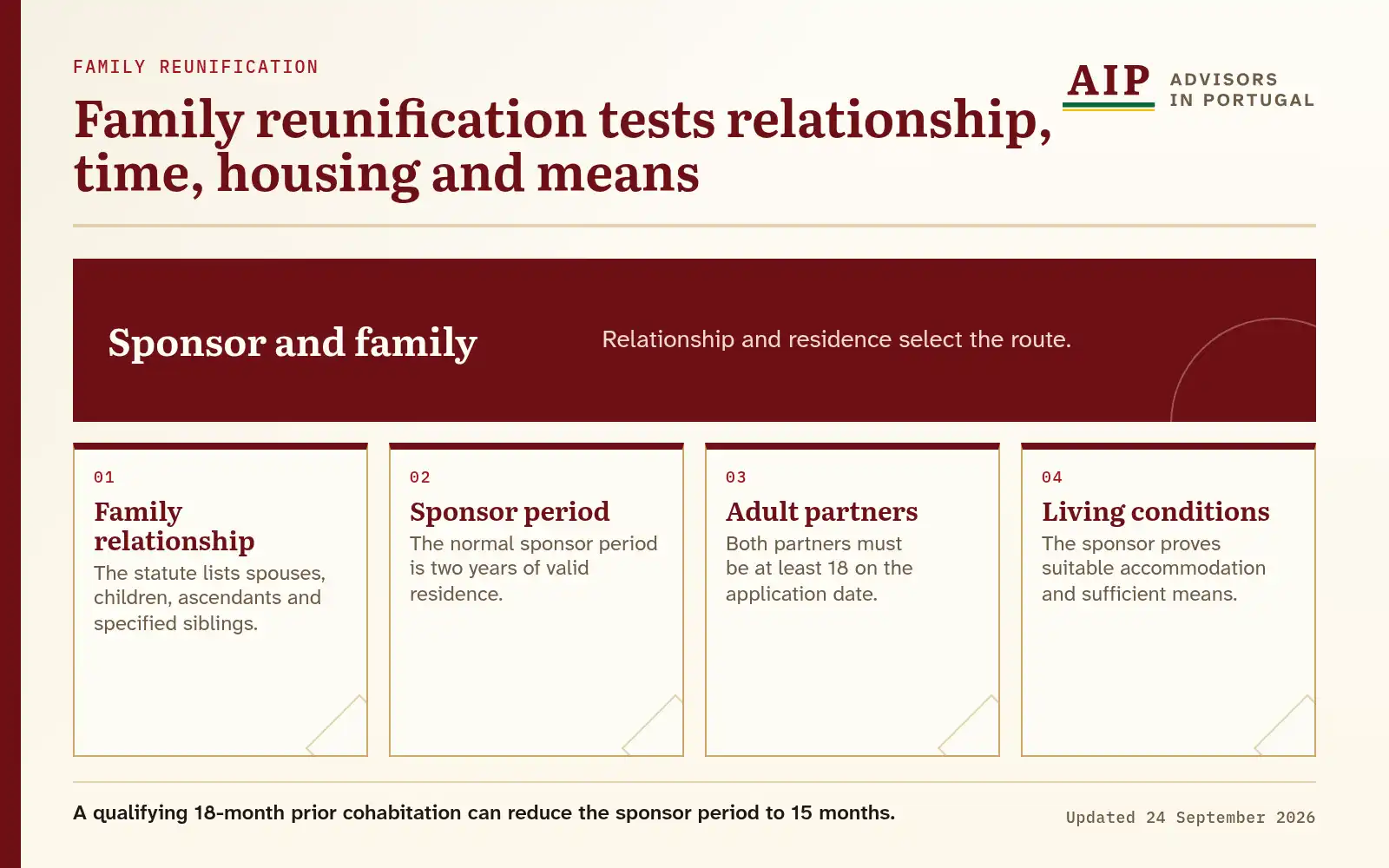
Diagram text version
The statute lists spouses, children, ascendants and specified siblings. The normal sponsor period is two years of valid residence. Both partners must be at least 18 on the application date. The sponsor proves suitable accommodation and sufficient means.
You should identify the statutory category, relevant dates and supporting records before acting. This guide covers Portuguese family reunification eligibility, sponsor periods, documents, AIMA decisions and family residence permits.
Who counts as a family member?
Lei n.º 23/2007 Article 99(1) includes a spouse, dependent minor or incapacitated children, specified adopted minors, dependent unmarried children studying in Portugal, dependent first-degree ascendants and specified minor siblings. Article 100 addresses a de facto partnership. You should identify the exact relationship and relevant paragraph for every person in the request.
A family description such as parent or child is only the starting point. Dependency, age, study, adoption or recognised tutorship may determine the applicable category. Each person’s civil record has to match the statutory category and the sponsor’s own residence position.
You should collect the documents that prove the relationship before asking AIMA to decide. A spouse needs evidence of marriage; a de facto partner needs evidence of the qualifying union; an ascendant needs evidence of both the relationship and dependency. The file should show which facts are already documented and which require further evidence.
How long must the sponsor have held residence?
Lei n.º 23/2007 Article 98(1), as amended by Lei n.º 61/2025, normally requires a residence permit valid for at least two years. Article 98(2) reduces the period to 15 months for a spouse or equivalent who cohabited with the holder for at least 18 months immediately before the holder entered Portugal. Article 98(3)-(5) contains further exceptions and reductions. You should calculate the permit period and any prior cohabitation separately.
The ordinary two-year rule turns on the sponsor’s valid permit and the family member’s qualifying connection. The permit issue date and the family evidence are read together. You should preserve proof of the 18-month pre-entry cohabitation if the shorter spouse or equivalent period is relevant.
An exception has to be tied to its own Article 98 paragraph. The applicable route follows from the sponsor’s permit and relationship history. You should not use the 15-month figure for every family member simply because the household lived together.
Which marriage or partnership conditions apply?
Lei n.º 23/2007 Article 99(6) requires a marriage or união de facto to be valid and recognised under Portuguese law. Both the sponsor and spouse or equivalent must be at least 18 on the application date. Article 100(1)(a) requires a de facto union to be duly proved. You should check both dates of birth and the legal status of the relationship before filing.
Foreign civil records must meet the Portuguese recognition requirement. You should provide any relevant marriage certificate, court decision or evidence of the union in a form the application can use. The age test is tied to the date of the request, so the date in the filing record matters.
Documents that support validity and recognition under Portuguese law belong in the file. You should separate the evidence of the relationship from evidence of the sponsor’s accommodation and means, because the law asks for both.
What accommodation and means are needed?
Lei n.º 23/2007 Article 101 requires suitable accommodation owned or rented by the sponsor and sufficient means for the family members without reliance on social support, subject to the refugee exception. Article 103(3) requires evidence of the conditions with the request. You should collect the housing and financial records for the actual household.
The detailed standards for accommodation and subsistence are referred to ministerial ordinances in Article 101. Those standards apply to the number of family members and the sponsor’s documented resources. The sponsor should show the address, occupancy basis and income evidence so the application describes one coherent living arrangement.
A sponsor who relies on an exception needs the relevant status evidence. You should identify that status before assuming the ordinary Article 101 tests apply. The conditions and supporting records belong in the application at filing.
Which documents accompany the request?
Lei n.º 23/2007 Article 103(3) calls for documents proving the family relationship or união de facto, documents proving the conditions for reunification and authenticated copies of the family members’ or partner’s travel documents. You should organise the file by person and legal condition.
Names, dates and relationships should match across civil records, passports, residence documents and housing evidence. A mismatch in a name or date may affect how AIMA reads the family link. You should preserve the authenticated travel-document copies specified by the article and keep the originals available for any required comparison.
The family file should show how every document answers a statutory condition. Some categories require a foreign decision to be recognised in Portugal. You should gather the residence permit and proof of the sponsor’s period separately from the family member’s travel papers.
Where is the request made?
Lei n.º 23/2007 Article 103(1) places a request for the entry and residence of family members outside Portugal with AIMA, I. P., made by the holder of the reunification right. Article 103(2) allows a request for specified relatives already lawfully in Portugal. You should establish each person’s location and lawful status before preparing the application.
Article 103(1) applies to family members outside Portugal and Article 103(2) to specified relatives already lawfully in Portugal. You should use the filing channel that AIMA makes available for the case and keep proof of submission.
A family member’s presence in Portugal does not by itself answer whether Article 103(2) applies. Immigration documents must match the family category and the sponsor’s right. The application should reflect the person’s real location and status on the filing date.
How long does AIMA have to decide?
Lei n.º 23/2007 Article 105(1) gives AIMA nine months to decide a family-reunification request. Article 105(2) allows an equal extension only in exceptional circumstances connected with the complexity of the analysis, except for the cases in Article 98(1)-(2). You should retain the application acknowledgment.
The nine-month period is a legal deadline for the authority. The filing date and the applicable Article 98 case determine whether the extension provision can be used. You should keep later requests for evidence with the same case record.
Article 105(3)-(4) are revoked in the current text. You should base a deadline analysis on the current paragraphs.
How long is the family permit valid?
Lei n.º 23/2007 Article 107(1) normally gives the family member a residence permit matching the resident’s duration. Under Article 107(2), the family member of a permanent resident receives a two-year permit, renewable for three-year periods. Article 107(3) gives a qualifying family member an autonomous permit after two years while family ties continue.
The timing of an autonomous permit depends on the sponsor’s permit, the family member’s issue date and any later change in family facts. Article 107(4)-(5) contains further exceptions to the ordinary autonomy sequence. You should keep the first permit and renewal records because the timing of autonomy depends on them.
The initial family permit and a later autonomous permit are different decisions. The request that fits depends on the family member’s current status. You should not assume the sponsor’s permanent residence automatically grants an immediate permanent permit to the family member.
What changed in the current 2026 text?
The current consolidated Lei n.º 23/2007 lists Lei n.º 62/2026 of 10 September among its amendments. Article 81-A now places residence-permit renewal requests with AIMA, I. P.; paragraph 2 contains a Madeira provision.
You should distinguish a new reunification request from renewal of an existing permit. Which article governs depends on the step the family needs now. A sponsor seeking entry of a relative uses the conditions and request rules in Articles 98 to 103. A family member renewing an issued permit needs the relevant renewal provision.
Lei n.º 62/2026 was published on 10 September 2026. You should keep any existing permit, renewal acknowledgment and AIMA correspondence so the correct current route can be identified.
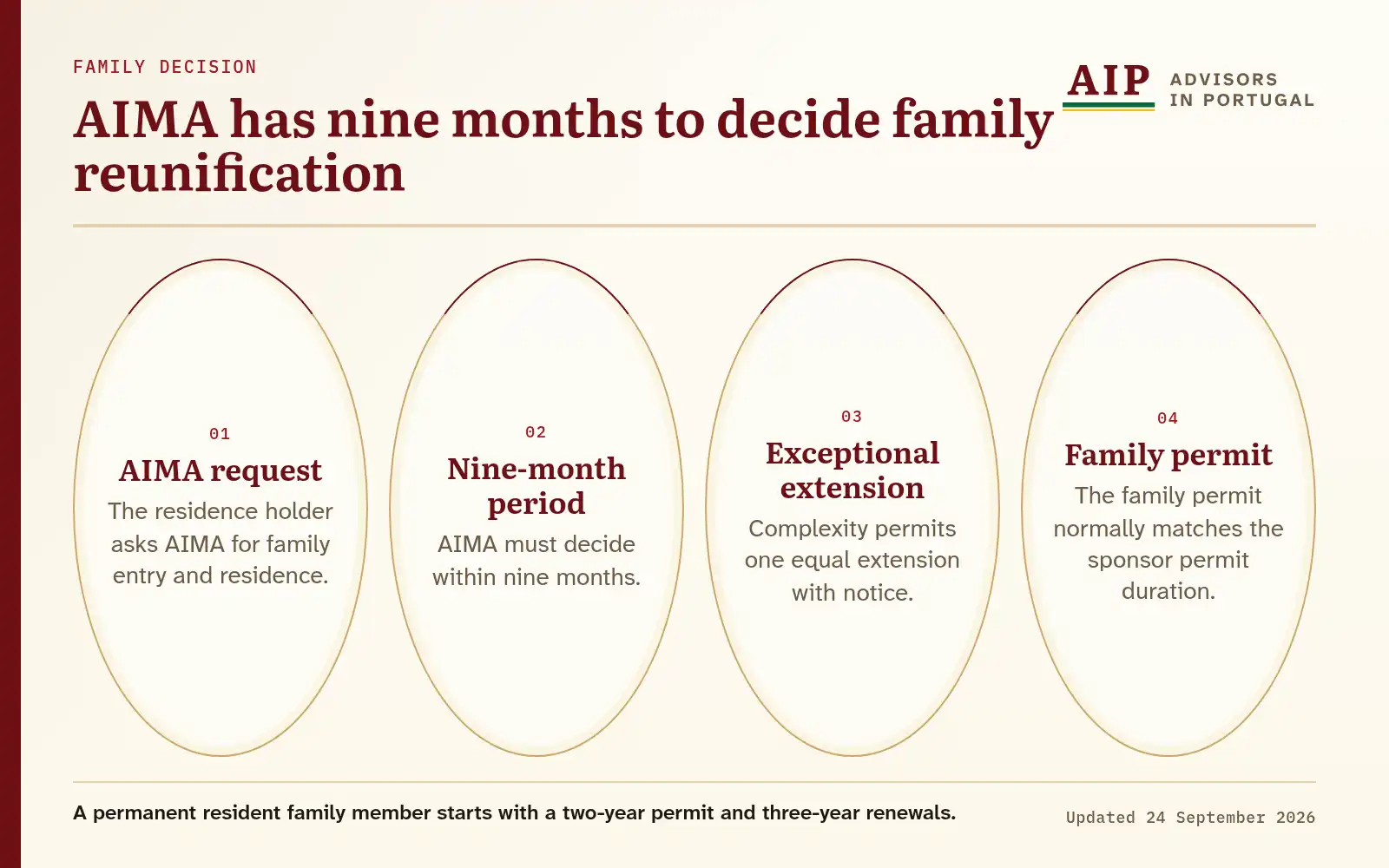
Diagram text version
The residence holder asks AIMA for family entry and residence. AIMA must decide within nine months. Complexity permits one equal extension with notice. The family permit normally matches the sponsor permit duration.
Common questions
May a minor sibling qualify?
May a child on a study route use the same list?
Can an autonomous permit be issued early when the sponsor has minor children in Portugal?
Must AIMA notify an exceptional extension?
How long does AIMA have to decide a family-reunification request?
Does Article 81-A let a representative file a renewal?
Related guides
The information on this page is checked against official sources and reviewed regularly. It is corrected when the law or official guidance changes, as the Editorial Standards describe.