AIMA Delays in Portugal: Decision Periods and Legal Options
An AIMA delay in Portugal is measured against decision periods of 90 days for residence grants, 60 days for renewal and nine months for family reunification. Residence visa holders may lawfully work while an application is pending for a reason not attributable to them.

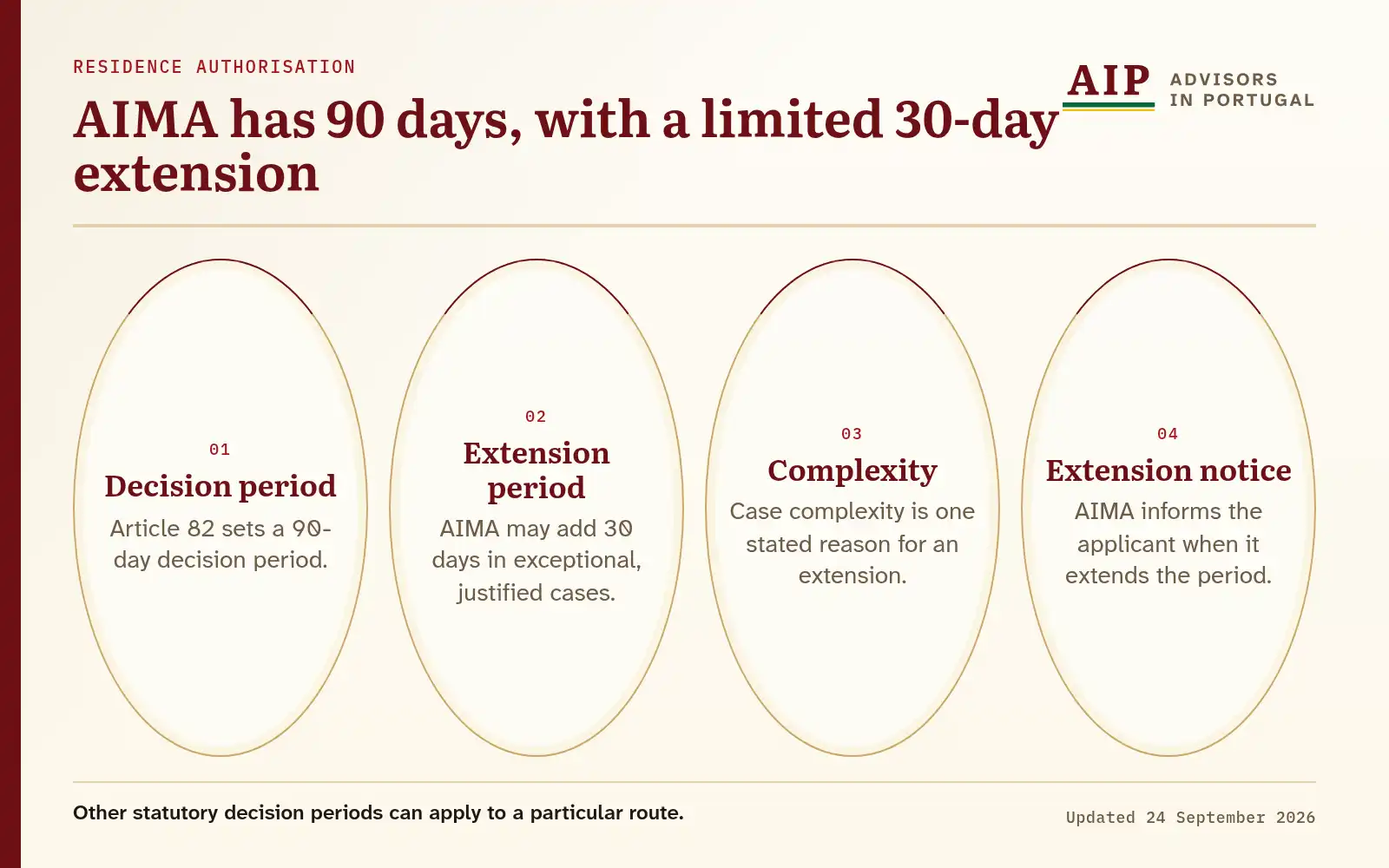
Diagram text version
Article 82 sets a 90-day decision period. AIMA may add 30 days in exceptional, justified cases. Case complexity is one stated reason for an extension. AIMA informs the applicant when it extends the period.
Lei n.º 23/2007 gives different decision periods to different AIMA requests. A delayed appointment and a delayed decision therefore need different records. The applicant should identify the request actually submitted, the date and proof of submission, and each notice AIMA has sent. Those records can then be compared with the relevant statutory period to show which administrative or court step the facts support.
How Long May AIMA Take to Decide a Residence Application?
Article 82(5) of Lei n.º 23/2007 sets a 90-day decision period for a grant of residence authorisation. AIMA may extend that period by 30 days only in exceptional, duly justified circumstances and must tell the applicant. Article 82(6) sets 60 days for a renewal decision. Article 105(1) sets nine months for family reunification. These are periods for the authority’s decision on the specified request; they are not promises that an appointment or card will arrive on those dates.
The application receipt is the first record to locate before counting time. A request for an appointment, an incomplete application and an application already under examination are different factual positions. The receipt and AIMA correspondence identify the act requested and any notice about missing material or an extension. The 90-day grant rule itself recognises that other decision periods in Lei n.º 23/2007 may apply, so the correct article comes before any calculation.
A family request and a renewal may run at the same time. Each application needs its own chronology, and the renewal period does not apply to a family decision. Keep the original submission record because a later email or appointment message may refer to the same case under a different reference. An accurate chronology supports a focused request for information or a challenge to the delay.
Which Application and Records Establish the Delay?
Article 116(1) of the Código do Procedimento Administrativo places proof of alleged facts on the interested person. You should identify the pending request precisely when explaining what remains unanswered. You should preserve the application and any appointment confirmation, payment record, uploaded documents, requests for more information and replies.
A useful chronology puts each event beside its date and case number. The first entry identifies the residence, renewal or family request; later entries show what AIMA asked for and when you answered. A screenshot without the submission reference may be difficult to match to the file, while a receipt and the corresponding message establish a usable sequence. The original files and their electronic acknowledgments belong together.
The record should also show who lodged the request and what authority that person used. That detail matters when correspondence goes to an employer or representative while you wait for a decision. The same reference can be supplied in a later submission without describing an appointment request as a completed residence application.
How Do You Request an AIMA Appointment?
AIMA’s current FAQ directs an applicant to request an appointment through its Contact Centre and attend a Loja AIMA while the digital channel for the relevant residence route is not operational. You should preserve the acknowledgment from the route you use. You should use the channel AIMA currently assigns to your requested authorisation and keep the acknowledgment.
The route matters before an appointment request is prepared, because a first grant, a renewal and a family request can each follow a different one. AIMA’s instruction for the route applies when its online channel is unavailable. You should retain the message through which AIMA offers a date and any response you send about it. The evidence shows what you actually requested, even when the appointment and final decision occur much later.
You should take the documents specified for the route to the appointed channel. AIMA verifies the statutory prerequisites that apply to your residence ground before the appointment, so the current list can be compared with what you have already supplied to identify any gap. AIMA controls the appointment and applies the statutory decision period.
What Duty to Decide Applies After a Delay?
Article 13(1) of the Código do Procedimento Administrativo requires administrative bodies to address matters within their competence, including petitions, representations, complaints and grievances. You may therefore identify the pending request and ask AIMA for a decision or a clear procedural response. AIMA must still decide the application under the applicable residence rule.
A concise communication states the requested act, the legal period and the evidence of submission. A request for a decision differs from a request to correct a missing document, because AIMA can only answer the matter placed before it. Article 116 supports attaching proof of facts that you allege and identifying records AIMA already holds. You should preserve the communication and its delivery record for any later step.
The Código de Processo nos Tribunais Administrativos supplies procedures before the administrative courts. An administrative complaint is considered before a court procedure is chosen, and the procedural route follows from the individual act or omission and the relief needed. You should keep any formal answer because it may alter the question that a later filing must address.
What Can You Do While a Residence Request Is Pending?
Article 81(4) of Lei n.º 23/2007 permits the holder of a residence visa to exercise a professional activity under the law while a residence-authorisation application is pending for a reason not attributable to the applicant. That rule depends on both the visa and the reason for the pending application. Travel and family questions have their own conditions.
The visa, the application receipt and any AIMA request for outstanding information show whether Article 81(4) applies. The file should show whether the delay arose after you supplied what the route required or whether the authority still awaits your response. A pending appointment request is not the same event as a pending residence-authorisation application under that paragraph.
A separate travel or family decision may arise while you wait. The particular visa, residence history and applicable rule govern that decision. Article 81(4) addresses professional activity only while the qualifying residence application remains pending, so a re-entry or family-member question needs its own basis in the law.
When Can You Ask an Administrative Court for Interim Relief?
Article 112(1) of the Código de Processo nos Tribunais Administrativos allows a person with standing to bring an administrative-court case to request an anticipatory or preservative interim measure appropriate to protect the usefulness of the final judgment. The requested measure and standing depend on the delayed act and the proposed main case. The court assesses the request against those conditions.
The elements to identify are the decision sought, the main action that may be needed and the harm that may arise before final judgment. The application chronology, notices and any evidence of the specific consequence the court is asked to address form the record. The court must apply the relevant procedural criteria to that record.
A later AIMA communication may change the factual position, so it should be compared with the original application before a court filing is chosen. A request for an appointment, a refusal, a request for further evidence and a failure to decide raise different questions. You should keep each notice in the same file so the request identifies the act or omission accurately.
What Changed for Renewals in 2026?
Article 81-A(1) of Lei n.º 23/2007, as amended by Lei n.º 62/2026 effective 11 September 2026, places residence-renewal requests with AIMA. The current consolidated text identifies the 2026 amendment. Article 82(6) continues to supply the 60-day decision period for renewal. You should distinguish the route for submitting a renewal from the period for deciding it.
The applicant keeps the version of the law in force on the filing date and AIMA’s acknowledgment. You should keep the previous residence title, renewal submission proof and any AIMA instruction together. If AIMA requests updated documents, your response and its acknowledgment belong in the chronology used to assess any later delay.
You may have heard of a different renewal platform or a previous administrative arrangement. Article 81-A(1) sets the statutory submission route. AIMA’s current instructions set the channel for each category, and the application date stays the legally relevant date. The case-specific facts determine which communication to make next.
Common questions
Can my employer submit a residence request?
Must an applicant use a lawyer for every AIMA request?
Can AIMA obtain evidence from another public body?
Can I request an AIMA appointment through a contact form?
Can my legal representative request a renewal?
Does Article 116 require me to supply a document AIMA already holds?
The information on this page is checked against official sources and reviewed regularly. It is corrected when the law or official guidance changes, as the Editorial Standards describe.