D7 Visa Portugal: Requirements and Residence Steps
The D7 visa in Portugal assesses household means of support across twelve months, starting at 100% of the minimum monthly salary for the first adult. Each further adult adds 50%, and each child under 18 or dependent adult child adds 30%.
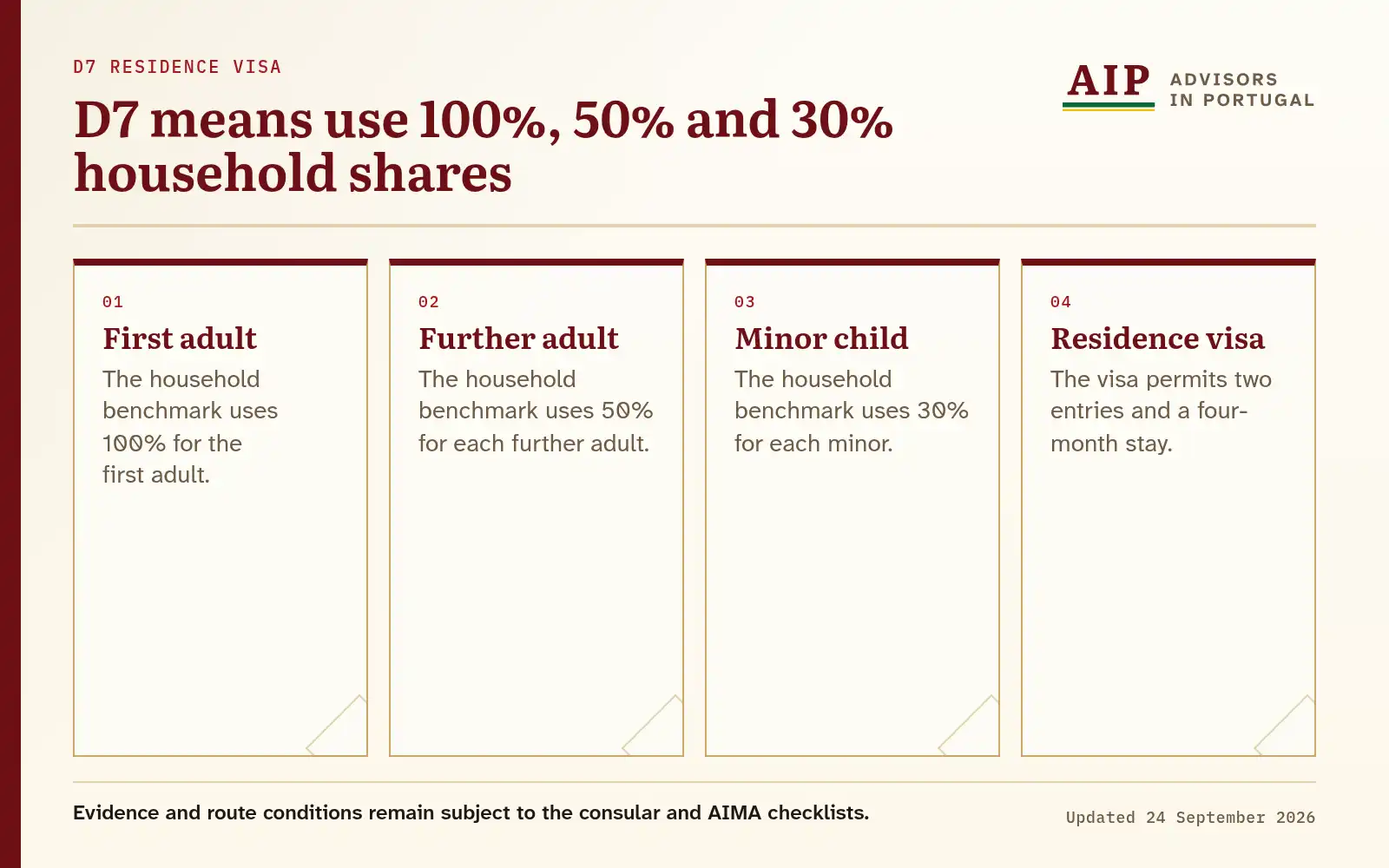
Diagram text version
The household benchmark uses 100% for the first adult. The household benchmark uses 50% for each further adult. The household benchmark uses 30% for each minor. The visa permits two entries and a four-month stay.
The D7 visa for Portugal uses the household means-of-support calculation in Portaria n.º 1563/2007 Article 2(2). Article 5(6) assesses the means of support across twelve months.
The route has a visa stage and a later AIMA residence stage. The two stages rely on related facts and apply different conditions. Applicants organise identity, income, accommodation and civil-status evidence before filing and keep the originals available for the residence stage.
Who Can Use the D7 Route to Portugal?
Decreto Regulamentar n.º 84/2007 Article 24(1)(b)-(d) identifies retirees and people living from property, intellectual-property or financial-application income for the D7 category. Lei 23/2007 Article 58(2) gives the visa two entries and four months, and Article 58(4) sets a 60-day decision period unless a shorter statutory period applies. The applicant’s nationality, residence, income and family plan are measured against those conditions.
An application describes every regular income source with the payer, country, amount, payment history and whether the income continues after the move. Savings and recurring income are identified separately because they may play different evidential roles.
The file also records the passport, the country of lawful residence, previous Portuguese visas or permits and any refusal or pending case. Those facts can determine the filing place and the document requirements.
The family plan belongs at the start. Relatives can form part of the visa application or need later family procedures, and each person needs their own evidence.
The timing and purpose of the move should match the income, accommodation and travel records, so that the application presents one consistent set of facts. The evidence is updated when the plan changes materially before filing.
Which Means of Support Does the D7 Route Require?
Portaria n.º 1563/2007 Article 2(2) uses 100% of the minimum monthly salary for the first adult, 50% for each further adult and 30% for each child under 18 or dependent adult child; Article 5(6) assesses the means across twelve months. The household calculation applies to the evidence current at filing.
The source documents behind the balance matter. Pension statements, rental contracts and receipts, investment statements, company records or other payment evidence may show the amount, regularity and expected continuation of income. The current checklist determines which records support the route.
Currency and tax records can matter when income arises abroad. Statements showing gross amounts, deductions and payment dates help, and translations or supporting contracts may be needed to show the source of the funds.
The file shows the applicant’s own resources, and a gap in them affects the application. How the move and the income are taxed in Portugal is a separate question for a tax adviser.
What Accommodation Evidence Is Needed?
Article 77(1) of Lei 23/2007 lists accommodation as a cumulative condition for temporary residence, separately from means of subsistence and the valid residence visa. The consular and AIMA evidence is checked against the intended address and occupancy arrangement.
The evidence covers the address, expected occupancy dates, owner or host information and the legal document supporting the right to stay. The accommodation record, the application dates and the household members need to be consistent.
The evidence changes with the arrangement if it changes before filing. A document for an address that is no longer intended for use creates factual inconsistencies.
A property purchase has its own title, contract and tax review. Qualifying accommodation evidence serves the immigration file, and property due diligence is a separate matter covered in the due diligence guide.
Which Documents Support a D7 Application?
Decreto Regulamentar n.º 84/2007 Articles 12, 12-A and 24 set route-specific identity, travel, means-of-subsistence and income evidence. Lei 23/2007 Article 77(1) separately makes accommodation a residence-authorisation condition. The current checklist for the applicant and the post applies.
Documents are organised by applicant: the passport, lawful-residence evidence, income and bank records, accommodation documents and any civil-status records. Each document may need originals, copies, certifications, legalisations and translations.
Dates and names stay consistent across the file. Different spellings, renewed passports, prior names and documents issued in different jurisdictions are flagged before submission.
Each stage sets how recent each document must be, so the checklist is read before documents are ordered. The applicant keeps a complete copy of the filed package and keeps later originals available for the residence procedure.
A separate folder for every applicant, using the names and dates shown in the passport, keeps one person’s evidence apart from a relative’s documents. The original-language document stays together with any certification, legalisation and translation.
Where Is the Visa Application Made?
Article 58(4) of Lei 23/2007 sets a 60-day residence-visa decision period unless a shorter period applies, and the visa is requested through the competent Portuguese consular post, per Lei 23/2007 art. 81(1) and the Gov.pt residence-visa service page. Nationality and lawful-residence facts determine the correct post.
The visa stage and the AIMA residence stage have different functions. The applicant submits the visa application through the applicable official channel and later deals with AIMA for the residence stage.
Travel plans and any expiry date on the passport or current status affect document preparation. Authority appointment availability and decision timing are set by the authority.
Every submission receipt, request and decision document is worth keeping, because that record supports the next step and any official request that follows.
Can Family Members Apply?
Article 58(5) of Lei 23/2007 allows the residence visa to include accompaniment by family members within the Article 99(1) definition. Each family member’s relationship, identity, nationality, status and timing fall under the family procedure.
Birth, marriage, partnership, adoption or dependency records explain the relationship. The documents for a particular family member may need legalisation or translation.
The principal applicant’s residence position and the relative’s facts both matter to the family procedure. Custody, prior marriage, adult dependency and name differences are worth flagging early.
Family members may have separate tax, education, healthcare or work questions after the move. The immigration evidence stays distinct for each applicant.
What Happens at the AIMA Residence Stage?
Articles 58(1)-(2), 77(1) and 81(1) of Lei 23/2007 require a valid residence visa, presence in Portugal, means of subsistence, accommodation, Segurança Social registration where applicable and the other Article 77 conditions for the residence-authorisation step. The AIMA file follows entry, and the route evidence is checked again at that stage.
AIMA confirms the current appointment and document requirements for each residence-authorisation case, so the applicant checks them with AIMA before the appointment. Another applicant’s appointment sequence does not apply to a different case.
The applicant files the residence application directly with AIMA. AIMA controls its appointments, processing and decisions, so no date or outcome can be promised.
The permit and its issue and expiry details belong with the immigration records once it is issued. Later renewal or family questions start from the actual authorisation.
Which Fees and Renewal Rules Apply?
The national visa processing fee has not been confirmed from the current official MNE fee table, so applicants confirm the current amount with the consular post before filing. Article 78(1)-(2) of Lei 23/2007 requires the holder to request temporary residence renewal no later than 30 days before the permit expires, with means of subsistence, accommodation, tax and Segurança Social compliance and relevant criminal-record conditions.
The residence permit at the AIMA stage carries its own charge under Portaria 307/2023, and that table is indexed every 1 March, so the amount is read from the table current at filing.
Residence, income, accommodation and family records stay current during the permit period. Renewal starts from the holder’s actual permit, evidence and expiry details.
Common questions
Who qualifies for a D7 visa in Portugal?
Is there one minimum-income figure for every D7 applicant?
Must I own property in Portugal?
Is there one D7 document checklist?
Does the visa application complete Portuguese residence?
Will AIMA collect biometric data?
How much does a D7 visa cost?
Who submits a D7 application?
The information on this page is checked against official sources and reviewed regularly. It is corrected when the law or official guidance changes, as the Editorial Standards describe.