Portugal Residence Permit Renewal: Timing and Conditions
Residence permit renewal in Portugal requires temporary residents to request renewal at least 30 days before their authorisation expires. Permanent residents renew their title every five years, so the status on your card determines which rule applies.

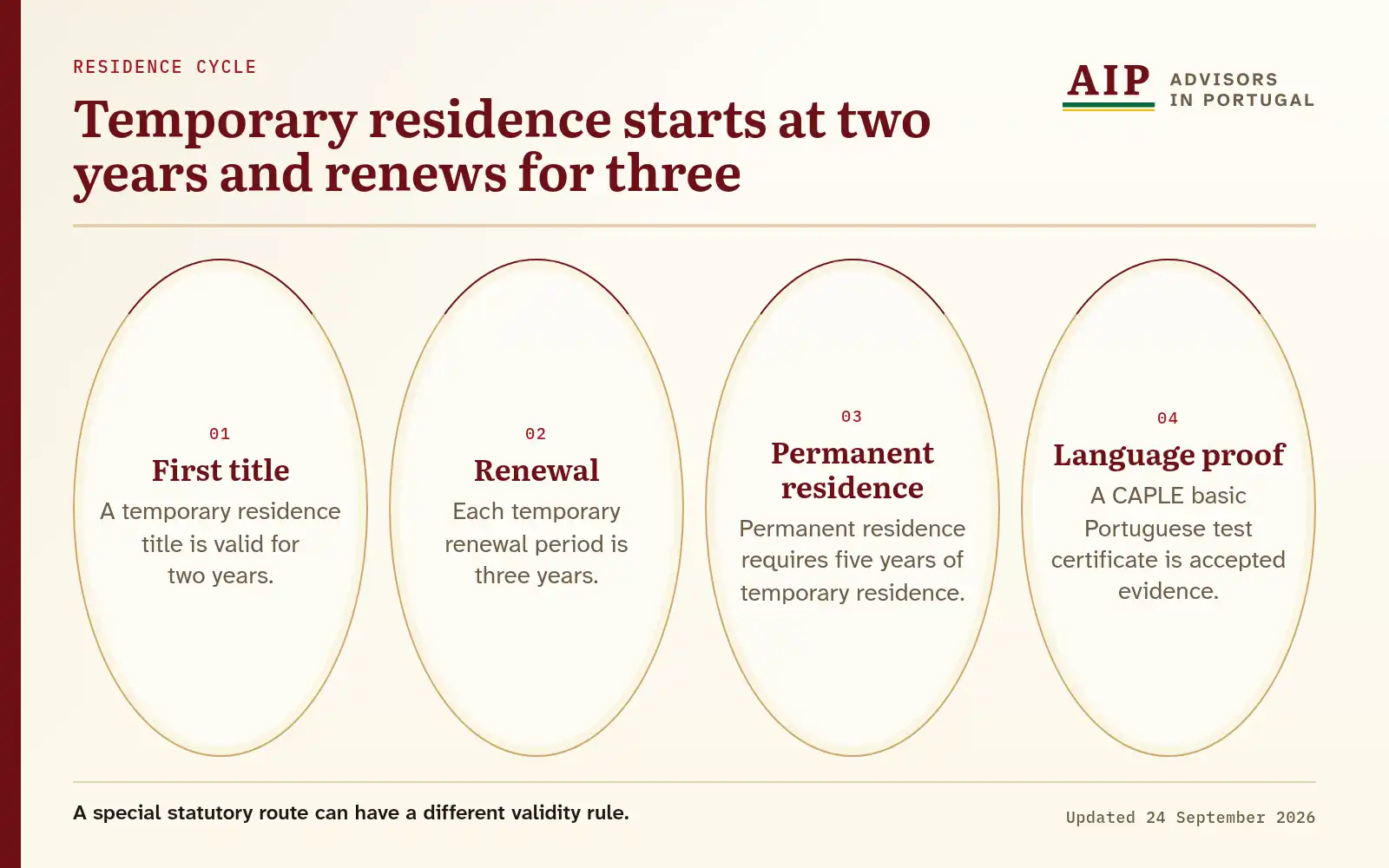
Diagram text version
A temporary residence title is valid for two years. Each temporary renewal period is three years. Permanent residence requires five years of temporary residence. A CAPLE basic Portuguese test certificate is accepted evidence.
Under Lei n.º 23/2007 Article 78, temporary residence holders file for renewal by 30 days before expiry and meet the listed conditions.
Which residence titles can be renewed?
Lei n.º 23/2007 Articles 74 to 76 distinguish temporary and permanent residence authorisations. Article 75(1) gives a temporary authorisation two years from issue and successive three-year renewals; Article 76(1)-(2) leaves the permanent right without a validity limit while requiring renewal of its title every five years. You should identify the status printed on the card before using a renewal rule.
A card’s expiry, its underlying authorisation and an application receipt are different records. You should keep each earlier title and renewal acknowledgement. Their dates can be compared with the authorisation category and the next action required. An identity change may call for a new title even where the underlying residence right continues.
A temporary-title holder must satisfy Article 78’s renewal conditions. A permanent-title holder renews the document under Article 76. The current card, identity document and any AIMA notice show the status actually granted, and that status decides which rule applies.
When must a temporary renewal be requested?
Lei n.º 23/2007 Article 78(1) requires the holder to request temporary residence renewal by 30 days before expiry. You should calculate the deadline from the authorisation’s printed expiry date and retain evidence of submission. The filing date is compared with Article 78 and any instruction in the notice.
The current Article 78 text, amended by Lei n.º 62/2026 of 10 September 2026, retains that 30-day filing rule. You should use the consolidated version for a current request. An older receipt or card may need to be read with a later amendment, so the dated document that controls the case should be preserved.
A request date and an authority decision date are separate. You should keep the appointment or submission record as evidence of when the request was made. That record answers a question about timeliness or the legal effect of the receipt while AIMA considers renewal.
Which conditions must the holder meet?
Lei n.º 23/2007 Article 78(2) conditions temporary renewal on means of subsistence, accommodation, tax and Social Security compliance, and the specified criminal-record test. You should gather documents for each condition for the period relevant to the renewal. Each document is compared with the exact paragraph that applies.
Article 78(2)(d) uses a prison-sentence threshold of one year and contains specific exceptions. You should provide the judgment and date where a conviction may be relevant. The entire paragraph, including its exceptions, is read against the full judgment and statutory wording.
The means condition uses a statutory ordinance for its definition. You should identify the actual source of your funds and housing arrangement in records AIMA can assess. The supporting documents map to Article 78’s listed conditions and show any change since the previous permit was granted.
Where and by whom is renewal requested?
Lei n.º 23/2007 Article 81-A(1) permits the interested person or a legal representative to submit a renewal request to AIMA, I. P. The applicant should identify who will sign and which authority to act supports a representative. The application form and any mandate are compared with the status and documents involved.
AIMA receives the renewal under the statutory provision. You should retain the submission acknowledgement and any later request for information. Each AIMA question relates to a condition in Article 78 or to an identity detail in the title. The filing record should show the applicant, permit and submission date clearly.
An applicant may use a representative, but the personal evidence remains tied to the holder. The passport, current card, address and compliance documents should be consistent across those records before the request is made, and the acknowledgement belongs with the complete file.
How long does AIMA have to decide?
Lei n.º 23/2007 Article 82(6) gives 60 days for a residence-renewal decision. You should record when the request was submitted and retain each AIMA communication. Those dates are compared with the statutory period and the status of the application.
A receipt for a renewal request has a separate effect under Article 78(7). You should keep the original and any later renewal of that receipt with the card. That document evidences the holder’s position during consideration of the request. The receipt period and the decision period serve different statutory purposes.
You should use the decision and any formal notice to establish the outcome of the application. The next procedural step follows from the actual AIMA record and the operative article.
When do identity changes require a new title?
Lei n.º 23/2007 Articles 75(4) and 76(2) require renewal of a temporary or permanent residence title whenever its recorded identifying information changes. You should compare the card’s name and identity details with your current passport or civil record. A document that explains the change supports the title update.
A permanent residence right has no validity limit under Article 76(1), but the physical title follows its five-year renewal cycle. You should preserve the old card and the change document when requesting the replacement. An update to the title differs from a fresh application for the underlying status.
The new card should reflect the holder’s actual current identity. You should keep the acknowledgement of the request and any AIMA correspondence. The issued record should be compared with the application so a discrepancy can be raised while the supporting documents are available.
How can absence affect renewal or status?
Lei n.º 23/2007 Article 85(2) permits cancellation of temporary residence for an unjustified absence of six consecutive or eight non-consecutive months during the title’s validity. For permanent residence, it sets a 24-consecutive-month or 30-non-consecutive-month threshold within three years. You should calculate travel periods from actual departure and return records under the status held at the time.
Article 85(3) provides a justification route before departure, or afterward in exceptional circumstances. You should retain the evidence explaining an extended period abroad and the timing of any notice to AIMA. Those facts are compared with the relevant paragraph and the explanation is built around the specific absence.
An absence analysis concerns cancellation as well as renewal planning. You should keep travel documents, work records and AIMA correspondence together. An unjustified threshold breach differs from a period covered by a statutory exception, and the correct temporary or permanent limit applies.
When can a holder seek permanent residence?
Lei n.º 23/2007 Article 80(1)(a) requires five years of temporary residence immediately before a permanent-residence application. Article 76(1)-(2) gives the permanent authorisation no validity limit but requires the residence title to be renewed every five years. You should order the temporary cards and renewal evidence by date before calculating the five years.
Article 80 contains other cumulative conditions to confirm against the current text before applying. You should prepare the corresponding records for the application actually sought. An ordinary temporary renewal differs from a move to permanent status, and the conditions and evidence for each stay separate.
A holder may continue to renew a temporary authorisation while planning a permanent application under the law. You should identify the present permit and the next expiry date. The residence history is compared with Article 80 and the current AIMA filing instructions to determine which request the documents support.
How should the renewal file handle fees and current law?
Lei n.º 23/2007 Article 81-A sends the renewal request to AIMA, while Article 78 states the conditions and 30-day filing rule. You should use the fee notice for the actual AIMA act when budgeting the public charge.
The consolidated Lei n.º 23/2007 lists Lei n.º 62/2026 of 10 September 2026 and shows Article 78 in its current form. You should retain the version and date used for your application. An older notice is compared with the current article, and the decision period is kept apart from appointment or issue dates.
The official charge is paid to the authority, and the payment receipt should be preserved. The amount is shown in the notice once AIMA issues it. The statutory source in this pack supports the deadline and conditions; the amount payable comes from the authority’s current tariff for the particular procedure.
Common questions
What happens when a temporary renewal is requested late?
Who receives a renewal request in Madeira?
How long does a renewal receipt remain effective?
Does silence after 60 days approve renewal?
What aggregate absence limit applies to permanent residence?
Can professional activity abroad qualify for an absence exception?
Related guides
The information on this page is checked against official sources and reviewed regularly. It is corrected when the law or official guidance changes, as the Editorial Standards describe.