Permanent Residency in Portugal: Five-Year Rule
Permanent residency in Portugal requires at least five years of temporary residence under Lei n.º 23/2007 Article 80. Any gap between cards or renewals can move the eligibility date, so applicants should trace their full permit history against AIMA's records before filing.

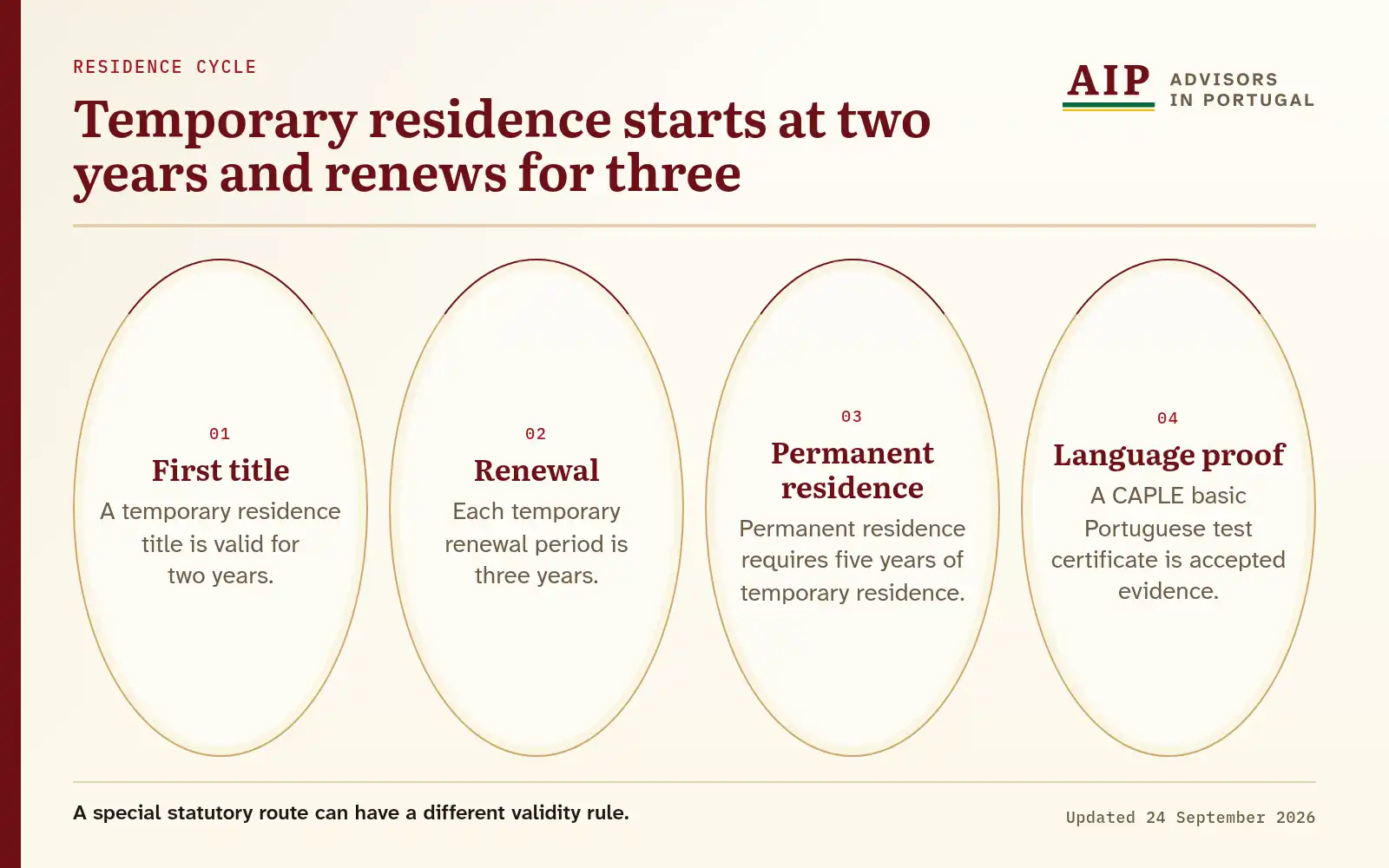
Diagram text version
A temporary residence title is valid for two years. Each temporary renewal period is three years. Permanent residence requires five years of temporary residence. A CAPLE basic Portuguese test certificate is accepted evidence.
Article 80 permanent-residence conditions, AIMA evidence, the application fee, card renewal and absence rules.
When can you apply for permanent residence?
Lei n.º 23/2007 Article 80(1) requires at least five years as a temporary-residence holder before permanent residence can be granted. The same article makes the other conditions cumulative. You should assemble the sequence of temporary permits and renewal records so the period can be traced. Each document can be compared with the dates recorded by AIMA.
The five years concern temporary residence under the statute. You should identify any gap between cards, a renewal request and the official status of that period before calculating eligibility. Article 80 separately requires accommodation, means of subsistence, compliance with tax and social-security duties, and basic Portuguese. The evidence can be organised under those legal headings.
You should state the residence history that actually occurred in the application. You should retain copies of earlier permits, renewal acknowledgments and AIMA notices. You should place the documents in date order so a missing period can be identified before the appointment. This sequence makes it possible to compare the permit history with the five years required by Article 80. The dates can then be set against the intended filing date, and each record can be matched to the Article 80 condition it supports.
How do you prove basic Portuguese?
Lei n.º 23/2007 Article 80 requires basic Portuguese knowledge. AIMA accepts recognised Portuguese school qualifications, an IEFP basic Portuguese course certificate, a recognised Portuguese course certificate, a CAPLE basic Portuguese test certificate. You should identify the route your document actually follows.
The issuer, course or test and the name on the certificate can be compared with AIMA’s accepted categories. You should preserve the original certificate and any record explaining an institutional name change. The statutory condition is about the applicant’s basic language knowledge, while the AIMA list describes ways to prove it.
A course enrollment and a completed certificate are different evidence. You should supply the completed qualification or test record that fits one accepted category. A foreign or older qualification can be checked against AIMA’s recognised school route before the appointment.
Which documents does AIMA ask for?
AIMA’s Article 80 guidance lists a valid passport or travel document, proof of means of subsistence, address evidence and proof of tax and social-security compliance. Its address route includes a declaration under honour and, where applicable, ownership or usufruct evidence. You should prepare records for the address and household described in the application.
You should compare your passport name, permit history and tax identification details before filing. A name change or discrepancy needs supporting documents. You should use means evidence that relates to your actual source of support. AIMA’s list is tied to the permanent-residence application, so you should show how each document meets its Article 80 condition in the file.
The signed AIMA form accompanies the application. You should retain a complete copy of the filed form and supporting documents. The residence, address and compliance evidence should be checked together, because inconsistent dates or addresses make it harder to see the five-year history clearly.
What criminal-record condition applies?
Lei n.º 23/2007 Article 80(1) requires the applicant to have no conviction during the previous five years for a prison sentence or combined sentences exceeding one year. The provision also addresses specified serious-crime and terrorism cases, including the stated circumstances where execution was suspended. You should identify the actual conviction and sentence documents before assessing this condition.
The date, offence, sentence and any suspension can be compared with the statutory wording, and the judgment shows where a conviction sits against the threshold. You should preserve the official criminal-record evidence and any judgment relevant to the analysis.
Article 80 places this condition alongside the five-year residence and other application requirements. You should keep the periods separate: one measures temporary residence and the other examines convictions in the previous five years. Each period rests on its own documents.
Where is the application filed and what is the fee?
AIMA says a permanent-residence application is filed in person by appointment at any Loja AIMA with the signed form. Its current fee table lists €351.10 for granting permanent residence in person, or €263.40 where the digital-channel reduction applies. You should identify the administrative charge separately from other case costs and check the fee table again before paying, because AIMA updates it.
AIMA may forward the case after instruction and decision to the services for the applicant’s residence area. You should use the appointment instructions in force for your case and keep the booking confirmation. The form and evidence should be reviewed before the in-person filing, and any AIMA request can be related to the condition it concerns.
The €351.10 in-person figure and €263.40 reduced digital figure are government grant fees in the AIMA table. You should budget the other case costs separately. You should retain the payment notice and receipt with the application copy. The exact AIMA notice shows whether a separate card or administrative act is being charged.
How long does permanent residence last?
AIMA says permanent residence has no limit of validity, while the residence card is issued for five years. You must renew the card every five years. You should distinguish renewal of the physical title from the underlying permanent-residence right when planning an update.
The card’s issue and expiry dates can be compared with the holder’s current identity details. You should preserve the earlier card and any renewal acknowledgment. You should keep documents that explain a name change alongside the card.
The permanent status remains subject to the legal cancellation provisions. You should keep residence and travel records because Article 85 sets absence thresholds for permanent residence. A period outside Portugal can raise an Article 85 question, and the card date is separate from the duration of the right.
How can absences affect permanent residence?
Lei n.º 23/2007 Article 85(2)(b) sets the permanent-residence thresholds at 24 consecutive months, or 30 interpolated months within three years. You should calculate each absence using travel dates and the status held during that period. The result can then be compared with the correct paragraph.
Article 85(3) supplies a procedure for justifying an absence. You should preserve evidence of the reason and dates where that route may apply. AIMA can assess the evidence against the statutory criteria. The explanation should be prepared with the underlying records before a cancellation issue is decided.
Article 85 separately includes public-order and other cancellation grounds. You should address the specific ground raised in an AIMA notice and retain the complete notice. The absence thresholds answer one part of the status question. Another stated ground falls under its own paragraph.
Does an ARI holder follow a different route?
AIMA says an ARI holder may receive permanent residence for investment after meeting the Article 80 conditions. The ARI framework has an absence-rule exception for the specified investment status. You should document the ARI title and the family relationship where relevant.
The permanent-residence request still needs the Article 80 evidence. The ARI history can be compared with the ordinary requirements for five-year residence, means, accommodation, tax and social-security compliance and basic Portuguese. You should keep investment-status evidence separate from the language and identity documents.
The status you actually hold determines which absence provision governs. You should state whether the current card is an ARI title, a family title or another temporary permit. That fact determines whether the special ARI exception is relevant to the cancellation analysis.
What changed in the current 2026 guidance?
AIMA’s permanent-residence FAQ is version 1.0 dated March 2026 and includes a question about scheduling a grant or renewal. The current consolidated Lei n.º 23/2007 lists Lei n.º 62/2026 of 10 September among its amendments. You should use the current AIMA appointment instruction for your application and the current statutory text for the legal conditions. You should keep a copy of both documents with the submission record so the version used in the case is clear. You should record when AIMA provided an instruction that differs from an earlier appointment notice.
The FAQ’s date identifies the guidance version. Article 80 remains the basis for the five-year threshold. An earlier booking or AIMA message can be compared with the current guidance before the next step. You should keep copies of the notices that control your actual case.
You or your legal representative must sign the AIMA form before submission. You should identify who will sign and attend under the appointment instructions. The supporting evidence and the authority to act should be reviewed together before submission.
Common questions
Can an A2 Portuguese as a Host Language certificate prove language knowledge?
May a legal representative sign the AIMA form?
When must a permanent card be updated before five years?
What is the rule for interrupted absences under a permanent card?
What address evidence may a tenant need?
Do ARI family members have a permanent-residence route?
Related guides
The information on this page is checked against official sources and reviewed regularly. It is corrected when the law or official guidance changes, as the Editorial Standards describe.