Portuguese Citizenship by Descent: Parent and Grandparent Routes
Portuguese citizenship by descent is open to a child born abroad to a Portuguese parent and to a grandchild whose originally Portuguese grandparent never lost that nationality. Birth certificates must link each generation, and grandchildren must prove Portuguese knowledge and pass statutory exclusion checks.

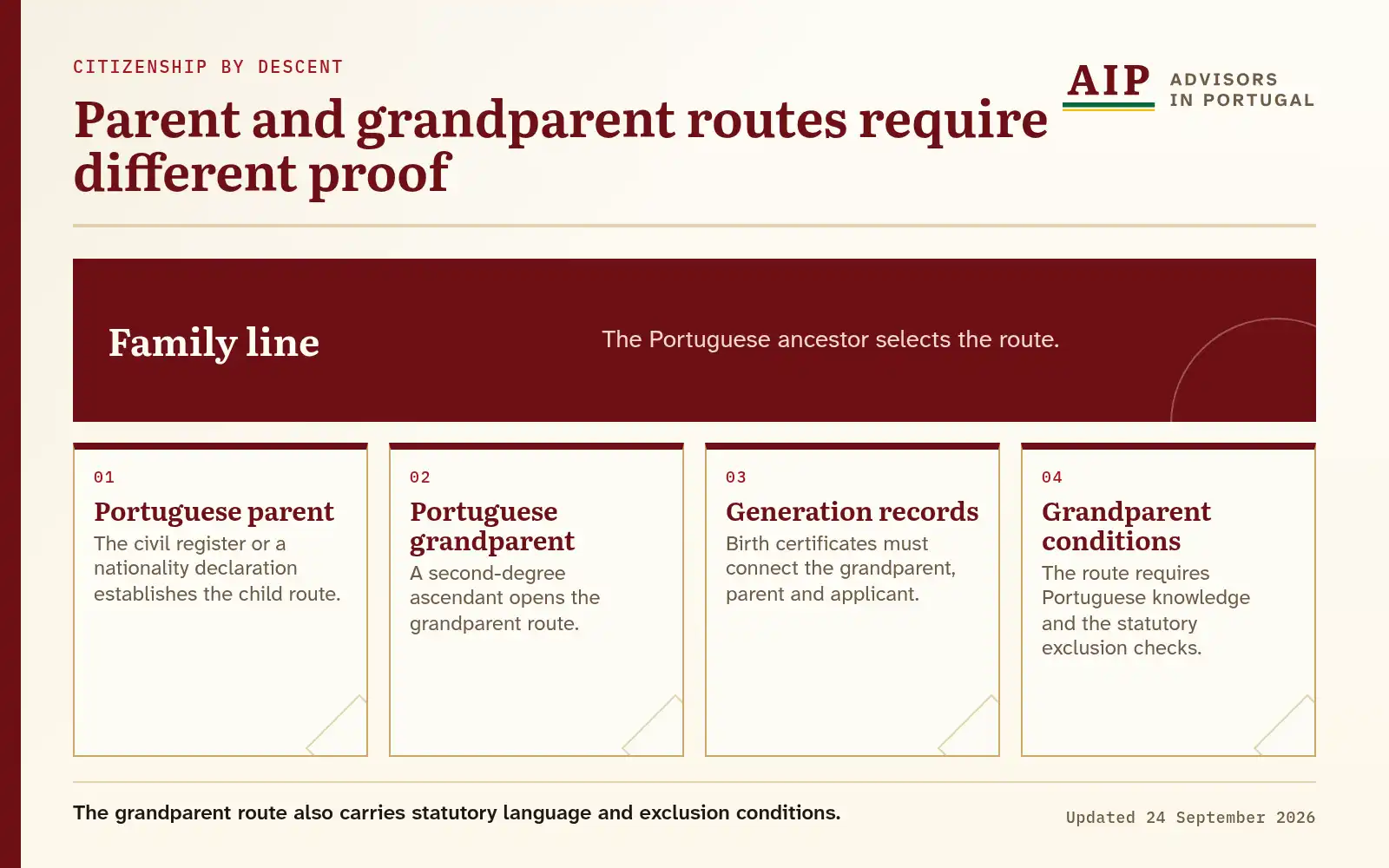
Diagram text version
The civil register or a nationality declaration establishes the child route. A second-degree ascendant opens the grandparent route. Birth certificates must connect the grandparent, parent and applicant. The grandparent route requires Portuguese knowledge and the statutory exclusion checks.
Portuguese nationality by descent runs through two routes in Article 1(1) of Lei n.º 37/81. Paragraph (c) covers a child born abroad to a Portuguese parent. Paragraph (d) covers a grandchild of an originally Portuguese grandparent. Each route rests on a documented chain of civil records from the Portuguese ancestor to the applicant.
How does the parent route work?
Article 1(1)(c) of Lei n.º 37/81 applies to a child born abroad to a Portuguese mother or father. The child’s birth is entered in the Portuguese civil register, or the child declares the wish to be Portuguese. The Portuguese parent’s status and the available registration path are the first facts to establish.
The sequence of steps depends on the parent’s civil-register position and the applicant’s own record. The open questions are whether the Portuguese parent’s record is available and how the applicant’s birth can be entered or linked to it.
What conditions apply to a Portuguese grandchild?
Article 1(1)(d) of Lei n.º 37/81 applies to a grandchild of a Portuguese grandparent. The route tests original Portuguese nationality in the second degree, the declaration and the current effective-link conditions. The grandparent must not have lost that nationality.
Article 1(3) applies the conditions of Article 6(1)(c)-(h) to this route. They include sufficient knowledge of the Portuguese language, culture, history and national symbols, and the listed exclusions for convictions and security grounds. Records of Portuguese knowledge and background are relevant to the statutory effective-link test.
Documents the authority asks for
Article 10-A(3)(b) of the Regulamento da Nacionalidade Portuguesa identifies the birth records of the grandparent and of the intervening parent on the grandparent route. A family tree does not replace those certificates. The applicant’s own birth record completes the chain between the Portuguese grandparent and the applicant.
The chain therefore holds three documents for the grandparent route:
- The Portuguese grandparent’s birth certificate.
- The intervening parent’s birth certificate.
- The applicant’s own birth record, with the parents recorded as the issuing authority shows them.
On the parent route, the chain starts with the Portuguese parent’s birth details and available Portuguese civil-register reference.
How are foreign certificates handled?
Foreign civil-registry certificates generally need legalisation or translation under the Regulamento, subject to conventions and special laws. The issuing country, the language and any existing legalisation or translation are the facts to record for each certificate.
How do records across generations reconcile?
Marriage, name-change, adoption and correction records explain differences in names, dates or identities between generations.
Reconcile changes of name and civil status
The applicant keeps each official change-of-name, marriage or correction record between the ancestor’s birth entry and the applicant’s own certificate. Placing those events in chronological order lets a registry officer follow the documented relationship.
Check the intervening parent’s record first
The parent named on the applicant’s birth record needs to match the parent named in the Portuguese grandparent’s family line. The applicant obtains a corrected or missing civil entry before relying on a certificate chain that contains a gap.
Order the certificates in the family chain
The Portuguese ancestor’s record sits beside each intervening birth entry and the applicant’s own certificate. Parentage traces from one generation to the next, and a missing link needs resolving before the request is assembled.
How does a descent application proceed?
The steps run in this order:
- The Portuguese ancestor’s nationality status and each generation in the family line are identified.
- The parent or grandparent ground is selected by applying the current Article 1 conditions to the documented family relationship.
- Names, dates and intervening events are compared across the birth and civil-status certificates.
- The legalisation or translation each certificate needs for the issuing state and route is identified.
- The birth-registration or nationality request is prepared for the Instituto dos Registos e do Notariado (IRN) and sent through the competent registry channel.
The Justiça nationality service lists the filing channels and the cost of each route. It also provides a postal application.
What does a descent application cost?
No single government fee applies to every descent claim. The Justiça nationality service ties the cost to the application type and the current registry-fee regulation. The official charge depends on whether the request is for the parent route or the grandparent route.
How long does a descent application take?
No fixed duration applies. The time depends on the ancestor record, the intervening certificates and the nationality ground those documents establish.
A descent file takes longer in three situations:
- A birth entry is missing and has to be obtained.
- Identities differ between generations and need reconciling.
- A new certificate has to be requested from a foreign authority.
The records already held for the applicant, the parent and the grandparent, together with the details needed to locate missing entries, are the starting point.
Common questions
Can I claim through a Portuguese parent if I was born abroad?
What conditions apply to a Portuguese grandchild?
Is a family tree enough to prove the grandparent route?
Does a grandchild need Portuguese knowledge?
Must my Portuguese parent's birth record already be available?
What if names differ between generations?
Do foreign certificates need legalisation?
Is there one government fee for every descent claim?
The information on this page is checked against official sources and reviewed regularly. It is corrected when the law or official guidance changes, as the Editorial Standards describe.