Doing Business in Portugal: Accounting, Tax and Filings
Doing business in Portugal through a company brings accounting, corporate tax and beneficial-owner obligations. The company must declare its activity before trading and its beneficial owner in the RCBE, and its first tax, registry and accounting filings should be aligned.

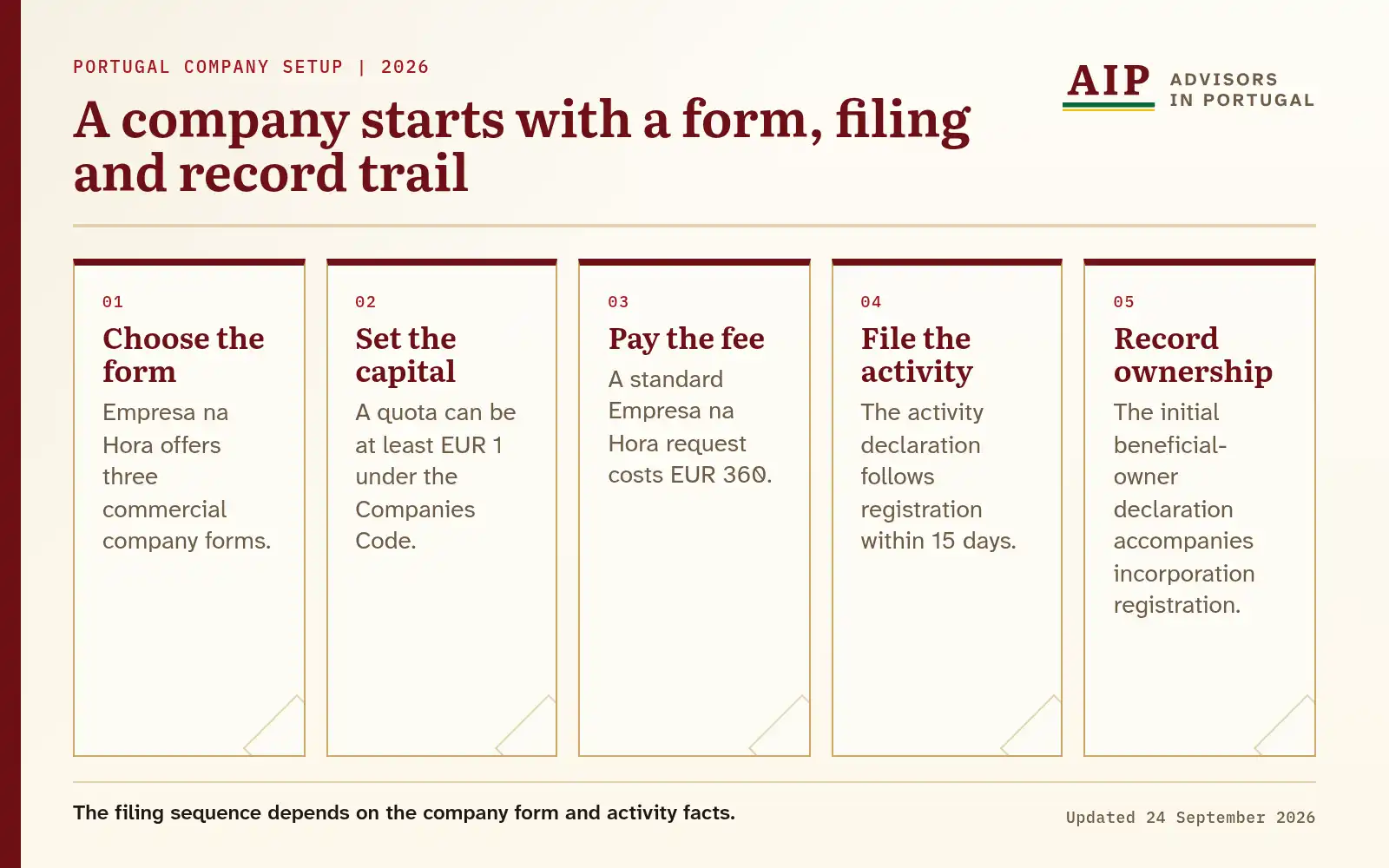
Diagram text version
Choose the form. Set the capital. Pay the standard fee. File the activity declaration. Record the beneficial owner.
The statutory category, the relevant dates and the supporting records determine each step. This guide covers Portuguese company forms, capital, formation routes, registration duties and the 2026 corporate tax rate.
Which company forms can you establish?
The Empresa na Hora service supports a sociedade unipessoal por quotas, a sociedade por quotas and a sociedade anónima. Those are the three forms in the Justiça service description. The founders first identify who will own the business and which form reflects the intended ownership. The proposed shareholders and management structure are then compared with the company contract before the incorporation documents are signed.
A single-member quota company records one quota holder. A quota company can have more than one holder, while an SA uses share capital. The service’s list establishes availability through Empresa na Hora; it does not settle which form best fits a particular ownership plan. The founders’ identities, ownership split and intended activity let the company contract identify the right parties and object.
The company needs a consistent form across the incorporation request, tax declaration and beneficial-owner record, and the records can be compared before filing. A difference in the shareholders’ names or proportions becomes harder to explain once separate authorities hold different versions of the facts.
How much share capital is required?
Código das Sociedades Comerciais Article 201 lets the shareholders set the capital of a sociedade por quotas in its contract. Article 219(3) requires a nominal value of at least €1 for each quota. Article 276(5) requires at least €50,000 of capital for a sociedade anónima. The ownership table distinguishes the company’s total capital from the nominal amount of each holding.
The capital figure and the allocation of quotas or shares go into the company contract. Initial funding is a separate business decision, and the incorporation papers record the capital actually chosen.
The SA minimum has a different legal basis from the quota-company rule. The founders check whether the proposed form accommodates their chosen contributions and decision rights. The capital clause should be read together with the shareholder identification and management clauses, because an inconsistency among them can affect the filing.
Where can you form the company?
Justiça describes Empresa na Hora as a one-counter formation route for the supported company forms. The incorporation papers identify the future registered seat. The founders decide who will attend and what authority each attendee holds before booking the formation step.
Justiça offers Empresa Online as a separate route. Every shareholder must have a Portuguese NIF for that online service. The service sets separate authentication conditions for foreign citizens. The founders’ documents are compared with the requirements of the chosen route.
The physical and online routes are different filing procedures. The company keeps its form, shareholder identities, capital and corporate purpose consistent across the chosen channel. Any electronically generated contract is checked against the founders’ agreed terms before the final submission.
What does formation cost?
The Justiça Empresa na Hora fee table sets €360 for a standard request. It lists €200 for a request with an associated trademark covering one class. These are official request charges for the specified route and do not cover every possible formation expense. The founders state whether they want a trademark in the initial request before comparing fee lines.
The €200 figure belongs to the service’s trademark-associated request, which has its own conditions. It is a different request from the ordinary €360 entry. The fee receipt belongs with the incorporation documents, because it helps reconcile the exact service requested with the registry result.
Those duties have separate legal bases. The duties that follow registration depend on the actual company form and activity, and an incorporation counter fee is not a complete operating budget.
Which founder identification is needed?
The Justiça Empresa Online requirements call for a Portuguese NIF for every shareholder. The same service describes passport-linked Chave Móvel Digital and eIDAS authentication for foreign citizens. Each founder’s exact name and NIF are needed before the online filing starts, because an authentication method does not replace the shareholder’s tax identifier.
The names in the founders’ identification are compared with the company contract, the beneficial-owner data and the identification used for online authentication. Inconsistent spellings or identifiers can delay a record even when the parties agree on the business plan.
The online requirement belongs to Empresa Online. The Empresa na Hora page describes its own attendance route. The route is decided before the signature set is prepared, so the documents correspond to the channel used.
When must activity be declared?
The Autoridade Tributária e Aduaneira explains under Código do IVA Article 31 and CIRC Article 118(1) that a company subject to commercial registration files its activity-start declaration within 15 days after presenting the registration request and always before activity begins. Both limits apply. The registration-request date and the intended trading date are the two inputs for the deadline.
The 15-day count begins with presentation of the commercial-registration request. The filing follows the company’s actual activity and tax classifications. Proof of the registration submission belongs alongside the activity declaration, so the filing order and dates can be checked.
A company can incur obligations soon after incorporation even before it invoices a customer. Código do IRC Article 123 concerns organised accounting. The person who will prepare the accounting record is identified before the first transaction.
How is company accounting organised?
Código do IRC Article 123 requires organised accounting for covered IRC taxpayers. The Estatuto da Ordem dos Contabilistas Certificados Article 20 governs the professional duties of certain accounting-service companies. The statute places professional duties on the certified accountant who prepares and signs statements and returns.
The company’s obligation to keep accounts is separate from the rule governing an outside accounting-services company. Bookkeeping and return work need the incorporation documents, activity details and transaction records before returns are prepared.
The professional rule depends on the accounting provider’s legal classification. The company checks the provider and signatory that will handle its records, then keeps its commercial and tax documentation in a consistent file. Not every entity or provider has identical requirements.
What corporate tax rate applies in 2026?
Código do IRC Article 87 and the transition under Lei n.º 64/2025 set the ordinary IRC rate at 19% for tax periods beginning in 2026. Qualifying SMEs and Small Mid Caps apply 15% to the first €50,000 of taxable income, with the ordinary rate on the excess. The tax period and the qualification are identified before either percentage is applied to a forecast.
The taxable-income threshold is not a turnover threshold. A 15% first band applies only where the company qualifies under the rule. The classification evidence belongs with the tax computation.
The transitional law sets different rates for later tax periods. A current return and a multi-year forecast therefore use different rates where a business plan spans several tax periods.
When is the beneficial owner declared?
Lei n.º 89/2017 Article 12(1) ties the initial Registo Central do Beneficiário Efetivo declaration to the company’s incorporation registration. The Justiça Empresa Online service says the declaration is made with incorporation; the company must complete the information when the online formation service does not collect it. The natural persons behind the ownership structure are identified before filing.
The RCBE record concerns beneficial ownership, which may require more analysis than simply copying the list of legal shareholders. The ownership chain is compared with the incorporation papers to identify the people whose information is required. The documents used for that decision are preserved so later changes can be traced.
The filing confirmation and the incorporation record show whether the formation channel collected the information. Any missing declaration is completed within the official period.
How should the first filings be aligned?
The 15-day activity-start period under CIRC Article 118(1), the incorporation-linked RCBE declaration under Lei n.º 89/2017 Article 12 and the 2026 IRC rate under Article 87 affect different parts of the same new-company file. The incorporation-request date, the intended activity date, the beneficial-owner information and the chosen tax period are best recorded together.
The company contract and registration evidence form the corporate record, and the tax activity and accounting work form the tax record. The same ownership and activity facts feed both. Otherwise the company may create mismatched corporate and tax records at the first filing stage.
The company form and capital choices come first. The filings then depend on the actual registration event and commencement of activity. The documents are reviewed in that order, with each statutory deadline tied to its own trigger.
Common questions
Can a foreign citizen authenticate for online formation?
Can any founder use an Empresa na Hora desk?
What if online formation does not collect beneficial-owner data?
Does the €200 trademark request include more than one class?
Who may sign the accounting company’s technical work?
Will the 2026 ordinary IRC rate stay at 19%?
The information on this page is checked against official sources and reviewed regularly. It is corrected when the law or official guidance changes, as the Editorial Standards describe.