Company Liquidation in Portugal: Steps and Deadlines
Company liquidation in Portugal follows dissolution, and Código das Sociedades Comerciais Article 150 gives the company two years to close liquidation and approve partition. Dissolution and liquidation registration must be requested from the IRN within two months of the shareholder resolution.

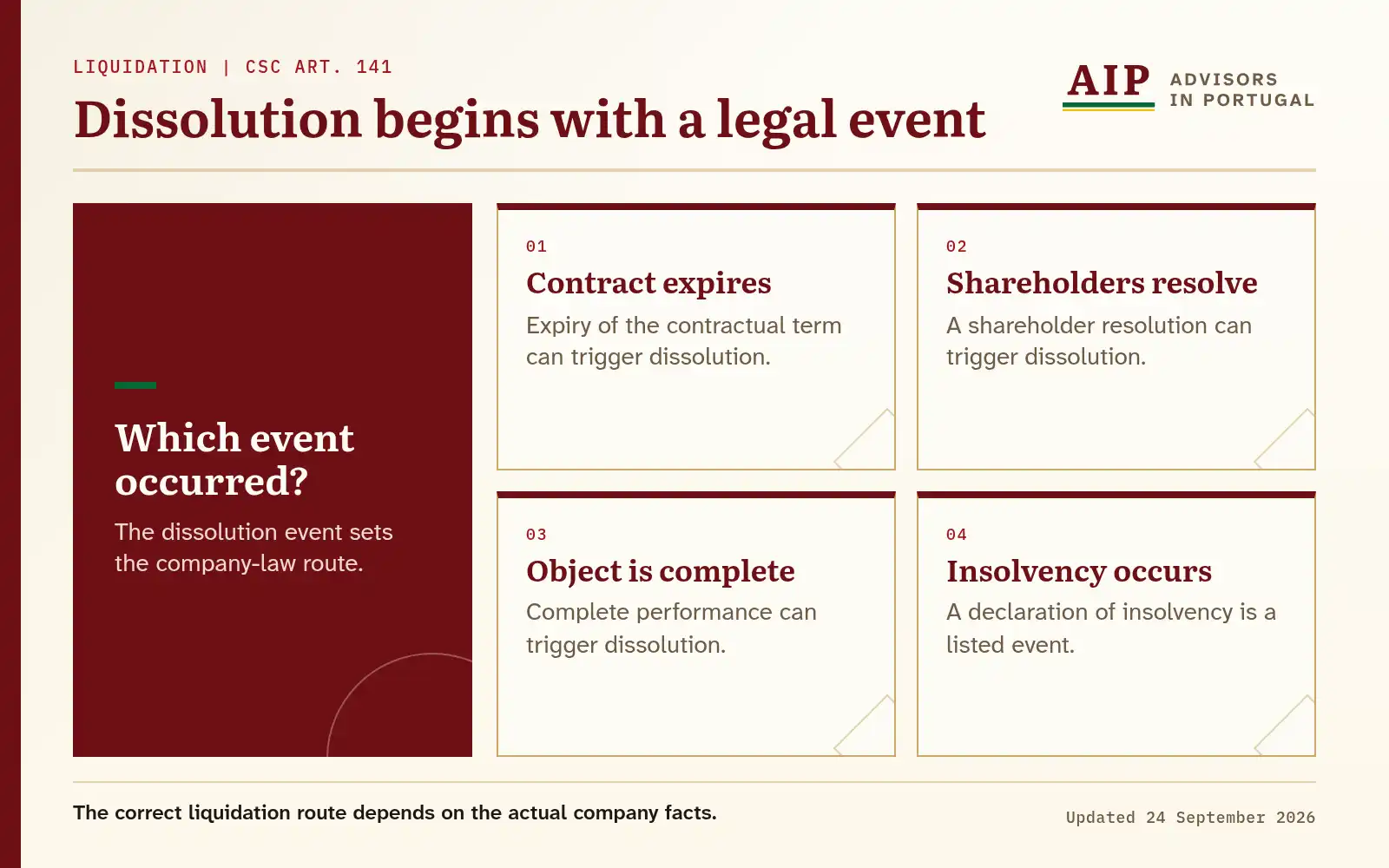
Diagram text version
The term can expire. Shareholders can resolve. The object can be complete. Insolvency can be declared.
Código das Sociedades Comerciais Article 146 sends a dissolved company into liquidation while it retains legal personality. Its directors normally become liquidators under Article 151, and Article 150 sets a two-year period to close the work and approve partition. You should identify the dissolution ground, outstanding liabilities and company records before asking the commercial registry to record a closing.
What Causes a Portuguese Company to Dissolve?
Código das Sociedades Comerciais Article 141 lists the grounds: the company contract may provide one, and the statute includes expiry of the contractual term, a shareholder decision, complete performance of the corporate object, supervening illegality of that object and insolvency. The articles of association and the event the shareholders say has occurred are the starting point. The dissolution ground controls the resolution and supporting documents that follow.
Article 141(2) lets shareholders recognise dissolution by a simple majority of votes cast for expiry, completed object or supervening illegality. Article 142(3) gives an absolute majority of votes expressed for the separate Article 142 causes. You should distinguish those statutory routes in the meeting papers. The company contract may change an available choice, and an insolvency issue may require a different procedure.
IRN accepts the approving decision in meeting minutes, a private document or a public deed for the registration route it describes. You should keep the chosen instrument with the notice, attendance and voting records so the commercial-registry application can identify what shareholders actually approved. The date of the decision matters for the filing period and for the later liquidation accounts. Any earlier decision that the company has already treated as effective belongs in the same file.
Who Approves Dissolution and Appoints the Liquidator?
Código das Sociedades Comerciais Article 151(1) makes the directors liquidators when dissolution takes effect unless the company contract or a contrary shareholder resolution provides otherwise. You should name the persons who may act in the company records and record any change before they sign accounts, creditor correspondence or registry forms.
The Article 141(2) simple-majority route and Article 142(3) absolute-majority route apply to different causes. The precise ground determines which vote applies. The registry file needs the decision establishing dissolution; it should not rely on a general statement that the company has ceased trading. You should preserve the minutes or other instrument and any appointment decision together, so the signatory’s authority can be read from the same record chain.
Article 145(2) places the dissolution-registration duty on the administration or liquidators. The IRN service lists managers, shareholders, administrators, legal professionals and attorneys among eligible applicants. An eligible applicant still needs documents that show the approved act. The corporate decision, the current registered officers and the applicant’s authority should match before the application is submitted.
When Must You Register the Dissolution?
The Instituto dos Registos e do Notariado says you must request dissolution and liquidation registration within two months after the shareholder resolution. Código das Sociedades Comerciais Article 145 addresses who has the duty to promote the registration. You should calculate the filing date from the resolution, retain the signed decision and identify the registration acts requested. A late filing can add to the official cost shown by IRN.
The competent commercial-registry service receives the act. IRN offers an online application, an in-person Registos counter and a postal route. The available route depends on who signs and which documents show the company’s decision. The application may combine dissolution and closing when the facts support both acts; a dissolution filing alone should not be treated as proof that liquidation is complete.
You should compare the registration acknowledgment with the shareholder resolution after filing. A corrected name, date or liquidator appointment may affect the subsequent accounts and closure record. The two-month period concerns the request following the decision; it is separate from Article 150’s period for completing liquidation. The company’s corporate file should keep those dates distinct.
What Happens Between Dissolution and Extinction?
Código das Sociedades Comerciais Article 146(1) sends a dissolved company immediately into liquidation, subject to the statutory exceptions, and Article 146(2) preserves its legal personality during that period. The company uses “sociedade em liquidação” or “em liquidação” with its name. You should treat contracts, receivables, creditors and accounts as company matters until the closing act is registered. Pending obligations need performance before any distribution.
Article 147 permits immediate partition when no debts exist at dissolution, subject to its tax-debt rule. That is a specific condition, not a general shortcut for a small company. You should gather creditor statements, tax records and the asset list before asking whether partition can be approved at the same time as dissolution. A contingent or disputed claim can require protection even if ordinary invoices appear settled.
IRN separately lists combined dissolution and liquidation registration and immediate-extinction registration. Its service instructions call for an application for immediate extinction but do not give a complete eligibility test for every company. The choice of that act depends on the actual closure facts, including which documents support ordinary liquidation and whether a faster statutory route is available.
What Must the Liquidator Do for Creditors and Accounts?
Código das Sociedades Comerciais Article 149 requires accounts prepared and approved as at the dissolution date before liquidation begins. The administration has 60 days after dissolution to do that work; the duty passes to the liquidators if it does not. You should give the liquidator the last approved accounts, ledger, creditor list, contracts and bank records. Your accountant can reconcile the dissolution-date position with transactions still awaiting collection or payment.
Article 152 requires liquidators to finish pending business, fulfil obligations, collect receivables, convert remaining assets to cash unless partition in kind is permitted, and propose partition. A shareholder decision is needed for certain exceptional acts, including borrowing for liquidation. You should distinguish a collection needed to settle a debt from a new commercial commitment. The company records should show who has authority to sign a proposed asset sale or transfer.
Article 154 requires liquidators to pay company debts where assets suffice and safeguard disputed creditor rights. Article 155 requires annual liquidation accounts and a detailed report within the first three months of each calendar year. You should retain invoices, settlement evidence and any security documentation beside those accounts. A final distribution should be considered against the creditor position shown by the records, not only the cash in the bank on one date.
How Long May Liquidation Continue?
Código das Sociedades Comerciais Article 150(1) requires liquidation to close and partition to be approved within two years from the date the company is considered dissolved, unless the contract or shareholders set a shorter period. Article 150(2) permits shareholders to extend that period by resolution for no more than one year. You should record the operative dissolution date and any shorter company deadline before planning asset sales or creditor settlements.
Article 150(3) provides for the competent registry service to initiate administrative liquidation when the applicable period expires without a request for closing registration. That trigger concerns the closing request, not simply whether the liquidator has prepared internal accounts. The final-account vote, the partition decision and the filing acknowledgment should be compared against the deadline. A shareholder extension should be resolved before the original period expires.
You should keep the company contract and the dissolution resolution beside the calendar. Those instruments can set the start and duration of the liquidation period. Your accountant can identify accounts that will be needed for each calendar year in which liquidation remains open. The statutory two-year outer period does not replace the separate 60-day preparation duty under Article 149 or the annual reporting duty under Article 155.
Which Records Prove the Company Has Closed?
Código das Sociedades Comerciais Article 157 requires the final liquidation report to say expressly that creditor rights have been satisfied or safeguarded and that receipts and supporting evidence can be examined by shareholders. Final accounts show the liquidation operations and partition map. You should retain the debt settlements, security documents and asset-distribution calculations that support those statements. The proposed final report should be compared with any unresolved claim before shareholders approve it.
The shareholders approve the final accounts and appoint a depositary for the books and accounting records under Article 157. You should identify who will actually hold the paper and electronic records after the company is extinguished.
Article 160 links extinction to registration of the closing of liquidation. You should obtain the registration record and keep it with the approved accounts, report and partition decision. IRN says the registry service communicates the registered dissolution and liquidation acts automatically to the Autoridade Tributária and Segurança Social. Your company still has follow-up work with tax activity, contracts, licences, banks, clients and suppliers after registration.
How Do You File and What Are the Registry Fees?
The IRN service lists EUR 170 online and EUR 200 in person for dissolution, and EUR 244.38 online or EUR 287.50 in person for dissolution with liquidator appointment. It lists EUR 170 online or EUR 200 in person for closing liquidation, and EUR 255 online or EUR 300 in person for combined dissolution and closing. Immediate extinction is listed at EUR 255 online or EUR 300 in person. You should choose the actual registry act before estimating the official fee.
IRN says urgent requests and requests more than two months after the shareholder resolution add costs. An online applicant pays the Multibanco reference within five consecutive days of submission. You should retain the payment evidence with the application acknowledgment. The application acknowledgment shows which act was charged and whether a separate liquidator appointment is part of the filing, since a combined price should not be assumed for every document set.
IRN permits online, counter and postal applications. The online route accepts several authentication methods; a person filing in person uses the relevant Registos counter. You should bring the signed social decision and any appointment document in the form required by the chosen route. The registry fee is an official charge; accounting work depends on the actual company and creditor file.
When Must Tax Activity End?
IRN says the company must communicate cessation of activity to the Autoridade Tributária within three months of registration of the closing of liquidation. The registry service’s automatic communication of the registration is a separate step. You should retain evidence of the tax communication and compare it with the final accounts and registered closing date. Your accountant can address any tax return or payment that remains due after the corporate decision.
IRN lists further follow-up: update the Registo Central do Beneficiário Efetivo, end contracts and internal documents, notify banks and other entities, cancel licences and authorisations, and notify clients and suppliers. You should identify which items apply to the company before disposing of records or closing access. A supplier agreement, employee matter or regulated licence can need action even when the registry shows the liquidation closing.
You should not assume that a universal clearance certificate exists for every tax, social-security and beneficial-owner question. The corporate code and IRN service identify duties and records, while the documents needed depend on the company’s actual liabilities and filings. The registry record should be compared with the tax, employment and contractual position before the closure work is treated as complete.
Common questions
Can a shareholder request registration when the directors do not?
Can shareholders replace the liquidator?
May a liquidator continue the old business?
What happens to a disputed creditor claim?
Which digital credentials can an online applicant use?
How long must the company books be kept after closure?
Related guides
The information on this page is checked against official sources and reviewed regularly. It is corrected when the law or official guidance changes, as the Editorial Standards describe.