Starting a Business in Portugal: Forms and Fees
Starting a business in Portugal carries a Justiça fee of €360 for a normal Empresa na Hora request, or €220 through Empresa Online with a pre-approved pact. The company must file its activity declaration before trading and within 15 days of presenting commercial registration.

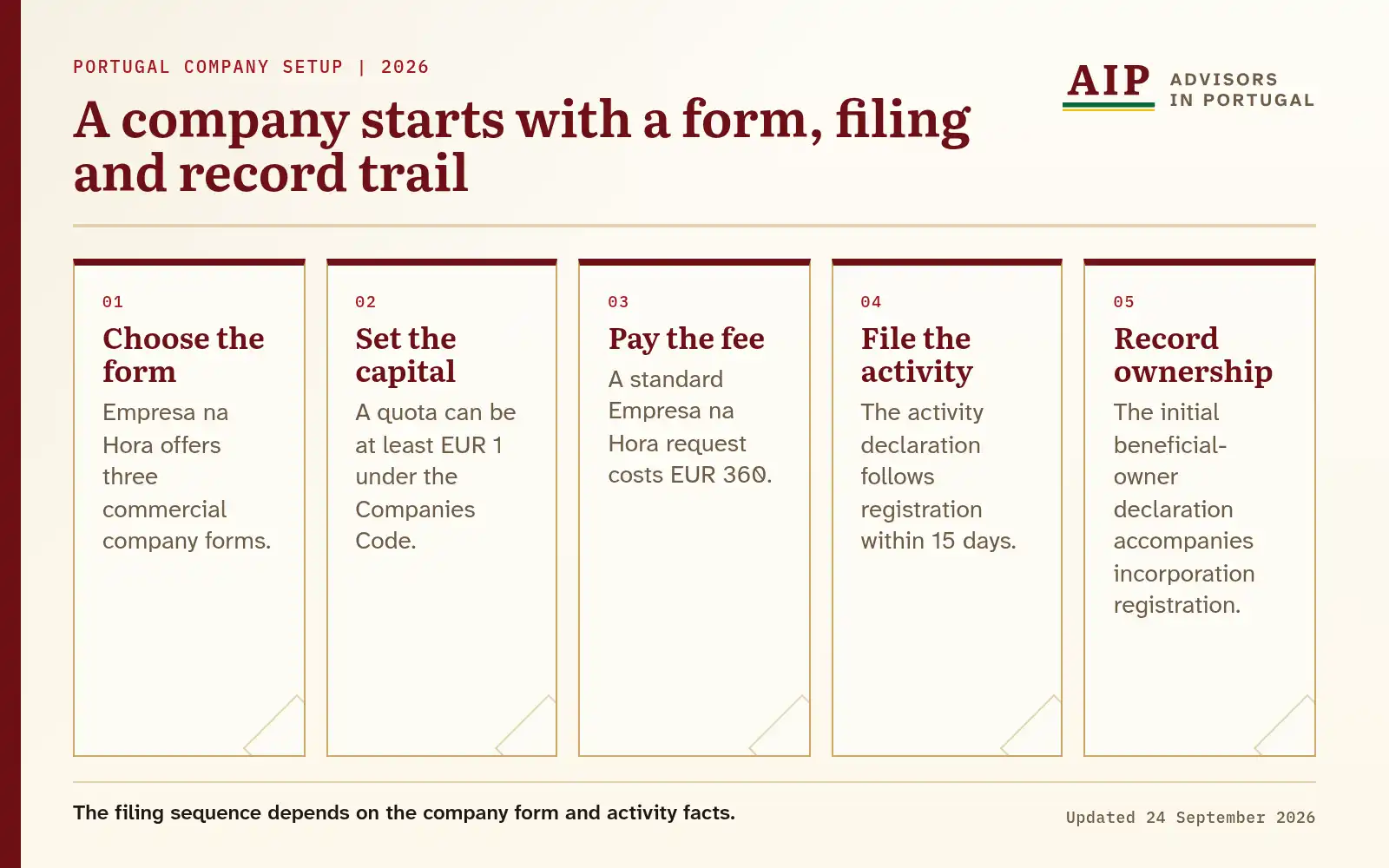
Diagram text version
Choose the form. Set the capital. Pay the standard fee. File the activity declaration. Record the beneficial owner.
Justiça lists a €360 normal Empresa na Hora request, while Código do IRC Article 118(1) sets the company’s first tax-activity deadline.
Which company form can a founder choose?
Justiça’s Empresa na Hora service supports a sociedade unipessoal por quotas, sociedade por quotas and sociedade anónima. The founders settle how many shareholders there will be, the proposed activity and the governance needs before selecting a form. The chosen form has to match the contract and registration route the founders intend to use.
A single-member quota company records one quota holder, while the other forms follow their own shareholder and capital rules. The founders supply their identity documents and intended ownership shares. The registered form and the practical decision making need to fit the business.
The official formation counter supports the listed forms, but the selected form also affects capital, management and later filings. The founders decide who will manage the business and sign at formation. Those decisions need to agree with the constitutive documents before the registration request is made.
How much share capital is required?
Código das Sociedades Comerciais Article 201 lets founders of a sociedade por quotas set capital in the company contract; Article 219(3) requires each quota to have a nominal value of at least €1. Article 276(5) sets €50,000 as the minimum capital for a sociedade anónima. The founders choose the form and allocate the capital among themselves before the company contract is prepared.
Nominal capital and operating cash answer different questions. The founders identify the amount they will contribute and the expenses the business will face after registration. The constitutive act records the chosen capital, and each quota or share has to meet the statutory minimum.
A change in founders or contribution amounts before signing can change the contract. The final ownership schedule and planned payment evidence need to agree with Articles 201, 219 or 276 for the chosen form. The formation papers should state the capital actually agreed by the founders.
Who may use Empresa na Hora?
Justiça allows a person or collective entity to form a supported company through Empresa na Hora when all future shareholders attend the counter. Each founder and any authority for a collective entity need to be identified before the appointment is chosen. The attendees have to match the proposed ownership in the company contract.
The service uses pre-approved company-name options or an approved certificate of admissibility for a chosen name. The founders decide which route fits the intended identity of the business. The name, seat and object in the constitutive papers have to agree with the accepted naming basis.
The founders bring their identity documents and the company details required for the selected counter route. Identification, tax numbers and signature authority have to agree with the registration papers. A counter request should reflect the entity that will own the shares and the place where the company will be registered.
What does Empresa na Hora cost?
Justiça’s Empresa na Hora fee table lists €360 for a normal request. The formation budget keeps the official charge separate from any accountant or trademark costs. The payment notice has to match the registration act and the founders.
The service page lists a separate charge for a request associated with a trademark. The founders decide whether a company name alone meets the business need or whether the trademark option is relevant. The chosen name and activity have to agree with the documents submitted at the counter.
The counter fee covers the official request described in the schedule. The founders retain the receipt and company registration details after formation. The first tax and beneficial-owner filings follow their own rules. A formation budget should distinguish the public fee from the resources needed to operate the company.
What does Empresa Online require and cost?
Justiça’s Empresa Online service lists €220 for a normal request using a pre-approved pact and €360 for a normal request with a founder-drafted pact. All shareholders need accepted authentication and active digital signatures. Each founder’s access needs to be confirmed before the online file is prepared.
The online route asks the founders to supply company details and approve the constitutive documents digitally. The founders agree the company name, form, registered office, capital and activity before anyone signs. The submitted pact has to agree with those decisions and the selected fee category.
The service publishes its own submission and payment instructions. The founders keep the online acknowledgement and payment record together. A failed signature or an inconsistent shareholder detail can prevent completion. The completed registration is the starting point for beneficial-owner and tax filings, not the end of the company’s first compliance steps.
When is a name-admissibility certificate needed?
Justiça’s certificate-of-admissibility service lists €75 for a normal certificate and gives it three months of validity for completing incorporation registration. A founder obtains one when the intended name or the constitutive details require a certificate and the founders are not using a pre-approved name. The approved name has to agree with the final company act.
A certificate may need attention where the applicant, name, registered office or object in the constitutive document differs from a certificate already issued. The applicant supplies the earlier certificate and draft company terms before filing. A discrepancy can make a fresh request necessary.
The three-month period concerns use of the approved certificate for registration. The founders record the issue date and planned incorporation date. The company details have to remain consistent during that period. A name decision should be made early enough for the certificate to support the chosen formation route.
When is the beneficial owner declared?
Lei n.º 89/2017 Article 12(1) places the initial Registo Central do Beneficiário Efetivo (RCBE) declaration with registration of a company’s constitution. The filer identifies the natural persons who ultimately own or control the company before filing. The ownership chart has to agree with the shareholder and management records.
The company’s registered shareholders and its beneficial owners may need different descriptions. The company retains the ownership evidence used for the RCBE declaration. The chain of control through any corporate shareholder has to be mapped, and the declaration has to be consistent with the constitutive act.
The online formation process can collect beneficial-owner data during creation. The founders check what the submission actually captured and keep its acknowledgement. The service record helps show whether the RCBE declaration is missing, and Justiça gives 30 days to complete it when the online flow did not collect those data. The legal duty belongs to the company’s formation and subsequent ownership changes.
When must tax activity be declared?
Código do IVA Article 31 requires the declaration of start of activity before taxable activity begins. Código do IRC Article 118(1) adds a 15-day period after presenting commercial registration for a registrable entity, while the declaration must still precede activity. The company identifies both the registration submission date and the intended trading date before filing.
A certified accountant recorded for the collective taxpayer submits the online declaration under the AT filing guidance. The company gives that accountant the company registration, activity description and tax details. The company documents have to agree with the date and activity stated in the tax declaration. The two legal time conditions apply together.
The declaration establishes the company’s tax activity record. The company retains the AT acknowledgement and compares its registered activity with the business actually started. A mismatch needs correcting before invoices and payroll are issued. The company should use the correct legal entity and tax number in its first transactions.
What corporate tax rate applies in 2026?
Código do IRC Article 87 and the transitional rule in Lei n.º 64/2025 set the ordinary IRC rate at 19% for tax periods beginning in 2026. The company identifies its tax period and taxable income before forecasting tax. The business plan then uses the rate applicable to that period.
Article 87 has a separate reduced rule for qualifying SMEs and Small Mid Caps, effective from 1 January 2026. The company identifies its size category and maintains the records that support it. The applicable portions of taxable income fall under the ordinary and reduced rules.
A formation decision and a tax forecast belong in the same financial plan but follow distinct legal provisions. The company keeps the registered form, expected revenue and expense assumptions together. The 2026 rate applies to a period that begins in 2026.
Common questions
Can the founders use any Empresa na Hora desk?
What does the associated-trademark request cost?
How quickly must an Empresa Online request be paid?
What does an urgent name certificate add?
What if the online company flow omits beneficial-owner data?
What 2026 IRC rate applies to a qualifying SME’s first €50,000?
The information on this page is checked against official sources and reviewed regularly. It is corrected when the law or official guidance changes, as the Editorial Standards describe.