Employing Staff in Portugal: Contracts and Payroll
Employers who hire employees in Portugal must communicate each new worker's Social Security admission by the start of work, subject to a narrow 24-hour exception. The general regime's rate is 34.75%: the employer pays 23.75% and the worker pays 11%, subject to statutory exceptions.

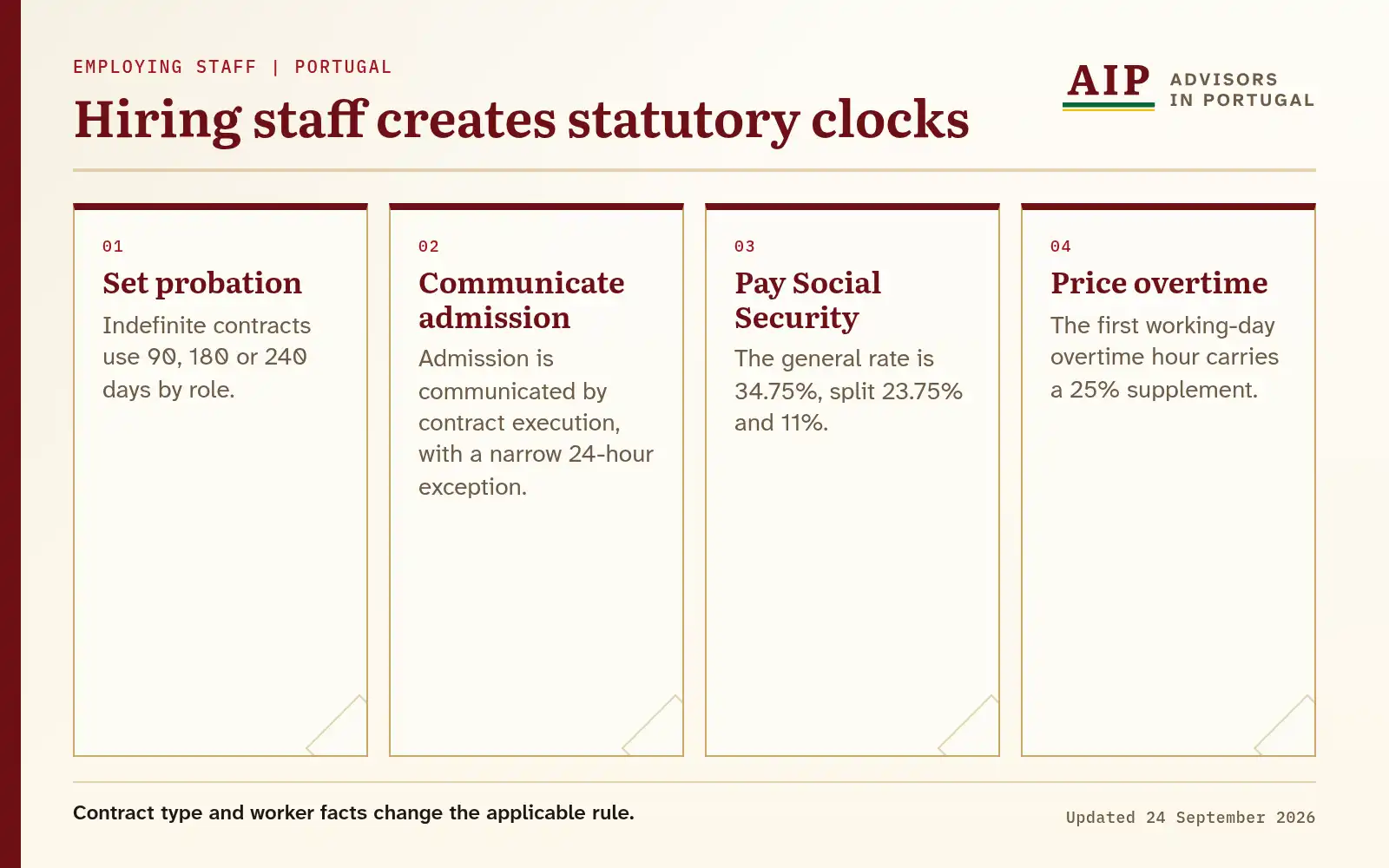
Diagram text version
Set probation at 90, 180 or 240 days. Communicate admission by execution. Pay 34.75 percent Social Security. Price the first overtime hour at 25 percent.
You should identify the statutory category, relevant dates and supporting records before acting. Portuguese employer duties for written terms, probation, working time, Social Security admission, contributions and leave.
What employment information must be written down?
Código do Trabalho Articles 106 to 109 require the employer to inform the worker of relevant employment terms. Article 107 requires written information in one or more documents signed by the employer. The specified information is due within seven days after work starts, with the remaining information due within one month. You should prepare the contract and information documents before the worker begins.
The written-information duty is broader than a job title and pay figure. Your company should identify the role, place of work, start date and applicable contract terms in documents that can be kept with the employee file. The written terms should match the intended relationship and the statutory information schedule.
The seven-day and one-month periods are separate. You should record which information has been delivered, when and in what signed document. The payroll team can use the same agreed pay and start-date facts for the admission communication. Inconsistent dates across the contract and payroll record can complicate the first monthly declaration.
Which probation period applies?
Código do Trabalho Article 112(1) sets 90 days for the generality of workers on an indefinite contract. It sets 180 days for the technical, responsible, specially qualified, trust and other specified circumstances in its subparagraphs, and 240 days for a director or senior-management role. Article 112(2) gives separate periods for fixed-term contracts. You should identify the actual contract and role before applying a period.
The role description and any previous service facts are read against Article 112. A management title alone does not establish that the 240-day category applies. You should keep the role description, contract and start date together so the period can be calculated from the same facts used in the employment record.
The statutory categories affect termination decisions during early employment. Probation does not replace the contract terms. A company should check Article 112 and its limits before relying on a probationary provision.
What are the working-time and leave limits?
Portugal’s Labour Code sets daily and weekly normal working-time limits under Article 203; check the current figures in the article before setting work schedules or payroll. Article 238(1) sets annual leave at a minimum of 22 working days, with working days ordinarily Monday to Friday except public holidays. You should build the schedule and leave record around the applicable contract and collective terms.
The normal limit and the annual entitlement answer different questions. Your company should record daily and weekly hours separately from days of leave earned and taken. A payroll specialist can compare the work schedule, absences and monthly pay data.
You should give employees a clear record of the working pattern and approved leave. A payroll calculation may depend on which days were worked, absent or on holiday. The contract file and monthly time record should use the same working arrangement, especially when overtime is claimed.
When must a new worker be reported?
Código dos Regimes Contributivos Article 29(2)(a), as amended by Decreto-Lei n.º 127/2025, requires the employer to communicate admission through Segurança Social Direta by the start of contract execution. Article 29 provides a narrow exception to the ordinary deadline. You should submit the admission using the worker’s NISS and agreed contract details before work starts in an ordinary hire.
The admission communication includes contract type and remuneration data. A payroll specialist can compare those fields with the signed employment papers before submission. You should keep the electronic acknowledgment, because it establishes when the employer made the communication.
The narrow exception requires evidence of its circumstances. Your company should record the exceptional reason where it applies. You can align the NISS, contract signature and payroll setup before the worker’s first shift.
What Social Security contributions are due?
Código dos Regimes Contributivos Article 53 sets the general regime’s global rate at 34.75%: 23.75% for the employer and 11% for the worker, subject to the statutory exceptions. Article 43 sets monthly payment of contributions and quotizações between day 1 and day 25 of the following month. You should identify whether the worker falls within the general regime before applying this split.
A payroll specialist can calculate the employer and worker portions from the remuneration base that applies to the employee. Your company should keep the monthly pay record and payment proof together. The worker portion is part of the global rate; adding 11% again to 34.75% would overstate the stated total.
A payroll specialist can align payroll tax entries and Social Security contributions using the applicable rules and actual remuneration data. You should keep the authority acknowledgments separately so each filing and payment can be traced.
How is overtime paid?
Código do Trabalho Article 268(1) provides a 25% supplement for the first overtime hour or fraction on a working day and 37.5% for each later hour or fraction, up to 100 annual overtime hours. It provides 50% for overtime on the specified rest days or holidays. Article 268(2) sets higher supplements once annual overtime exceeds 100 hours. You should maintain an annual overtime count for each worker.
The first-hour and later-hour rates require the payroll record to identify when the work occurred. Your company should distinguish a normal working day from the rest-day and holiday categories in Article 268. A payroll specialist can reconcile time records with the monthly payslip.
The 100-hour threshold changes the supplement. Your company should not reset the count at each pay period. You should preserve the underlying authorisation and time evidence so the payroll calculation can be checked later.
What notice and challenge periods matter?
Código do Trabalho Article 387(2) normally gives the worker 60 days to challenge a dismissal; Article 388(2) gives six months from contract cessation to challenge a collective dismissal. Article 400 generally requires 30 or 60 days of written notice for a worker’s resignation depending on seniority; fixed-term contracts use 30 or 15 days. You should distinguish employer dismissal from worker resignation before calculating a date.
The event that triggers a period matters. The communication and contract type are read against the relevant article. Your company should preserve the signed notice and proof of delivery, because the written record helps establish what was communicated and when.
A payroll team may need the correct termination date for final pay. You should give the same date and document to the payroll specialist.
What safety and insurance duties apply?
Código do Trabalho Articles 281 to 284 require employers to provide safe and healthy working conditions and organise occupational-safety measures. Workplace-accident insurance follows a separate legal regime. You should identify the actual worksite and tasks before selecting safety arrangements and insurance cover.
Your company should keep its safety service documentation and insurance evidence with the employee file. The general duty in the Código do Trabalho differs from the detailed obligations in the separate safety and insurance legislation. You should not assume that one general code provision states every record-retention period.
The duties apply alongside pay and contract rules. A payroll specialist can use the employee and remuneration records for the relevant administrative data, while the person handling safety assesses the workplace conditions. You should align the start date so the required measures are in place when the employee begins work.
What changed in 2025?
Lei n.º 32/2025 added Código do Trabalho Article 252-B, effective 26 April 2025. The article grants a female worker with the specified incapacitating menstrual pain caused by endometriosis or adenomyosis a justified absence of up to three consecutive days per month, subject to its conditions. This is a distinct absence category within the current Código do Trabalho.
Your company should assess the condition and documentation under the article before coding the absence in payroll. A payroll specialist can distinguish it from annual leave or an ordinary unpaid absence. You should keep the record needed to apply the provision without broadening the entitlement beyond the specified condition.
You should update the absence categories in the employee file while retaining the correct start-date and contribution processes for every worker.
Common questions
What does the admission notice identify?
When may a worker start before admission is communicated?
Who may decide whether a dismissal is lawful?
Does Article 43 set the income-tax withholding deadline?
Does the 2025 menstrual-health absence reduce pay?
Which probation period applies to a standard indefinite contract?
The information on this page is checked against official sources and reviewed regularly. It is corrected when the law or official guidance changes, as the Editorial Standards describe.