Portugal Income Tax Rates 2026: IRS Bands and Rules
Income tax rates in Portugal for 2026 start at 12.50% on the first EUR 8,342 of taxable income and reach 48% only on the portion above EUR 86,634. Your income category determines whether these bands or Article 72 autonomous rates apply.

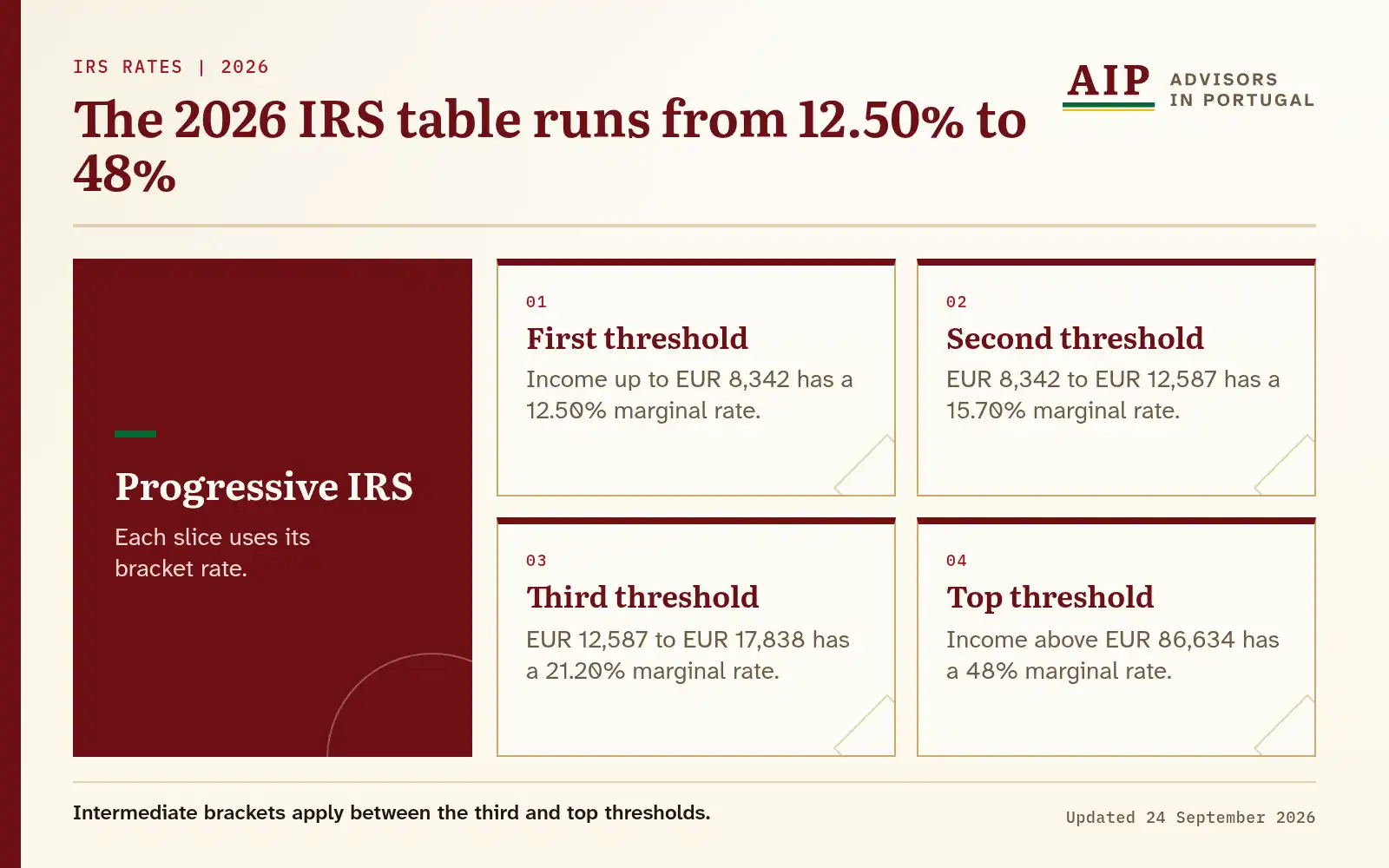
Diagram text version
Income up to EUR 8,342 has a 12.50% marginal rate. EUR 8,342 to EUR 12,587 has a 15.70% marginal rate. EUR 12,587 to EUR 17,838 has a 21.20% marginal rate. Income above EUR 86,634 has a 48% marginal rate.
The 2026 IRS table in Article 68 of the CIRS charges 12.50% on the first EUR 8,342 of taxable income and 48% on the portion over EUR 86,634. Article 72 takes specified categories out of that table and taxes them at an autonomous rate.
What Are Portugal’s Income Tax Rates in 2026?
Article 68 of the CIRS sets 12.50% on taxable income up to EUR 8,342 in 2026. The full band boundaries then move through EUR 12,587 and EUR 17,838, continuing upward through the intervening bands, before the 48% rate applies above EUR 86,634.
These are marginal rates on taxable income after the applicable deductions and classification rules. The tax year, the taxable-income amount and the income categories must be identified before a percentage is applied.
How Does the Progressive IRS Calculation Work?
Article 68(2) requires a split calculation when taxable income exceeds EUR 8,059: the portion up to the highest completed band uses the relevant average rate, and the excess uses the normal rate for the next band. The code’s table and formula therefore produce a marginal calculation.
Your return may also include deductions, withholding and autonomous categories. The calculation should be reconciled to the official table, and each income stream should be traced to its place in the taxable base.
Which Tax Rate Applies Above EUR 86,634?
The 48% Article 68 rate applies only to the portion of 2026 taxable income above EUR 86,634. The bands below that threshold keep their own rates.
A band-by-band schedule shows taxable income, the completed bands, the average-rate calculation and the excess. That schedule makes withholding and the final assessment easier to check.
How Are the 2026 Bands Updated?
Article 68-B links the annual band update to the GDP deflator and GDP per worker published by INE unless direct legislation changes the table. Lei n.º 73-A/2025 amended the 2026 values, including EUR 8,342 at the first band and EUR 86,634 at the top threshold.
Use the table for the relevant tax year. A return that crosses a legislative change should cite the Budget amendment or the current consolidated CIRS.
When Does Article 72 Use an Autonomous Rate?
Article 72 sets autonomous rates for specified categories, including 28% examples for specified non-resident income and certain gains and 25% for qualifying residential rental income, with conditions in the article and related provisions.
Classification decides whether Article 68 or Article 72 applies. The asset, the recipient status, the election and the statutory conditions must be identified before an autonomous rate applies, and a label such as “investment income” does not settle the question.
How Does Portugal Tax Capital Gains?
Article 43(2)(b) includes 50% of the balance of a property gain in the general calculation, and securities gains have additional holding-period rules in the code. Whether a full-inclusion exception applies under Article 43(2)(a) is still being independently re-checked, so confirm it against the current code before relying on it.
The acquisition date, asset type, expenses, residence and any treaty can change the result. Purchase and sale evidence should be preserved, and the Article 43 paragraph that governs the transaction should be identified.
Which Residence Rules Set the Tax Base?
Article 15(1) generally taxes Portuguese residents on worldwide income, while Article 15(2) generally limits non-residents to Portuguese-source income. A separate statutory test in Article 16 determines residence using day-count and home criteria; the current wording of the article governs.
Determine residence before calculating the rate. The next steps are to classify the source, apply any treaty and check whether foreign tax credit relief changes the Portuguese amount.
When Do You File the IRS Return?
Article 60(1) sets electronic filing from 1 April to 30 June for the preceding year. Article 60(3) can extend the filing deadline in specified circumstances involving foreign tax credits that could not be determined by the normal deadline, subject to the article’s conditions.
Collect foreign statements before April. The extension route depends on whether its conditions are met and whether the communication preserves the required evidence.
What Should You Gather Before a Rate Review?
The 2026 rates depend on taxable income, residence, category, dates and foreign tax. Gather payslips, pension statements, rental schedules, investment reports, property records, withholding certificates and travel dates for the relevant year.
Each document maps to Article 68, Article 72, Article 43 or Article 81. That map prevents a progressive rate from being applied to income governed by an autonomous rule.
Withholding is a payment mechanism, and the annual return sets the final tax. Employers, banks, tenants and pension administrators can withhold during the year, while the annual return applies the Article 68 calculation, deductions, autonomous categories and credits. Every withholding certificate should be reconciled to the return.
Taxable income can include several categories with different statutory treatment. Employment and pension income generally enter the progressive calculation, while specified investment, rental or gains categories can have an Article 72 rule or a required aggregation election. Each category is classified before the arithmetic is prepared.
Household status, deductions and the code’s aggregation rules change the taxable base before the 2026 bands apply. The assumptions behind the schedule should be shown.
A complete cost file matters for property gains. Keep acquisition price, improvement invoices, transfer costs, financing evidence and sale expenses. Article 43(2)(b) includes 50% of the balance of a property gain in the general calculation, and securities gains have additional holding-period rules in the code. Whether a full-inclusion exception applies under Article 43(2)(a) is still being independently re-checked, so confirm it against the current code before relying on it.
The holding period for securities gains falls under Article 43 and related provisions. The instrument, acquisition date and disposal date can affect whether a special rule applies. The security should be identified and the current code cited before a percentage is selected.
Foreign tax paid can interact with both the rate and the filing deadline. Foreign tax credit relief depends on the same income and applicable limits, while Article 60 can allow a later filing only when its communication conditions are met. Keep foreign assessments and payment proof as well as the bank statement.
The tax year that generated the income governs the calculation. A payment received in 2026 can relate to work or a disposal in another period, and a legislative amendment can change the applicable table. State the tax year and event date in the calculation.
For a multi-country taxpayer, retain both the Portuguese calculation and the foreign calculation. The same payment can have different source, timing and credit treatment in each system. A side-by-side schedule shows a mismatch before filing or payment.
State the assumptions in plain language: residence status, taxable-income figure, category, rate, deductions, foreign tax and filing date. The schedule can then be compared to the documents, and a change in any fact can be traced through it.
Separate gross receipts from taxable income in the rate review. Keep evidence for deductions, allowable costs, exemptions and category rules.
Cross-border families should identify who received each payment and where that person was resident. Portuguese aggregation, dependent and source rules can change the result even when the same bank account receives the money. The schedule should show the taxpayer and year beside every line.
Keep copies of the consolidated CIRS and the Budget amendment used for the calculation. Rates and thresholds can change by legislation or annual update, while an old online calculator can continue to display an obsolete band. The working paper should state that it used the 2026 table.
Check whether an election or aggregation option is available when an autonomous rate applies, and whether it changes deductions or credits. Article 72 conditions can vary by income type. Record the choice and its effect before filing.
Review the final assessment against the working paper after submission. Check the taxable-income bands, autonomous amounts, withholding, foreign credit and payment references. Any correction should identify the code article and line that changed, so the next year’s documents remain consistent.
Keep the final schedule with the filed return and payment receipt. Note the tax year, residence status and rate table version on its cover. That record helps explain any difference between an estimate, withholding and final assessment when the Tax Authority updates the bands.
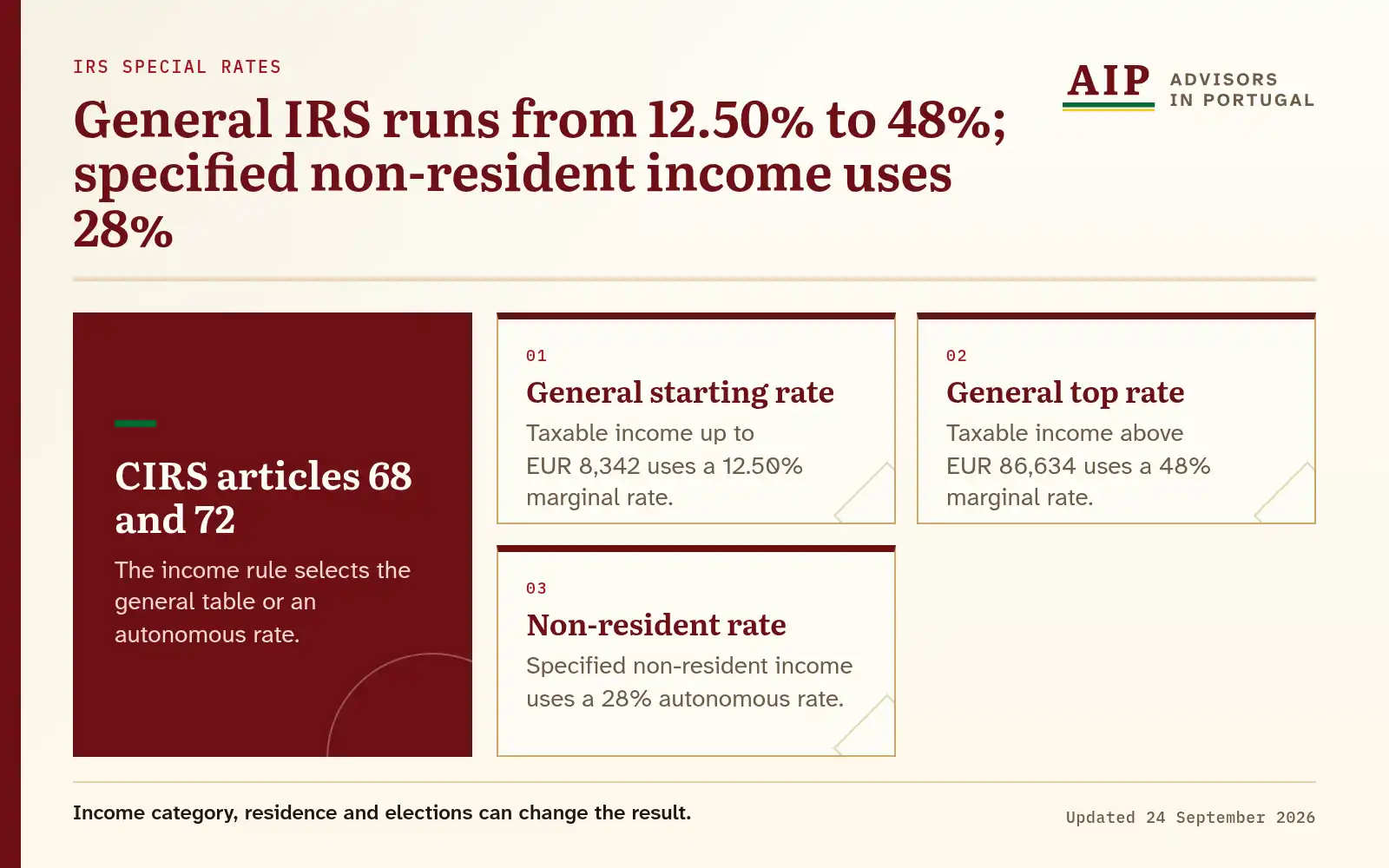
Diagram text version
Taxable income up to EUR 8,342 uses a 12.50% marginal rate. Taxable income above EUR 86,634 uses a 48% marginal rate. Specified non-resident income uses a 28% autonomous rate.
Common questions
What is the lowest Portuguese IRS rate in 2026?
Does the 48% rate apply to all my income?
Can an autonomous rate replace the progressive bands?
Do non-residents use the same tax base?
When is the Portuguese IRS return filed?
Is a property gain ever included in full?
The information on this page is checked against official sources and reviewed regularly. It is corrected when the law or official guidance changes, as the Editorial Standards describe.