Portugal Golden Visa Requirements: ARI Guide
The Portugal Golden Visa fund route requires EUR 500,000 in qualifying non-real-estate collective-investment units. Lei 56/2023 closed the former real-estate routes to new applications, so a property purchase no longer supports a new ARI application.

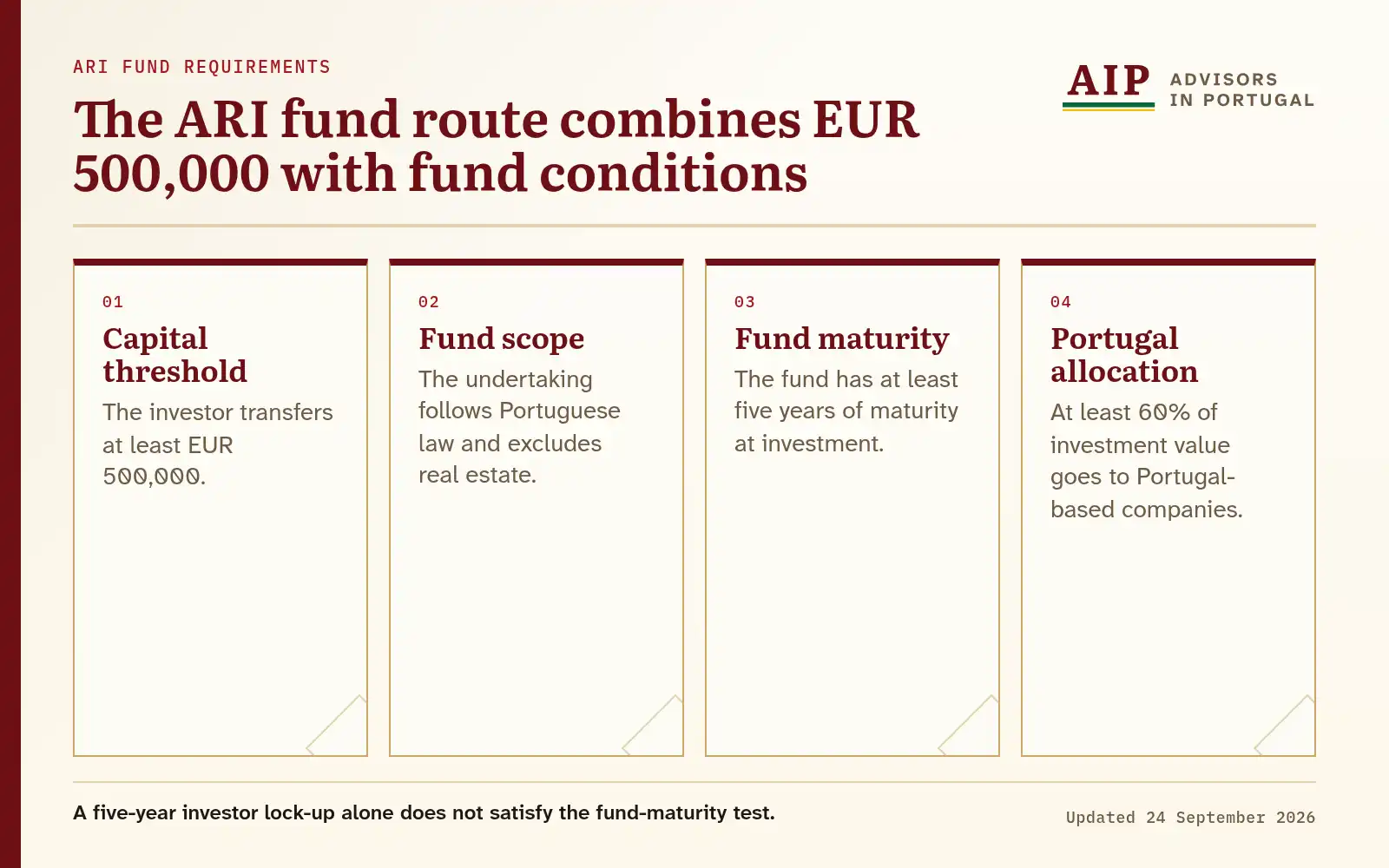
Diagram text version
The investor transfers at least EUR 500,000. The undertaking follows Portuguese law and excludes real estate. The fund has at least five years of maturity at investment. At least 60% of investment value goes to Portugal-based companies.
Portugal’s Golden Visa is the Autorização de Residência para Investimento (ARI). Article 90-A of Lei 23/2007 applies the Article 3(1)(d) investment routes to a third-country applicant who meets the general conditions. The applicant, the investment, the transfer and the supporting evidence are all assessed against the current procedure.
Family evidence, stay records, official charges and renewal requirements follow the same procedure after the first filing. An investment can be commercially valid without satisfying a residence route, so the route conditions need checking before funds are committed.
Who Can Apply for a Portugal Golden Visa?
Article 90-A of Lei 23/2007 gives the ARI route to third-country nationals who carry out a qualifying investment and satisfy the Article 77 conditions, except the valid-residence-visa requirement. Lei 56/2023 closed the former real-estate routes to new applications. The applicable route depends on the applicant’s nationality, status, investment and source-of-funds records.
The principal applicant and every family member are identified at the start. Passport and residence information is needed for each person, and the principal route is distinct from any family process. Previous Portuguese immigration applications, refusals, permits and pending procedures belong in the applicant’s records.
The person or entity making the investment matters because ownership, control and transfer records may form part of the route evidence. A company, trust, nominee or joint ownership arrangement needs explaining before funds move.
The ARI conditions cover residence eligibility only. Legal, financial, regulatory and tax questions on the investment sit outside them, and immigration eligibility does not assess investment quality or performance.
The funding sequence is worth recording before any transfer: which account sends the capital, which person or entity receives it and which documents evidence the completed investment. A change of investor, ownership chain or funding source changes the facts, and the evidence needs revising before the transaction proceeds.
Which ARI Investment Routes Are Available?
Article 3(1)(d) of Lei 23/2007 lists the open routes: at least 10 jobs under sub-paragraph (ii), EUR 500,000 for research or scientific activity under sub-paragraph (v), EUR 250,000 for qualifying cultural or artistic activity under sub-paragraph (vi), EUR 500,000 in qualifying non-real-estate collective-investment units under sub-paragraph (vii), and EUR 500,000 to create or reinforce a Portuguese company with five permanent jobs under sub-paragraph (viii). Article 90-A applies those routes to ARI applicants.
Each route has its own statutory conditions and evidence. The investment type, amount, recipient, holding structure and timing determine which route applies, and a change from one route to another changes the document set.
The evidence matches the selected route and covers proof of transfer, ownership, maintenance and qualifying activity. Tax and commercial questions on the investment are separate from the route conditions, and market, liquidity and counterparty risks also sit outside them.
The investment plan stays consistent across subscription, banking and immigration records. Names, ownership details and transaction dates need to match, and unexplained differences are best resolved while the issuing institutions can still correct their records.
What Must a Fund Investment Satisfy?
Article 3(1)(d)(vii) of Lei 23/2007 requires at least EUR 500,000 in qualifying non-real-estate collective-investment units constituted under Portuguese law. The fund must have at least five years of maturity at investment and at least 60% of its investments in Portuguese companies with registered offices in Portugal.
The fund’s constitutive and offering documents, manager information, subscription agreement and any eligibility statement supplied by the fund show whether it meets those conditions. Transfer records show the investor, recipient and date. AIMA states that the investment may not be directed, directly or indirectly, at real estate, so a real-estate-linked fund does not qualify.
Fund maturity, asset allocation, manager status and redemption terms are matters for the fund documents and a financial adviser. An ARI conclusion covers residence eligibility only, and return, liquidity and capital preservation are investment questions.
Does Property Qualify for a Golden Visa?
Lei 56/2023 Articles 42(1)-(5) and 43 exclude new ARI applications under the former real-estate categories in Article 3(1)(d)(i), (iii) and (iv) of Lei 23/2007. A legacy or pending case is assessed against its filing date.
A property purchase is a separate matter involving title, contracts, registration and taxes. It counts as ARI evidence only when the current route expressly supports it. The buying property in Portugal guide covers the purchase process.
Historical descriptions of the programme can be misleading because they may describe routes or conditions that no longer apply. The law and official procedure at the proposed filing date apply.
Property due diligence and the ARI route analysis are separate, so neither decision should rest on an assumption made for the other.
Which Documents Does an ARI Applicant Need?
Articles 77 and 90-A of Lei 23/2007 require route-specific evidence of the qualifying investment, identity and travel status, Segurança Social registration where applicable, criminal-record status and the other general conditions. The proof for the selected route is added to those records.
Passports, current residence documents, tax and identification records, bank evidence, contracts and investment documents are organised by applicant and transaction.
Source-of-funds records explain how the investment capital arose and moved. Bank statements, sale documents, earnings records, company distributions or inheritance documents may be relevant depending on the facts.
The checklist differs by route and stage, and some documents are expiry-sensitive. Documents are best ordered or legalised against the current list.
Can Family Members Join the Application?
Articles 98 to 102 of Lei 23/2007 govern family reunification as a separate residence-authorisation process linked to the ARI holder’s right of residence. Each relative’s relationship, age, dependency, accommodation and means evidence is assessed under the applicable Article 98 process.
Civil-status records are needed, and any marriage, partnership, adoption, custody or dependency issue needs explaining. Later events may require an update to those records.
AIMA approves family applications only after the principal ARI application is approved. The ARI holder, as family sponsor, should time the family applications with the principal application, even when the sponsor files them separately. Passports, residence histories and travel plans affect document preparation. AIMA controls appointment and decision dates.
Tax residence, education, healthcare and succession questions connected with a move are separate from the ARI eligibility conclusion.
Which Stay Requirement and Fees Apply?
Article 65-C of the implementing regulation sets the ARI minimum presence at 7 days, consecutive or non-consecutive, in the first year and 14 days in each subsequent two-year period. The periods run from the actual permit, and travel and presence records support the requirement. A comparison of the calendar with official records before renewal shows any gap.
Portaria 307/2023 lists original indexed amounts of EUR 773.74 for receipt and analysis, EUR 7,730.11 for an ARI grant and EUR 3,865.79 for renewal, while its annual-indexation rule updates the payable amounts each 1 March. AIMA’s fee table effective from 1 March 2026 lists EUR 842.80 for receipt and analysis, EUR 8,418.90 for permit issuance and EUR 4,210.30 for renewal, with reduced charges shown separately in the table.
Government charges, investment costs, taxes and professional fees are separate amounts. Authority-controlled fees and procedures may change.
What Happens at Renewal?
AIMA states that the initial temporary permit is valid for two years from issue. Article 90-A(2) provides renewal periods of 2 years when the applicant proves that a qualifying investment situation remains maintained. The actual authorisation, investment, stay records, general conditions and current AIMA procedure govern the renewal filing. AIMA has used its electronic renewal portal for ARI renewals since 16 February 2026.
Investment evidence stays current throughout the permit period. Fund statements, ownership records, bank documents and other route evidence may be needed to show the continuing position.
Each family renewal is separate. Each family member’s permit and relationship evidence is checked against the principal position, and passport changes, civil-status changes and altered dependency facts are reported before renewal documents are prepared. AIMA controls appointment availability and decision dates.
Does a Golden Visa Create Portuguese Tax Residence?
The ARI permit does not itself establish Portuguese tax residence. Article 16 of the CIRS commonly treats a person as resident after more than 183 days in a 12-month period or when the person maintains a habitual residence in Portugal. A tax adviser applies those tests to the holder’s facts.
When Can a Golden Visa Holder Apply for Nationality?
Lei Orgânica n.º 1/2026 took effect on 19 May 2026. It requires seven years of legal residence for CPLP and EU nationals and ten years for other nationals for nationality procedures started from 19 May 2026. It counts legal-residence periods within a maximum nine-year window for CPLP and EU nationals and a 12-year window for other nationals. Procedures pending on 19 May 2026 remain under the prior text. The Portuguese-language requirement is CEFR level A2. The nationality application has requirements beyond residence time and language.
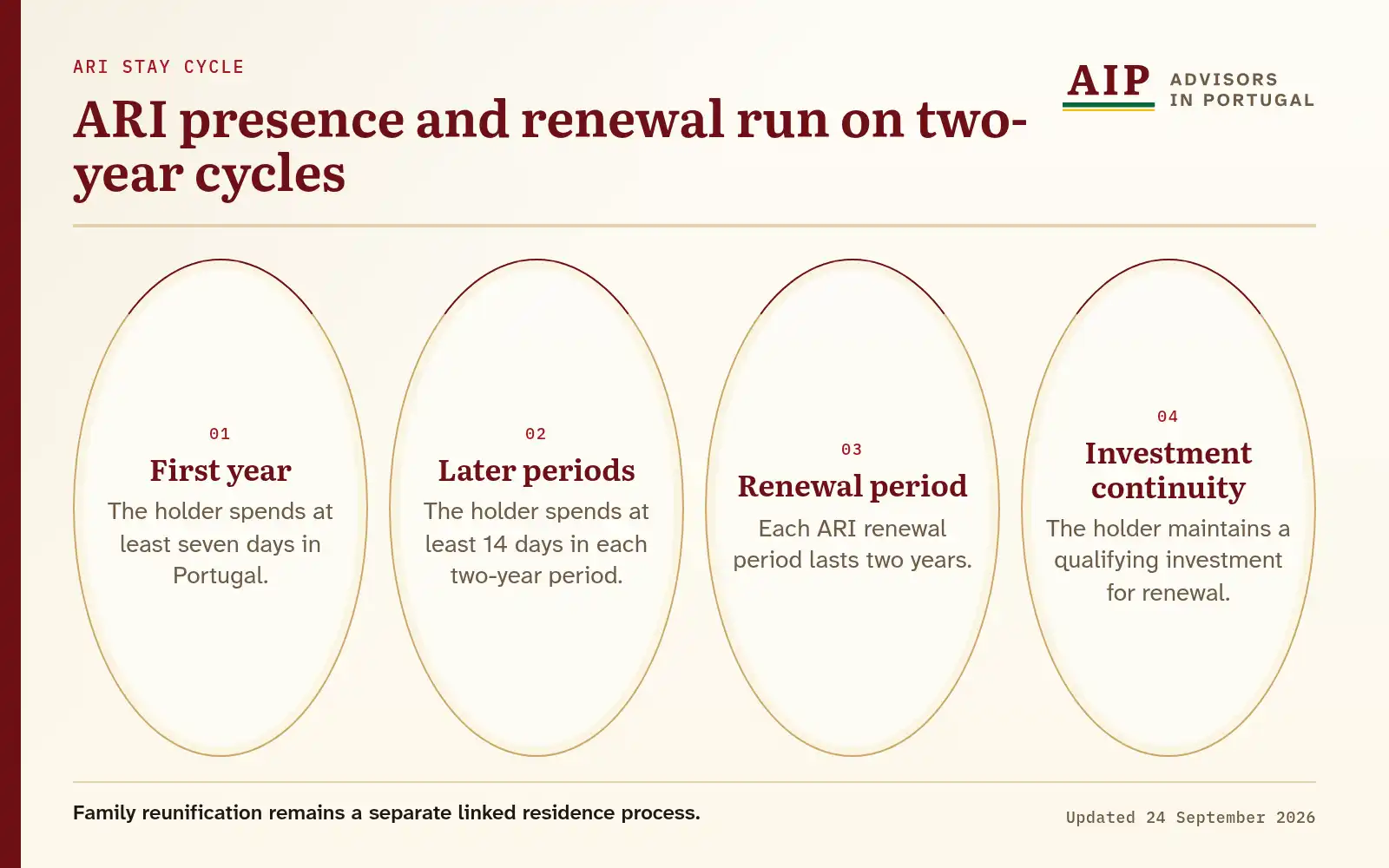
Diagram text version
The holder spends at least seven days in Portugal. The holder spends at least 14 days in each two-year period. Each ARI renewal period lasts two years. The holder maintains a qualifying investment for renewal.
Common questions
What does ARI mean in Portugal?
Is there one investment threshold for every Golden Visa route?
Can I obtain a Golden Visa by buying property?
How many days must an ARI holder spend in Portugal?
Can my family be included?
How much are the official Golden Visa fees?
The information on this page is checked against official sources and reviewed regularly. It is corrected when the law or official guidance changes, as the Editorial Standards describe.