Residency by Investment in Portugal: Current ARI Routes
Residency by investment in Portugal is open through the current ARI routes, including qualifying investments of €250,000 or €500,000 held for at least five years. Lei n.º 23/2007 Article 3(1)(d) also lists the creation of at least ten jobs.

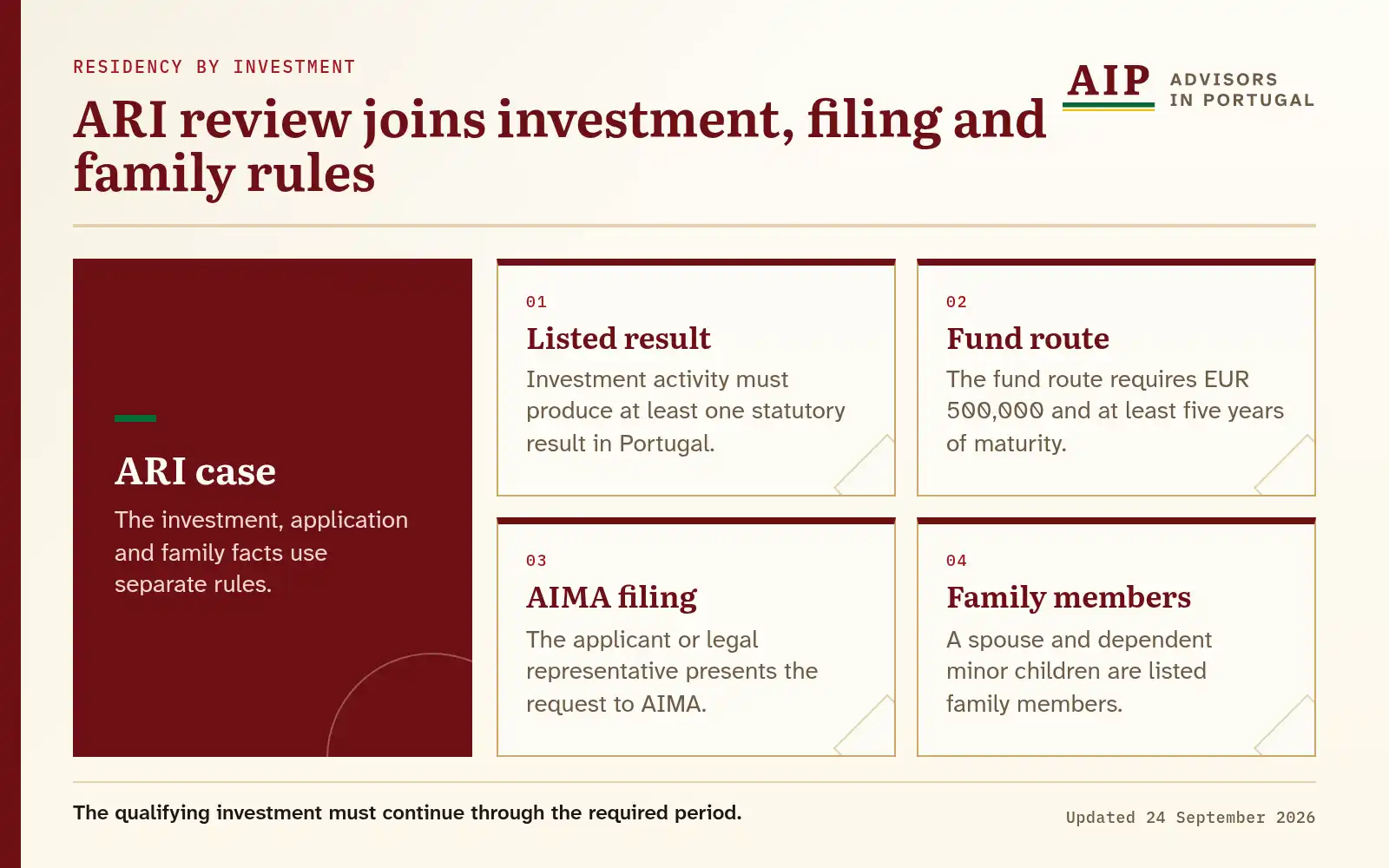
Diagram text version
Investment activity must produce at least one statutory result in Portugal. The fund route requires EUR 500,000 and at least five years of maturity. The applicant or legal representative presents the request to AIMA. A spouse and dependent minor children are listed family members.
Lei n.º 23/2007 Article 3(1)(d) sets five-year investment routes, including qualifying €500,000 research and fund commitments.
Which investments qualify for residency by investment?
Lei n.º 23/2007 Article 3(1)(d) lists several current qualifying results held in Portugal for a minimum of five years. The list includes €500,000 for qualifying research, €250,000 for artistic or national-heritage support, €500,000 in qualifying non-real-estate collective-investment units and €500,000 in a Portuguese company with the specified jobs condition. The investor identifies the route before committing capital.
The statute gives each route its own conditions. The governing contract, the recipient or fund documents and evidence of the Portuguese result show whether a route applies. A transfer of funds and a qualifying statutory investment are different factual questions, and the route’s conditions control the assessment.
The collective-investment route has further conditions. Article 3(1)(d)(vii) requires the undertaking to have a maturity of at least five years when the investment is made. The statutory route also requires at least 60% of the investment value to be placed in commercial companies headquartered in Portugal. Article 3(5) provides that the investment may not be directed, directly or indirectly, at real estate. Article 90-A(1)(d) describes this route as a capital transfer of at least EUR 500,000 to acquire units or interests in qualifying Portuguese-law collective-investment undertakings. Selecting a particular fund is an investment decision that needs an authorised financial intermediary, and this guide does not recommend any fund.
The current Article 3(1)(d) list does not include a new real-estate purchase route. An existing ARI holder should record the earlier investment and application dates separately, because the rules for a new application differ. The route selected at entry determines the evidence needed later.
How long must the investment be maintained?
Lei n.º 23/2007 Article 3(1)(d) defines the qualifying investment result by a minimum five-year period in Portugal. Evidence of the investment and its continuity covers that whole period. The transaction date, the legal holder and any subsequent changes each belong to the record.
A fund investment has a separate condition linked to the undertaking’s maturity. The constitutive documents and subscription terms show that maturity. The maturity of a fund and the investor’s five-year result are related but distinct facts and each has its own date.
A company investment or research contribution needs its own evidence of the result in Portugal. Payment records, ownership or recipient documents and any later restructuring record make up that evidence. A divestment or transfer can affect the statutory condition.
Which residence conditions accompany the investment?
Lei n.º 23/2007 Article 77(1) lists general residence-authorisation conditions including means of subsistence, accommodation, Social Security registration where applicable, the specified criminal-record condition and no relevant entry or return alert. Personal records are kept separate from the investment evidence.
The investment provision identifies a qualifying activity, and Article 77 deals with the person seeking residence. The passport, address, tax and supporting documents sit with the transaction record. The applicant named in the application should match the investor shown in the payment and ownership documents, and a mismatch in names or dates needs an explanation before filing.
The statute supplies conditions, while the authority’s current procedure identifies the document form and submission method. An official AIMA request is kept with the documents actually sent. Each request relates to a specific legal condition, and an investment certificate is a different document from evidence of accommodation or means.
Who can present the ARI residence application?
Lei n.º 23/2007 Article 81(1) permits the interested person or legal representative to present a residence application to AIMA, I. P., subject to special regimes. The authority of the person who signs for the applicant should be preserved with the application. Decreto Regulamentar 84/2007 Article 51 provides that the applicant, an employer or host institution, a family sponsor, or a lawyer or solicitador may submit a residence application.
AIMA is the residence authority under Article 81(1). The official submission acknowledgement and any later notice are kept. An IAPMEI, fund or bank document is a different record from the immigration request received by AIMA. The investment and residence procedures involve different records even when they concern the same person.
An applicant group may include more than one residence question. The principal investor and each person seeking a related status are identified, and each person’s identity and civil records belong with the appropriate application. The statute allows representation, and the required personal facts remain those of the applicant.
How can family reunification be requested?
Lei n.º 23/2007 Article 99(1) allows an applicant for residence authorisation to request family reunification at the same time. The family relationship and the status sought for each person are identified. Civil documents are compared with the current family provisions before the requests are made.
A simultaneous request is a procedural possibility under the statute. Each relative’s identity and relationship evidence is kept with the principal applicant’s file. Each family member falls under a specific family paragraph and condition, and the family case connects to the investor’s residence record.
AIMA’s decision on a family member follows the relevant family and residence conditions. The family application and official notices are kept separately from the investment documents. A request for further evidence refers to the person and legal category involved, and a fee or document list follows the actual current procedure.
What duration and renewal timing matter?
Lei n.º 23/2007 Article 75(1) gives an ordinary temporary residence authorisation two years from issue, and Article 78(1) calls for a temporary renewal request by 30 days before expiry. Article 90-A(2) renews an ARI permit for two-year periods once the investor shows that the Article 3(1)(d) investment requirement remains maintained. The title granted and any special rule are read before the general timing applies to an investor.
The card and the qualifying investment have separate dates. The issue and expiry dates of the residence title sit alongside the five-year investment record. A renewal assessment considers the status and conditions that apply to the holder. An ARI permit does not by itself establish Portuguese tax residence, which CIRS Article 16 governs with its own tests.
AIMA states seven days of stay in Portugal in the first year and 14 days in each subsequent two-year period. Evidence of stay covers the period relevant to the permit and renewal. An official renewal notice identifies the act and applicant, and it is kept with the original approval and the investment evidence. The statutory general rule gives context, and the holder’s actual permit identifies the current procedural step.
What official charge applies to an ARI application?
Lei n.º 23/2007 Article 209(2)-(4) places administrative fees and other charges under a ministerial ordinance. The authority’s current notice for the analysis, grant or renewal act states the public charge payable.
The AIMA fee table effective from 1 March 2026 lists EUR 842.80 for ARI receipt and analysis, EUR 8,418.90 for issuance and EUR 4,210.30 for renewal. AIMA’s current fee table governs the amount at the time of payment.
An investment threshold is separate from a residence-administration fee. The investment transfer and the official payment notices belong on separate budget lines. The AIMA procedure may require a payment document or appointment step under its current instructions, and the notice and acknowledgment issued for the case are kept. The law’s fee-authority provision supplies the legal basis for a charge, and the current ordinance and actual notice supply its amount and payment step.
Can an investor later seek permanent residence?
Lei n.º 23/2007 Article 80(1) includes at least five years of temporary residence, plus means, accommodation, basic Portuguese and the specified criminal-record condition, before an application for permanent residence. The residence history and language evidence are assembled separately from the qualifying investment.
Article 76(1) gives a permanent residence authorisation no validity limit. The right and the physical title are different things, and the card history is kept. Article 80 requires the residence, means, accommodation, language and record conditions for the later application, and an earlier ARI period may count toward the five-year requirement.
Nationality has a separate legal basis and procedure. Lei Orgânica n.º 1/2026 requires seven years of legal residence for nationals of Portuguese-official-language countries and EU nationals, and ten years for nationals of other countries. The periods are counted within a maximum window of nine years for the first group and 12 years for other nationals, and pending procedures may be subject to transitional rules. The Portuguese-language requirement for nationality is CEFR level A2. Continued ARI status, permanent residence and nationality are three different goals, and a five-year period does not decide any of them alone. A residence application and nationality decision are separate legal outcomes.
What changed in the current 2026 legal text?
The current consolidated Lei n.º 23/2007 lists Lei n.º 62/2026 of 10 September 2026 among its amendments and still displays the Article 3(1)(d) investment routes described above. A new ARI analysis uses the current version, and the version cited in the application is retained.
An amendment date differs from the legal rule that applies to the transaction. The Article 3 text governs the investment, and the administrative act for which AIMA sends a notice is identified separately.
A later permanent-residence plan uses the current Articles 76 and 80 for its own conditions. Earlier titles and decisions are preserved so the period can be reconstructed. The investment-history evidence and the residence-history evidence stay aligned while each provision applies to its own question.
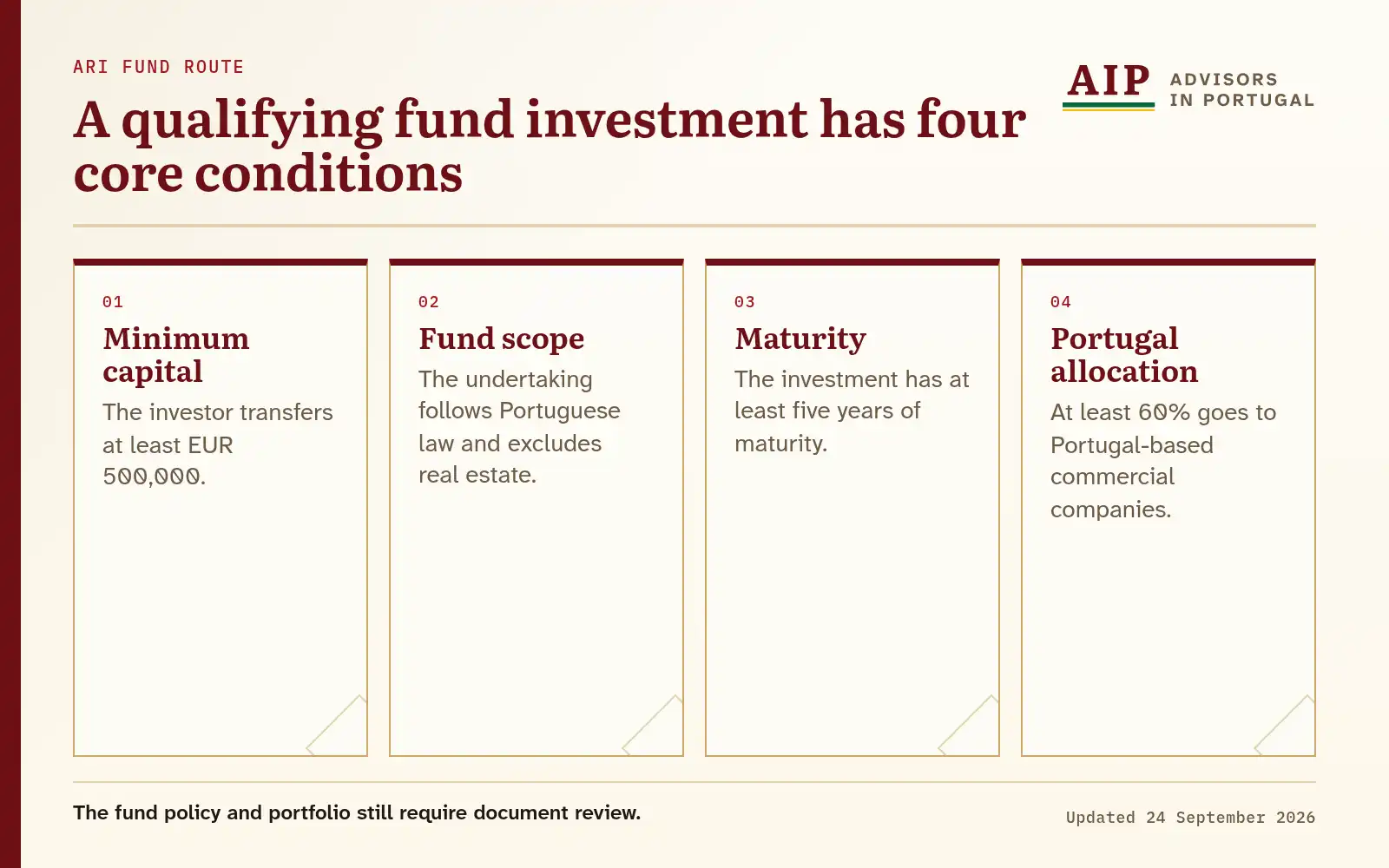
Diagram text version
The investor transfers at least EUR 500,000. The undertaking follows Portuguese law and excludes real estate. The investment has at least five years of maturity. At least 60% goes to Portugal-based commercial companies.
Common questions
How many jobs can meet the listed job-creation route?
How long must a qualifying fund last at investment?
May an employer submit the residence application?
How long are general temporary-residence renewals?
How often is the permanent-residence card renewed?
Who receives administrative fees charged by AIMA?
The information on this page is checked against official sources and reviewed regularly. It is corrected when the law or official guidance changes, as the Editorial Standards describe.