Portugal Golden Visa Cost: 2026 AIMA Fees and Investment
The golden visa cost in Portugal includes AIMA's ARI grant fee of €8,418.90 in person or €6,314.20 through the digital channel under the schedule effective 1 March 2026. AIMA indexed these fees for 2026, so older websites may show the lower 2023 figures.

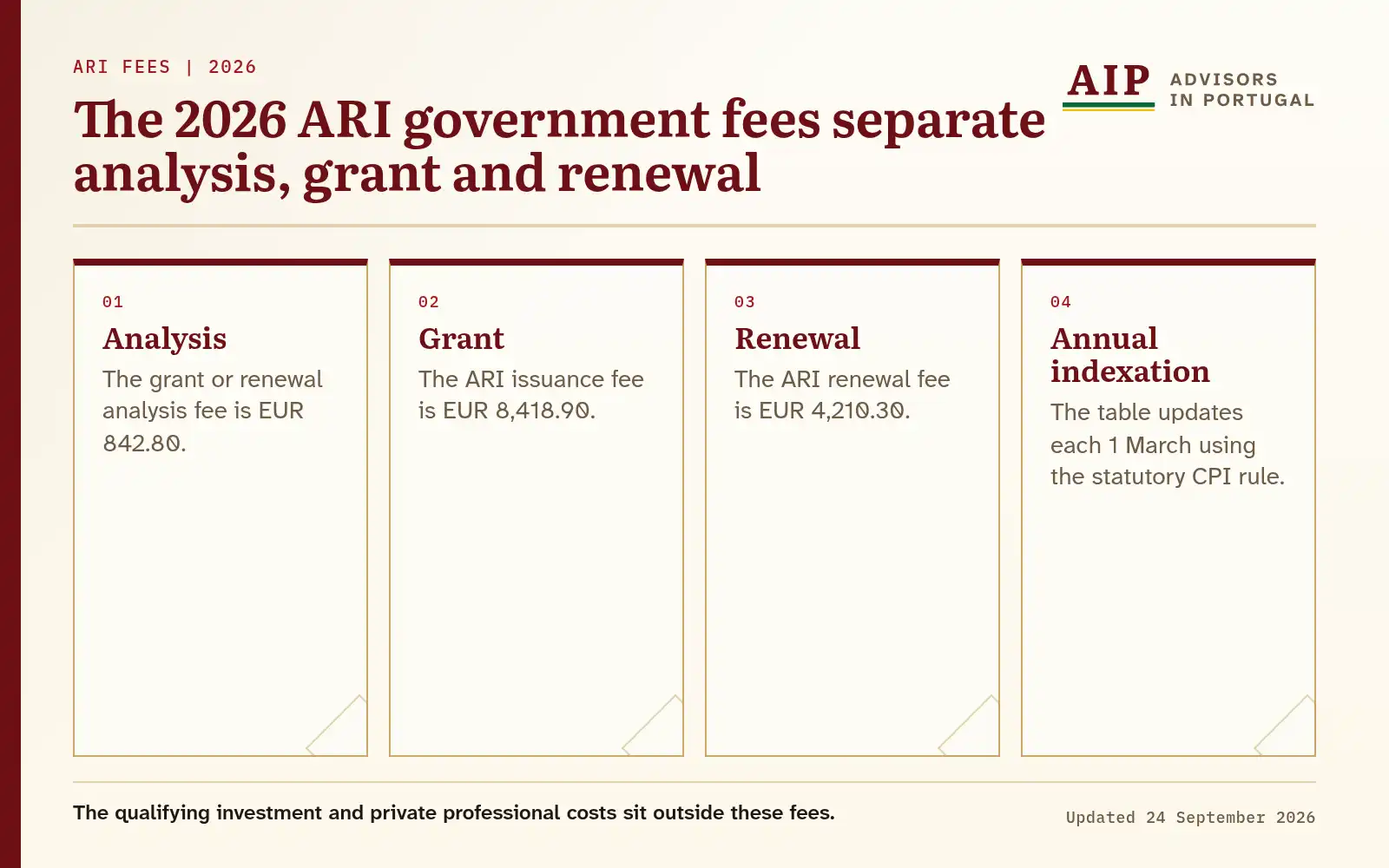
Diagram text version
The grant or renewal analysis fee is EUR 842.80. The ARI issuance fee is EUR 8,418.90. The ARI renewal fee is EUR 4,210.30. The table updates each 1 March using the statutory CPI rule.
Current AIMA ARI analysis, grant and renewal charges alongside the qualifying fund investment threshold.
What are the 2026 Golden Visa government fees?
AIMA’s schedule effective 1 March 2026 lists €842.80 in person (€632.10 through the digital channel) for analysis of an Autorização de Residência para Investimento (ARI) request, €8,418.90 in person (€6,314.20 through the digital channel) for the grant and €4,210.30 in person (€3,157.80 through the digital channel) for renewal. These are separate administrative charges. You should identify which procedural event applies to each applicant and compare the payment notice with AIMA’s current table before paying.
Portaria n.º 307/2023 Annex III provides the fee instrument behind the ARI charges, and Annex XIV provides the digital-channel reduction shown in AIMA’s current table. AIMA indexed its schedule for 2026 and published the updated table on 26 February 2026. The current listed amounts therefore differ from the original 2023 annex figures. You should keep a copy of the schedule used for your estimate alongside the later payment notice. The notice names the analysis, grant or renewal act to which a payment is allocated.
The three figures do not form one automatic invoice. An analysis charge arises for the application stage, while grant and renewal concern later acts. You should keep the applicant list and the official notices for each stage. The amounts AIMA requests for each person in the case appear in those records.
How does the ARI analysis fee work?
AIMA lists €842.80 in person (€632.10 through the digital channel) for ARI analysis in its fee schedule effective 1 March 2026. Portaria n.º 307/2023 Annex III set the original fee category and annual indexation changes the published amount. You should budget for the analysis stage as an administrative charge separate from the investment itself.
You should keep the AIMA payment request and receipt with the application record. The charged category should match the application type and number of applicants. The official notice identifies the legal event billed more precisely than a third-party estimate. The official notice and fee table give the useful classification. You should place the notice beside the table used for the estimate and record the administrative stage.
The analysis charge is one part of the public-cost picture. AIMA’s €8,418.90 in person (€6,314.20 through the digital channel) grant fee and €4,210.30 in person (€3,157.80 through the digital channel) renewal fee in the same 2026 table concern different later stages. You should separate those events in the budget. AIMA makes the later decision.
What does AIMA charge when it grants ARI?
AIMA’s 1 March 2026 fee schedule lists €8,418.90 in person (€6,314.20 through the digital channel) for an ARI grant. Portaria n.º 307/2023 Annex III identifies the grant as its own administrative act. You should distinguish this charge from the €842.80 in person (€632.10 through the digital channel) analysis fee and from the qualifying investment amount. You should check which grant notice applies to each applicant in the file.
A grant fee becomes relevant at the grant stage, and the official charge follows AIMA’s current schedule. You should retain the issued notice and its payment details. You should read the act described in the notice before payment. Neither an application submission nor payment of an analysis charge establishes a grant decision.
A private cost estimate should show any professional work separately. AIMA’s table lists the public charges, and your documents may require third-party expenses. The €8,418.90 in person (€6,314.20 through the digital channel) figure is the AIMA grant amount. You should budget the investment and other costs separately.
How much is ARI renewal?
AIMA’s schedule effective 1 March 2026 lists €4,210.30 in person (€3,157.80 through the digital channel) for ARI renewal. Lei n.º 23/2007 Article 90.º-A(2) provides for renewal in two-year periods while the relevant conditions remain met. You should retain the investment and residence records needed to support the later application.
Portaria n.º 307/2023 Annex III distinguishes renewal from analysis and grant. AIMA’s 2026 indexation changed the amount stated in that original annex. The renewal notice should match the current published fee, the applicant and the title being renewed. The official charge is distinct from any work needed to assemble updated evidence.
Article 90.º-A requires continued fulfilment of the route’s conditions. You should collect records of the qualifying investment and any required status documents before a renewal request. The evidence follows the route under which the ARI was granted. The current renewal fee applies to the administrative act, while the applicant’s evidence determines the merits.
Why do older websites show different ARI fees?
Portaria n.º 307/2023 set the original, lower analysis, grant and renewal amounts in Annex III. Its indexation mechanism updates the schedule each 1 March with the stated consumer-price formula. AIMA’s table updated 26 February 2026 supplies the amounts effective 1 March 2026: €842.80 in person (€632.10 through the digital channel), €8,418.90 in person (€6,314.20 through the digital channel) and €4,210.30 in person (€3,157.80 through the digital channel) respectively.
The Portaria entered into force on 29 October 2023. You should date every price you compare. A quote may repeat the 2023 annex or apply the 2026 AIMA schedule, so check which one it uses. The annex remains the legal instrument for the fee categories, while the current table supplies the indexed values. The effective date makes the applicable schedule clear.
AIMA can update the table again under the annual formula. You should compare the published schedule with the notice for the date of your act. The annex and the newer table show any change. The figure on this page is the published 2026 amount. Later schedules may change it.
What investment must accompany a qualifying fund route?
Lei n.º 23/2007 Article 3(1)(d)(vii), as amended by Lei n.º 56/2023 Article 44, sets €500,000 for the qualifying investment-fund route; Article 90.º-A(1)(d) links ARI eligibility to that provision. The units must be in non-real-estate collective investment undertakings with at least five years of maturity and at least 60% of investment in Portuguese commercial companies. You should compare the fund documents with each statutory condition.
The €500,000 is the capital investment threshold for that route. AIMA charges the processing fee under its own schedule. You should keep subscription, payment and fund evidence separate from the AIMA receipts. Article 90.º-A sets conditions on the fund’s legal form, stated maturity and investment policy. The governing fund documents establish the relevant policy and terms.
The law also contains other qualifying routes, including company-capital and job-creation routes, with their own conditions. You should identify the route actually chosen before estimating the evidence and charges. The route’s statutory wording sets the conditions a proposed transaction must meet. The cost and risk of an investment depend on its transaction terms and underlying assets.
Can a new property purchase qualify for ARI?
Lei n.º 56/2023 removed the real-estate route for new ARI applications when its amendments took effect. It preserved specified treatment for earlier ARI renewals. You should establish the application date and the legal route shown in the earlier record before relying on any property-related status.
A new property purchase is different from maintaining a status already granted under an earlier route. The earlier approval, the investment documents and the applicable transitional provision are read together. You should keep the date of the original request and each later renewal, because those facts determine whether the preservation rule may be relevant.
The remaining qualifying routes have their own thresholds and document tests. The €500,000 non-real-estate fund route requires the five-year maturity and 60% Portuguese-company conditions. You should compare a proposed investment with the current route before paying a subscription. The ARI provision that supports a new request depends on the route.
What other costs belong in an ARI budget?
AIMA’s 2026 schedule establishes the public charges of €842.80 in person (€632.10 through the digital channel) for analysis, €8,418.90 in person (€6,314.20 through the digital channel) for grant and €4,210.30 in person (€3,157.80 through the digital channel) for renewal. Translations, apostilles, banking, professional fees and the economics of an investment have separate costs. You should list those categories against the documents and route your case actually needs.
A fund subscription under the €500,000 route is capital placed in an investment, with its own terms and risk. It should sit in a separate budget line from administrative charges. An investment professional can address the investment’s commercial risk. You should keep the subscription agreement and fee disclosures alongside the immigration evidence.
An applicant group may face several notices and third-party bills. You should retain each notice and record which applicant and administrative act it names, because a family budget can otherwise combine unrelated charges. You should use the official fee table for public charges and written proposals for professional work. The final outlay follows the applicants, route, documents and actual decisions, so a generic all-in price would misstate the components.
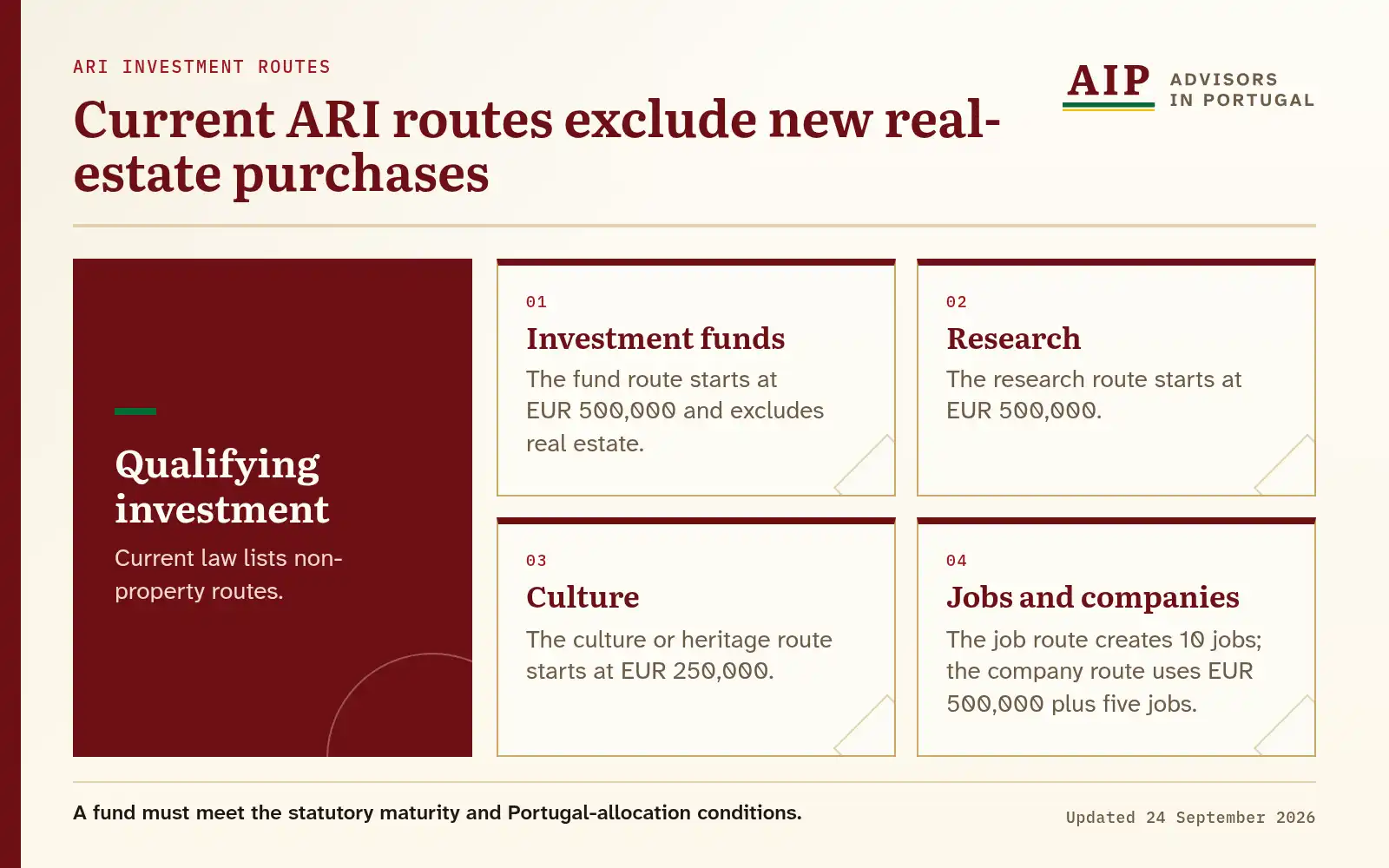
Diagram text version
The fund route starts at EUR 500,000 and excludes real estate. The research route starts at EUR 500,000. The culture or heritage route starts at EUR 250,000. The job route creates 10 jobs; the company route uses EUR 500,000 plus five jobs.
Common questions
What were the 2023 ARI analysis and grant charges?
What was the 2023 ARI renewal charge?
Must the qualifying fund be established under Portuguese law?
Can an existing property-route ARI holder renew?
Is there a single total for bank, translation and other third-party work?
How long is each ARI renewal period?
Related guides
The information on this page is checked against official sources and reviewed regularly. It is corrected when the law or official guidance changes, as the Editorial Standards describe.