Portugal Investment Funds: Formation and CMVM Rules
Investment funds in Portugal must have a CMVM-authorised manager before activity starts, under RGA Articles 22 and 28. Promoters must resolve any mismatch between redemption terms and asset liquidity before they issue investor documents.

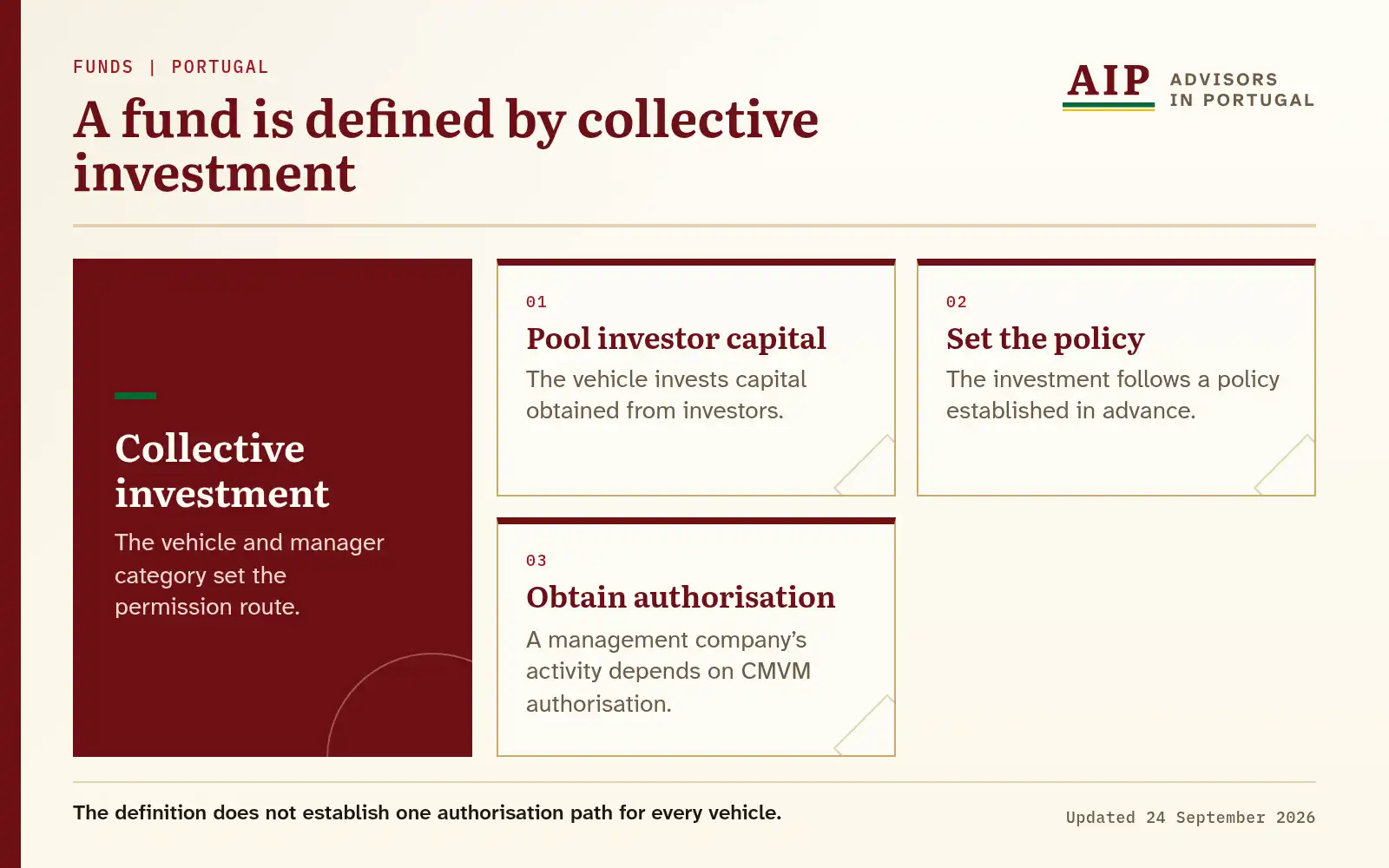
Diagram text version
Pool investor capital. Follow a pre-established policy. Obtain the authorisation required for the manager.
RGA fund forms, manager authorisation, investor documents, charges and feeder-fund rules.
What is an investment fund under Portuguese law?
The Regime da Gestão de Ativos (RGA), approved in the annex to Decreto-Lei n.º 27/2023, defines collective investment undertakings in Article 2 by their collective investment purpose and pre-established policy. A promoter describes the investors, pooled assets and investment policy before selecting a legal form. The intended investor rights and asset schedule belong with that description. Those records connect the proposed legal form to the actual assets and the promises made to investors. The proposal is then compared with the RGA definition and the manager activity it requires.
RGA Articles 3 and 4 distinguish a corporate investment company from a contractual fund and open from closed structures. Units in an open structure vary with subscriptions and redemptions, while a closed structure follows its own fixed-unit framework. The promoter identifies whether investors expect redemption rights and what the assets permit. The form and constitutive documents follow those economics. The proposed redemption terms sit beside the asset policy so both can be assessed together. A mismatch between the portfolio liquidity and redemption terms requires a decision before investor documents are issued.
The RGA classification follows the proposed rights and operating structure. The draft policy, subscription terms and governance arrangements show which classification applies. The legal form is settled before the documents are circulated. The Article 2 definition and Articles 3 and 4 are the starting point for a structure that will take money from multiple investors.
Who must obtain CMVM authorisation?
RGA Articles 22 and 28 place authorisation of investment-management activity with Comissão do Mercado de Valores Mobiliários (CMVM) before a manager starts that activity. Article 28(1) sets the manager categories available for authorisation. The proposed manager and the category of undertaking are identified before an application is prepared. Under the RGA (Decreto-Lei n.º 27/2023), the CMVM procedure depends on the fund and manager category and may be authorisation, communication or prior communication.
The manager and fund are distinct questions of law. The manager needs its own authorisation under Articles 22 and 28. The manager’s ownership, governance and activity plan accompany the proposed fund documents. The planned functions are compared with the authorisation scope sought from CMVM.
CMVM maintains records of authorised entities. The exact legal name and activity matter, especially where a group has several companies. The public entry is compared with the service the proposed manager would actually perform. The authorisation condition applies to the manager’s activity, so the correct entity must appear in the analysis.
Which fund form should the promoter choose?
RGA Articles 3 and 4 allow corporate or contractual form and open or closed structures. The choice follows the assets, redemption policy and investor terms. The promoter decides whether investors can request redemption and how the portfolio will meet that obligation. The chosen form is then documented around those facts.
A contractual fund uses units and a manager under its constitutive documents. A corporate investment company has its own corporate form. The promoter identifies which entity will own assets, enter contracts and report to investors. Those roles are related to the RGA definitions and to the selected manager’s Article 28 authorisation.
The open or closed decision affects the terms investors receive. The promoter describes subscriptions, transfers, redemptions and the intended life of the vehicle before seeking approvals. The legal documents must be consistent with those terms. RGA classification follows the proposed investor rights and structure.
What governance does the manager need?
RGA Article 104 requires a suitable management board and internal policies and procedures that protect participants. The promoter identifies the people who will direct the manager and the controls over decisions involving investor assets. The proposed governance is compared with Article 104 and the activities for which Article 28 authorisation is sought.
A board chart should show the actual decision makers. Responsibilities, conflicts handling, portfolio decisions and record keeping are documented. Those facts show whether the written procedures describe the manager’s real operation. Article 104 ties governance to the interests of participants. Each responsibility is assigned in the written policy.
The manager may use service providers, but its own authorised role remains relevant. The documents identify who performs administration, custody-related functions and investor communication. Those arrangements are mapped to the manager’s duties and contracts. The Article 22 authorisation file should match the structure that will operate after launch.
What must investors learn before subscribing?
RGA Article 88(1) requires a key investor information document that helps investors understand the nature and risks of an undertaking and make an informed investment decision. Article 88(4) requires the information to be correct, clear, consistent with the prospectus and not misleading. Investors receive the version that describes the actual policy and costs. Distribution and investor restrictions depend on the fund category and offer under the RGA.
The key information document, prospectus and subscription materials are compared before circulation. A conflict in the stated asset policy, fees or redemption rights is resolved in the constitutive documents. Article 88 requires useful and consistent investor information in the required disclosure.
An investor needs to know how the fund will invest and how an exit can occur. The portfolio rules, risk description and charges accompany the subscription agreement. Each document is compared with the Article 88 standard. Changes to the structure should be reflected across the investor materials before new subscriptions are taken.
How may a feeder OICVM invest?
RGA Article 193(1) requires a feeder OICVM to invest at least 85% of its net asset value in units of a master OICVM. The master, the feeder and the intended asset allocation are identified before the provision is applied.
The promoter obtains the master fund’s documents and the proposed feeder policy. The holdings and legal categories are compared with Article 193(1). The remaining portion of assets is governed by the applicable feeder rules and fund documents. A portfolio description should identify the exact master units with the units and master identified.
The feeder structure adds an investment relationship between two undertakings. That relationship is explained in the investor materials and governance arrangements. The Article 88 disclosures are compared with the 85% statutory allocation. Investors should receive the terms of the vehicle they subscribe to and the material risks of its dependence on the master.
Which charges may a fund bear?
RGA Article 69(1)-(2) controls charges borne by the fund and requires costs appropriate to sound and prudent management. Management, administration and other proposed charges are listed in the documents investors will receive. The schedule is compared with Article 69 before the fund begins charging.
A budget needs to distinguish a fund-borne expense from a manager or promoter expense. The documents identify who contracts for each service and who pays it. The constitutive documents and provider agreements must be consistent. Article 69 governs what the fund may bear; formation charges follow the selected structure and procedure.
Fee calculations and any variable charge appear in the relevant investor materials. They are compared with the Article 88 requirement for clear, consistent information. An expense added after subscription raises a different question from a disclosed charge in the documents. The permitted cost analysis starts with the fund’s constitutive terms and the applicable RGA provision.
What changed for alternative funds that lend?
Decreto-Lei n.º 103/2025 Article 9 amended RGA rules for alternative investment undertakings that grant credit. The decree’s entry-into-force date must be confirmed before the amended text is relied on. Whether the proposed undertaking lends decides which amended provision governs its assets and activity.
A lending policy needs the fund and manager categories to be stated precisely. The draft lending terms, borrower profile and risk controls are the facts that decide the analysis. They are compared with the amended RGA provisions and the manager’s Article 28 authorisation scope. A proposal to buy debt instruments may require a different analysis from one that originates credit.
The selected structure and official procedure determine the formation charges, and the relevant fund category determines its capital rules. The budget rests on the selected structure and applicable official procedure. The constitutive documents must reflect the provision that applies to the proposed lending activity. The date matters for the current legal text, and the fund’s actual activity determines the operative rule. The proposed lending policy is retained with the dated version of the constitutive documents.
Common questions
How do unit numbers differ in open and closed structures?
Can one manager seek authorisation for both OICVM and OIA?
Must a feeder OICVM invest all its assets in a master?
Can a fund charge an expense missing from its constitutive documents?
Does a single statutory setup fee apply to all funds?
Which lending provisions did the 2025 decree amend?
Related guides
The information on this page is checked against official sources and reviewed regularly. It is corrected when the law or official guidance changes, as the Editorial Standards describe.