Buying a Company in Portugal: Structure, Due Diligence and Registration
Buying a company in Portugal raises company-law questions under the Código das Sociedades Comerciais, and the transaction structure and the target's articles are the first documents to check. Due diligence findings can affect the price terms, conditions and warranties.

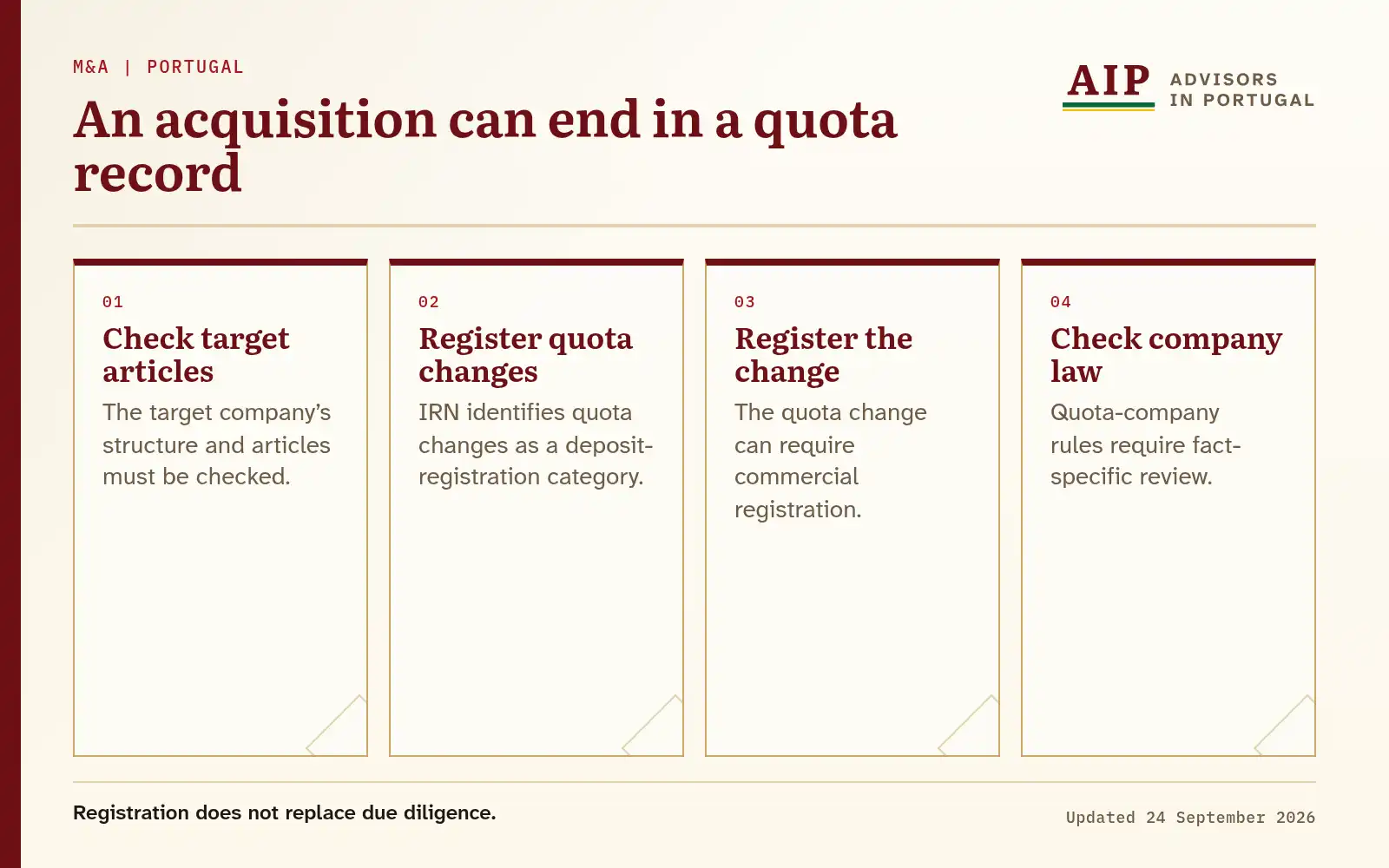
Diagram text version
Check the target articles. Register quota changes. Check the company form. Review company law.
A Portuguese company acquisition combines company-law rules, a commercial-registration step and, for listed securities or a public offer, a separate securities-market procedure. The Código das Sociedades Comerciais governs the company-law questions, IRN records commercial-registration deposits and CMVM is Portugal’s securities-market authority.
Which rules govern the acquisition of a Portuguese company?
The Código das Sociedades Comerciais governs Portuguese company-law questions. The transaction structure and the target company’s articles are the first documents to check. The articles and the transaction documents raise the consent and validity questions that apply to a transfer of quotas.
Is a share acquisition the same as a statutory merger?
No. A statutory merger follows a distinct process under the Código das Sociedades Comerciais and can require registration and creditor-protection analysis. A share acquisition, a statutory merger, a listed-securities deal and a public offer each need a distinct analysis.
What does due diligence cover in a Portuguese acquisition?
The review areas follow from the target and the transaction facts. Due diligence can cover corporate, contractual, employment, property, financing, disputes and regulatory records when those areas form part of the agreed scope. The issues it finds can affect the price terms, the conditions, the warranties and the closing documents.
Which target records does a review draw on?
The core records are the target’s articles, commercial certificate, ownership records, accounts and available corporate books. A review can add current registry extracts, litigation records, detailed employment records and any beneficial-ownership records the target holds.
Further records depend on the agreed scope:
- Contracts, employment records, licences, property records and financing documents.
- Disputes that involve the target.
- Any letter of intent, term sheet, acquisition agreement, disclosure material or corporate approval already prepared.
- Any listed securities, regulated activity, sector approval or public-offer issue connected with the transaction.
A record that is unavailable is noted so that the transaction documents can address the gap.
How is a quota transfer registered?
IRN identifies quota changes as a commercial-registration deposit category. The consent and validity questions are checked against the articles and the transaction documents, and the applicable Registo Comercial filing follows closing. An ownership change can also require an update to the beneficial-ownership (RCBE) registration.
When do CMVM rules apply?
CMVM is Portugal’s securities-market authority. A transaction that involves listed securities or a public offer can be subject to a separate securities-law or CMVM procedure. The question arises at the start of a transaction because the selected procedure sets further steps.
What do AML rules ask about owners and funds?
AML due diligence can require identification and risk assessment, including beneficial-owner and funds information when relevant. The information involved covers the direct and beneficial owners, the acquisition vehicle and the available source-of-funds information.
What are the official registration fees?
IRN states that a registration request can be rejected if the applicable fee is unpaid. The charge depends on the exact registration act, so the current IRN charge for that act applies.
How long does an acquisition take?
One period does not fit every acquisition or merger. The timeline depends on the transaction structure, the due diligence material, the negotiations, the corporate approvals and the applicable authority procedure. It grows longer when target records are unavailable, when document negotiations or approvals remain outstanding, or when the selected registration or CMVM procedure requires further steps. The deadline for the selected commercial-registration act can be checked after the transaction structure is fixed.
How do signing, closing and registration fit together?
Signing and closing need the signing authorities, the conditions and the documents that the agreed closing steps require. The completion document needs the form that the act requires, and the parties settle that form before they close. The Registo Comercial filing follows closing, and an ownership change can trigger the RCBE update described above.
Common questions
Which rules govern a private-company acquisition in Portugal?
Does a transfer of quotas require commercial registration?
Is a share acquisition the same as a statutory merger?
Which authority handles Portuguese listed-company and public-offer matters?
What does due diligence cover in a Portuguese acquisition?
Will the buyer need beneficial-owner or source-of-funds information?
What are the official commercial-registration fees?
How long does an acquisition in Portugal take?
The information on this page is checked against official sources and reviewed regularly. It is corrected when the law or official guidance changes, as the Editorial Standards describe.