International Tax Structuring in Portugal
International tax structuring in Portugal maps the tax presence of groups that are opening, acquiring or expanding a Portuguese operation. We test permanent-establishment facts under CIRC Article 5, including service activities in Portugal that exceed 183 days in a 12-month period.
First conversation free Reply within one business day

Who Needs International Tax Structuring in Portugal
- Your group is opening, acquiring or expanding a Portuguese operation and needs the tax presence mapped.
- Your company is testing whether people, services or dependent agents create a Portuguese permanent establishment.
- Your Portuguese parent holds or may hold a foreign entity and needs the CFC threshold and attribution period checked.
- Your group needs withholding, treaty, foreign-credit or transfer-pricing work aligned across countries.
A domestic bookkeeping request, a standalone personal return or aggressive arrangements that depend on hiding ownership or income are outside the offer.
What's Included in International Tax Structuring
The tax and reporting work your group needs is set out before any filing starts.
- Residence and source map. A certified accountant applies CIRS Articles 15, 16 and 18 to the people, income and relevant periods in the structure.
- Permanent-establishment review. A certified accountant tests the fixed-installation, service-duration and dependent-agent facts under CIRC Article 5.
- CFC analysis. A certified accountant checks the 25% holding threshold, 50% effective-tax comparison and attribution to the period containing the foreign entity’s year-end under CIRC Article 66.
- Withholding and treaty work. A certified accountant maps the 28% and 25% domestic rates in CIRS Article 71, then tests the recipient, beneficial owner, treaty and forms.
- Foreign-tax credit. A certified accountant applies CIRS Article 81’s lower applicable limitation to the foreign income and evidence.
- Transfer pricing and APA route. A certified accountant applies the arm’s-length rule in CIRC Article 63 and considers an advance-pricing agreement under Article 138.
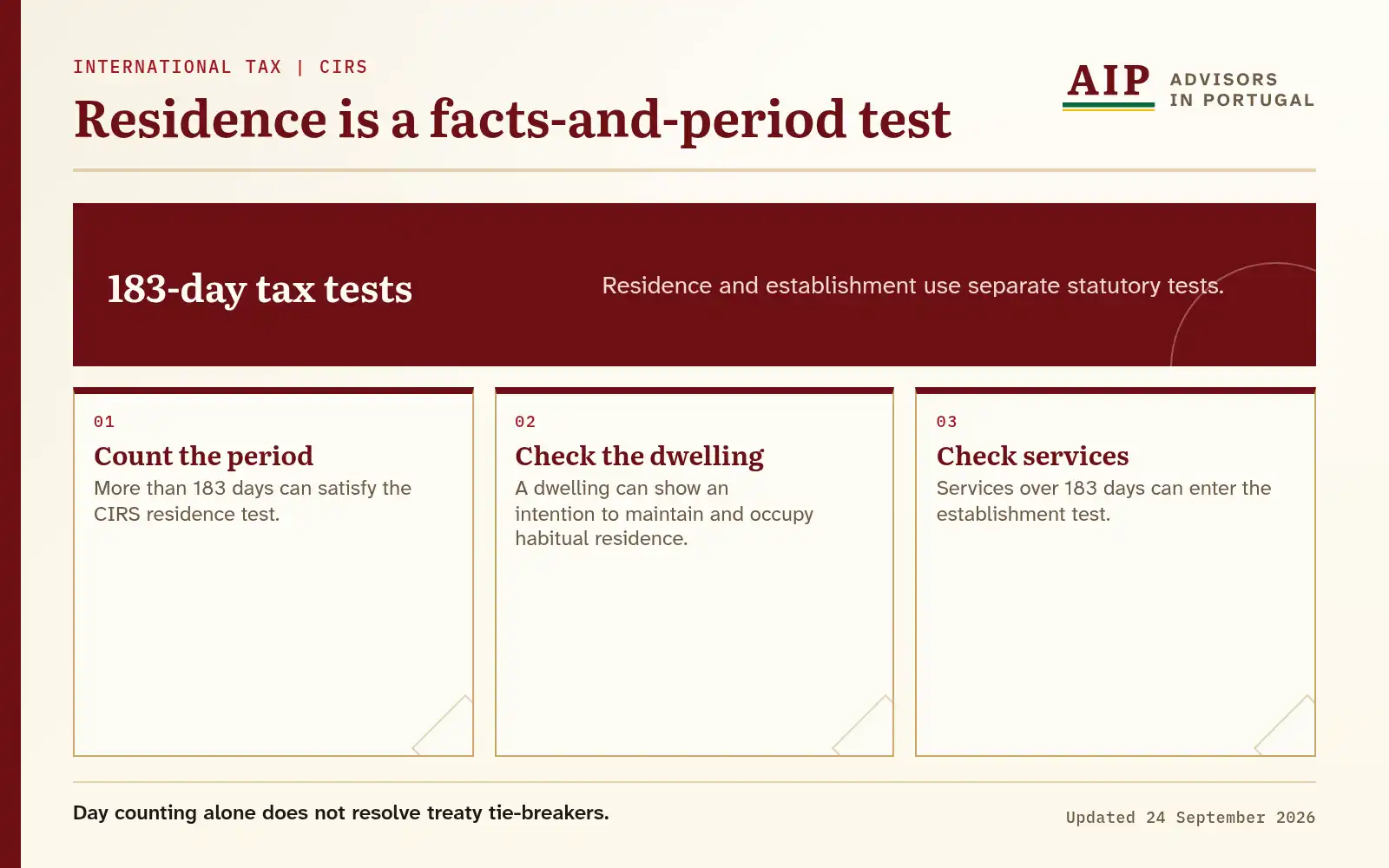
Diagram text version
Count the period. Check the dwelling. Check service days for establishment.
What Your Group Needs to Provide
- Group chart
- The entities, ownership, voting rights, beneficial owners, directors and jurisdictions in the proposed structure.
- People and presence
- Residence dates, homes, travel, employees, contractors, agents and the locations where decisions and services occur.
- Transaction map
- The goods, services, financing, royalties, dividends, management charges and restructurings between the relevant parties.
- Tax evidence
- Foreign assessments, withholding certificates, treaty forms, entity accounts and effective-tax information for the relevant period.
- Existing compliance
- Portuguese returns, transfer-pricing files, disclosures, rulings, registrations and any authority correspondence.
How International Tax Structuring Starts
Every case starts with the form below. Describe your group, people, jurisdictions and transactions. A certified accountant handles the tax work in English or Portuguese.
A certified accountant builds the tax analysis around the Portuguese IRS or IRC filing position for filing with the Autoridade Tributária e Aduaneira, and flags corporate, accounting, audit and reporting questions along the way.
-
Map people, entities and activity
A certified accountant records the residence, ownership, decision-making, personnel and transaction facts for each relevant jurisdiction.
-
Test the Portuguese tax presence
A certified accountant applies the CIRS residence and source rules and checks the CIRC permanent-establishment conditions.
-
Model CFC and payment flows
A certified accountant tests the 25% CFC threshold, effective-tax comparison, year-end attribution and each payment category.
-
Check relief and pricing
A certified accountant maps treaty relief, foreign-tax credits, beneficial ownership, transfer pricing and the evidence each conclusion needs.
-
Separate the professional routes
A certified accountant takes the accounting and tax work. Statutory-audit work follows the OROC route.
-
Prepare the compliance plan
The Portuguese filings, disclosures, supporting records and authority questions for the agreed structure are set out.
Timing and Possible Delays
Set case by case
The work is planned around the number of entities, jurisdictions, transaction types and periods that need analysis.
What delays it
The work takes longer when ownership is layered, foreign tax evidence is incomplete, a treaty position needs another country’s facts or an advance-pricing route is being considered.
What to prepare now
You prepare the group chart, residence calendar, transaction flows, accounts, tax assessments and existing Portuguese filings before the work begins.
Ongoing Cross-Border Tax Obligations
Permanent-establishment evidence
A certified accountant records where people work, where decisions occur, which premises are available and how services are delivered. You provide contracts, travel calendars, staffing arrangements, agent authority and customer-facing activity. The certified accountant compares the fixed-installation, service-duration and dependent-agent evidence, then records the conclusion before the Portuguese filing position is set.
CFC and payment-flow records
A certified accountant keeps the ownership percentages, voting rights, rights to income or assets and foreign tax computation in one schedule. You preserve the payment dates, recipient status, beneficial-owner evidence and treaty forms for each dividend, interest, royalty or service fee. The certified accountant checks the year-end attribution after reconciling those payment records and before the Portuguese return is prepared.
Transfer pricing and professional routes
A certified accountant identifies related-party transactions before the accounting file is prepared and sets the document sequence for the pricing analysis. Your group provides comparable terms, agreements, invoices, financing schedules and any proposed restructuring. Statutory-audit work follows its own professional route, and any Article 138 advance-pricing request goes to the tax authority.
Set out your cross-border structure
State the entities, jurisdictions, people, transactions and Portuguese questions your group needs to resolve.
Common questions
When does an individual become Portuguese tax resident?
What creates a Portuguese permanent establishment?
What is the CFC holding threshold?
Does Portugal apply one withholding rate to every payment?
Can Portugal credit foreign tax?
How does transfer pricing apply to group transactions?
Can the group request an advance-pricing agreement?
Who may carry out international tax structuring work?
How is my international tax structure handled?
How the Tax Structuring Service Works
-
One point of contact for the whole case
The tax, accounting, corporate and reporting questions of your case are kept together, and each regulated route stays separate as described in the FAQ below.
-
English or Portuguese.
English or Portuguese, whichever you are most comfortable in.
-
A written quote before work starts.
You get a quote in writing before any work starts. Fees are set case by case.
Contact us
Your request is in
Every request is read in house. The requirements are assessed, and a reply by email sets out the appropriate next steps.
Every enquiry is read in house, and the aim is a reply within one business day.
The information on this page is checked against official sources and reviewed regularly. It is corrected when the law or official guidance changes, as the Editorial Standards describe.