Trusts and Portugal: Tax Treatment and Reporting
Trusts in Portugal are not incorporated into Portuguese law as a general legal figure, according to the tax authority's opinion in Processo 2018001283. The authority treated the trust as an IRC taxpayer in that case only where the beneficiary's identity was unknown.

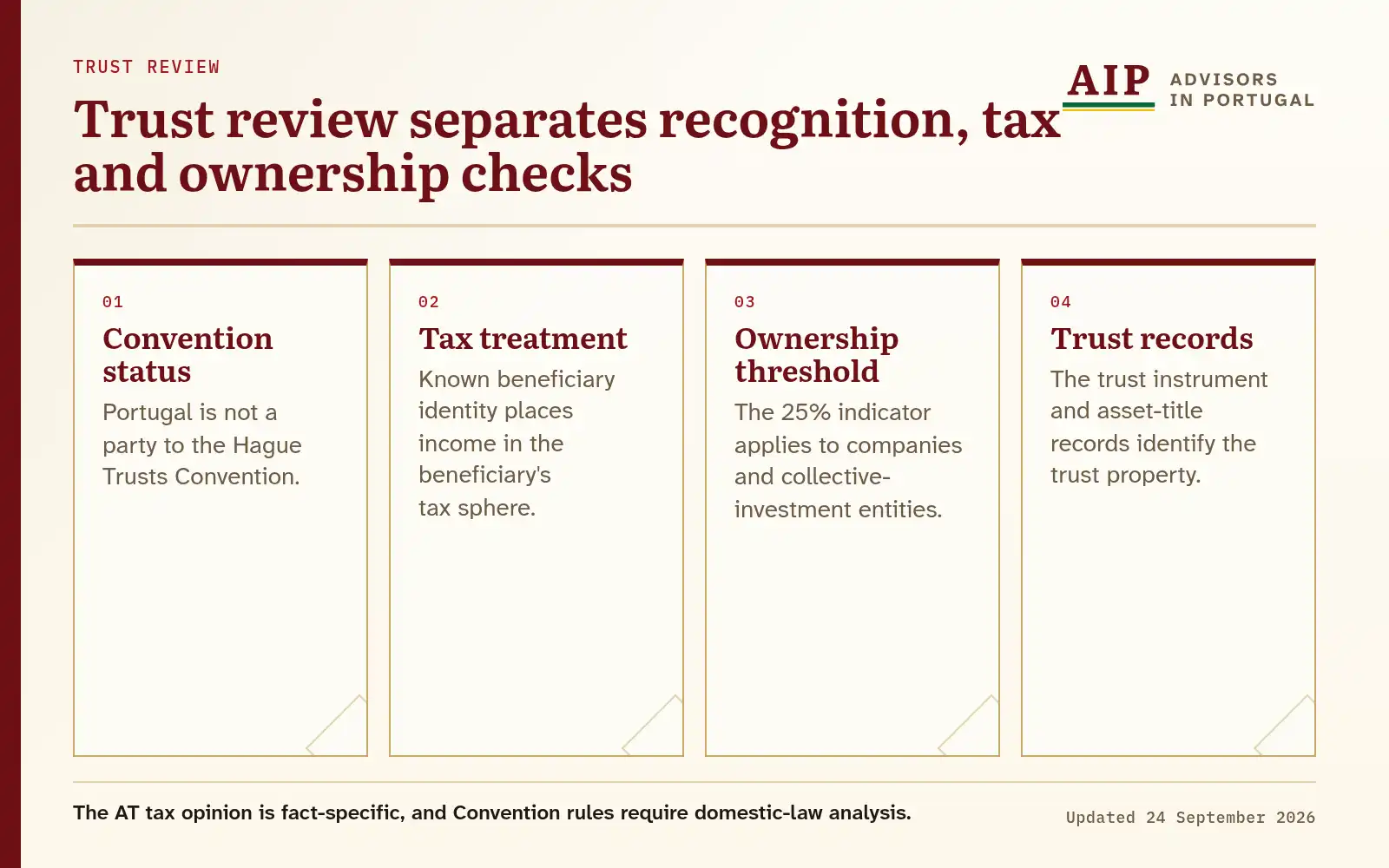
Diagram text version
Portugal is not a party to the Hague Trusts Convention. Known beneficiary identity places income in the beneficiary's tax sphere. The 25% indicator applies to companies and collective-investment entities. The trust instrument and asset-title records identify the trust property.
Article 2 of the Hague Trusts Convention describes a relationship in which a trustee controls assets for a beneficiary or purpose. Article 3 confines that Convention to voluntary trusts proved in writing. A Portuguese connection requires separate analysis of the trust instrument, its governing law, the people involved and the location of each asset.
This guide sets out how the Convention, the Portuguese tax authority’s opinion and the beneficial-owner rules apply to trust documents and records.
What counts as a trust under the Hague Convention?
Article 2 of the Hague Convention on the Law Applicable to Trusts and on their Recognition describes assets placed under a trustee’s control for a beneficiary or specified purpose, during life or after death. Article 3 limits the Convention to trusts created voluntarily and proved in writing. You should obtain the instrument or other writing that evidences the arrangement before applying the Convention language.
The Article 2 characteristics include assets held as a separate fund, title in the trustee’s name, and trustee powers and duties under the terms and applicable law. Each characteristic is traced to the document that establishes it. You should keep the asset-title records beside the trust instrument. The Convention definition describes the legal relationship. The relevant Portuguese tax or succession rule is then examined separately.
Which law governs a trust with a Portuguese connection?
Portugal is not a party to the Hague Trusts Convention. The Convention therefore does not supply Portuguese governing law. A foreign trust’s own law may apply the Convention rules. Where that law applies the Convention, Article 6 permits the settlor to choose the applicable law expressly in the instrument or writing proving the trust. Article 7 points to the law with the closest connection where there is no choice, using factors that include the place of administration, asset location and the trustee’s residence or business.
You should produce the full instrument, amendments and documents showing where the trust is administered. The written choice under the foreign trust’s own law is compared with the assets and acts that bring the arrangement into contact with Portugal. You should therefore identify the law governing the transfer as well as the law named for trust administration. Those questions can differ in a cross-border estate.
Which documents identify the people and assets?
Article 2 of the Hague Trusts Convention identifies the settlor, trustee, beneficiary or purpose and the assets under trustee control as the central features. The trust instrument and asset-title records are the primary documents for identifying those features. The Convention does not prescribe one Portuguese form covering every trust arrangement.
You should collect the signed instrument, later amendments, trustee appointment records, beneficiary provisions and title or custody statements for each relevant asset. A distribution or asset transfer is traced back to the clause that authorises it. You should distinguish a named beneficiary from a class described in the instrument, and a trustee who controls property from a custodian who merely holds a record. Those distinctions matter to the fact-specific tax analysis and to the identification work under anti-money-laundering rules. Each Portuguese income item or asset is then related to the person and period concerned.
How may a foreign trust’s income be taxed?
Article 2(1)(c) of the Código do IRC features in the Autoridade Tributária e Aduaneira’s Ficha Doutrinária, Processo 2018001283. In the case addressed by that opinion, the authority treated the trust as an IRC taxpayer only where the beneficiary’s identity was unknown; where the institutor or beneficiary was known, it discussed taxation in the beneficiary’s sphere. The opinion concerns the facts it describes.
You should identify the taxpayer, income source, receipt and distribution for each Portuguese tax question. The structure is compared with the facts and reasoning in the opinion and the current law. You should preserve accounts showing when income arose and when a beneficiary received an amount. A distribution may involve a different fact pattern from income retained in the arrangement. Those questions are separated before a Portuguese return is prepared. You should not use the label ‘trust’ as a substitute for the taxpayer analysis.
Who must be identified as a beneficial owner?
Article 30(1)-(2) of Lei n.º 83/2017 uses more than 25% of capital, voting rights or participation as an indication of direct ownership for a company or collective-investment entity. It provides for control by other means and a senior-management fallback after reasonable means have been exhausted. You should identify the entity or arrangement to which the particular rule applies before using a percentage test.
Article 29(4)-(5) requires obliged entities to record the actions taken to identify beneficial owners and keep those records available to sectoral authorities. The settlor, trustee, beneficiaries, powers and assets shown in the instrument are mapped against the actual identification obligation. You should preserve documents showing control, appointments and amendments. The applicable route and the reasoning behind it are documented.
When do identification records need updating?
Article 40(1)-(4) of Lei n.º 83/2017 requires obliged entities to update identification and beneficial-owner information periodically. The period follows risk and may not exceed five years for low-risk clients. The article requires immediate updating when money-laundering or terrorist-financing suspicions arise, or when a legal duty requires it.
You should provide a changed trustee appointment, amended beneficiary class or asset-control record to the obliged entity handling the relevant relationship. The next step is to identify whether the change affects the recorded people or control analysis. You should retain the earlier and revised instrument versions so that the chronology is clear. The five-year maximum for low-risk records does not postpone an immediate update triggered by one of Article 40’s stated conditions. The transaction and relationship facts identify what must be revised.
Where does trust-related information go?
Article 29(4)-(5) of Lei n.º 83/2017 requires obliged entities to hold written beneficial-owner identification records available to sectoral authorities. That record duty is distinct from a Portuguese tax return or any other filing that a particular trust-related transaction may require. You should specify the obligation before deciding which authority or recipient is involved.
The income and taxpayer are identified for a filing with the Autoridade Tributária e Aduaneira. The instrument and any Portuguese property or succession act may require a separate step. You should keep correspondence and receipts for each actual filing. You should identify each obligation and its recipient separately from the Article 29 record duty.
Which professional authority applies to each act?
Article 8 of the Hague Trusts Convention addresses trustee powers and duties under the law governing the trust. You should identify the professional authority that applies to each proposed legal, tax or investment act. Legal drafting, tax advice, accounting, anti-money-laundering work and regulated investment advice are separate activities. An investment service is identified separately so that the relevant regulatory permission can be assessed for that activity.
How can Portuguese succession rules affect a trust?
The Autoridade Tributária e Aduaneira’s Ficha Doutrinária, Processo 2018001283 describes a conflict involving a testamentary trust and immovable property under Portuguese law, including possible limits on trustee powers by reference to executor rules. You should identify the asset and transfer act before treating the trust instrument as the whole succession answer.
The will, relevant family relationships, title records and the law that governs succession are examined. You should supply documents that show when and how the property moved. The applicable trust law and the law governing succession or land rights can address different issues. A Portuguese property can therefore require separate analysis even where the trust instrument chooses a foreign law. The tax consequences are then considered for the identified person and transaction.
What current legal position should you use?
The current consolidated Lei n.º 83/2017 contains the Article 30 beneficial-owner identification and Article 40 updating provisions. The Autoridade Tributária e Aduaneira issued Ficha Doutrinária, Processo 2018001283 in 2018 for its stated facts. You should date the instrument, transactions and tax year before applying any rule.
The governing-law clause is compared with the foreign trust’s own law and, where that law applies the Convention, with Articles 6 and 7, alongside Portuguese rules for the affected asset. The current tax law is applied to the identified income. You should retain the source documents behind every ownership and payment step. The analysis begins with what the parties did and which law governs the particular issue, not with a generic label attached to the arrangement.
Common questions
Does Portuguese law incorporate the trust as a general legal figure?
Can the settlor choose the governing law implicitly?
Does the trust’s purpose matter when no law is chosen?
Does the AT trust opinion set one tax rate for all trusts?
Can a doubt about identification details trigger an immediate update?
Does the Convention settle the validity of a will transferring property to a trustee?
Related guides
The information on this page is checked against official sources and reviewed regularly. It is corrected when the law or official guidance changes, as the Editorial Standards describe.