Portugal Tax Return Guide
A Portugal tax return reports the previous year's income on Modelo 3, which you file electronically between 1 April and 30 June under Article 60. Your residence position decides whether Modelo 3 covers your worldwide income or generally only Portuguese-source income without withholding.

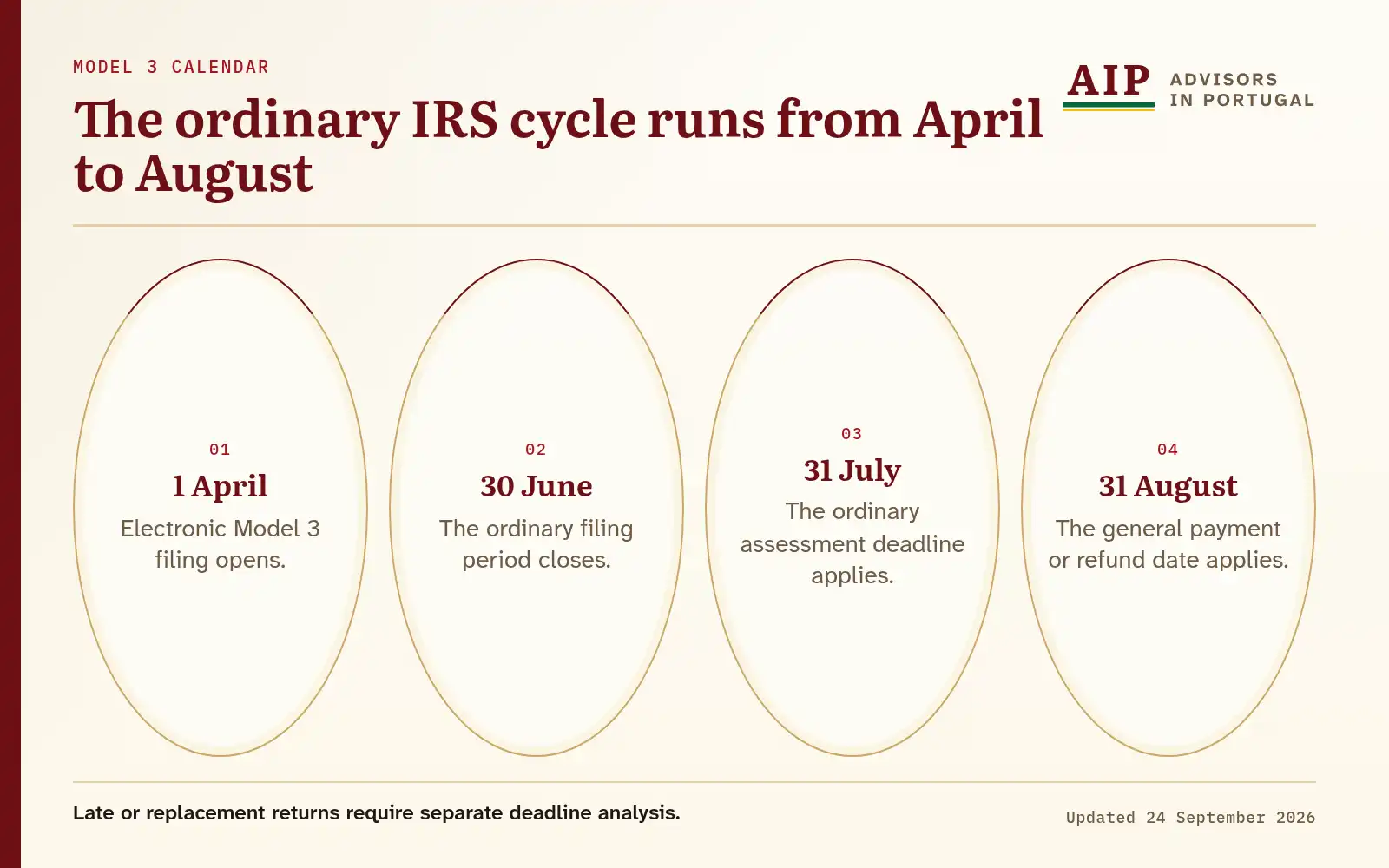
Diagram text version
Electronic Model 3 filing opens. The ordinary filing period closes. The ordinary assessment deadline applies. The general payment or refund date applies.
Portugal’s annual IRS return reports the previous year’s income under Article 57 of the Código do IRS. You file Modelo 3 electronically from 1 April through 30 June under Article 60. The answer for your return depends on your residence, income categories, household election and evidence of tax paid abroad.
Who has to file a Portuguese tax return?
Article 57 of the Código do IRS requires IRS taxpayers to submit an annual official-model return for the previous year’s income . The Autoridade Tributária e Aduaneira explains that residents report worldwide income, while non-residents generally report Portuguese-source income that was not subject to withholding. You should identify your residence position for the tax year before deciding which income belongs on Modelo 3.
You may have Portuguese employment, business, rental, capital, gain or pension income in the same year. You should list each source and the dates when it arose. Classifying the income then shows whether a Portuguese return is required. A withholding entry on a payslip does not describe every income category that you might need to report. You should retain annual statements and the underlying records, especially where an employer or payer reported an amount to the tax authority.
When and how do you file Modelo 3?
Article 60(1) of the Código do IRS sets electronic filing from 1 April to 30 June for the annual return under Article 57. The Autoridade Tributária e Aduaneira directs taxpayers to Portal das Finanças, IRS > Entregar Declaração. You should plan the return around the statutory window and the tax year that the return covers.
You should have access to the filing account and all income records before you start. The proposed return should match payer statements and the household information shown in the portal. You should retain the submission receipt and a copy of the filed declaration. A later correction raises a separate question about the applicable correction rules; the ordinary 1 April to 30 June period by itself does not answer that question.
Which 2026 IRS rates apply?
Article 68 of the Código do IRS, as amended by Lei n.º 73-A/2025 for 2026, starts the general progressive table at 12.50% on taxable income up to €8,342 and reaches 48.00% above €86,634. Those are tax-year rates, not a single rate on every euro and not the withholding tables used during the year. You should identify the correct tax year before using either end of the table.
You should separate income subject to the general progressive table from income that may fall under a special rate or another treatment. The assessment is calculated from the actual income categories and elections. A payroll withholding amount is an advance collection item and cannot by itself tell you the final annual tax. You should keep the income statement and withholding evidence so the annual calculation can account for tax already collected.
Which income annexes and records belong with the return?
Article 57 of the Código do IRS and the Autoridade Tributária e Aduaneira’s Modelo 3 guidance cover employment, self-employment, capital, rental, capital-gain and pension income. The authority maps category B business or professional income to Annex B or C . You should classify each stream before selecting the annexes.
You should collect payer statements, invoices, contracts, property records and investment statements that explain the amounts in the declaration. Those records should match the income categories and any available pre-filled information. The appropriate annex set depends on your income and elections. You should retain the records behind the filed figures, including records from outside Portugal, because the electronic return captures a calculation but does not replace the underlying evidence.
How do you report foreign income and foreign tax?
Article 81 of the Código do IRS governs the international double-tax credit. The Autoridade Tributária e Aduaneira says a resident who reports foreign income on Modelo 3 reports the foreign income and tax paid. You should identify the country, income type, gross amount and foreign tax shown on your records.
A treaty may affect the Portuguese assessment for a particular income stream. Read the treaty and Article 81 together with the foreign tax documentation. You should distinguish tax actually paid from a payer’s estimate or an amount merely withheld pending a later foreign assessment. You should keep the foreign return, assessment and payment evidence where those exist. The credit depends on the applicable rule and the information entered for the relevant tax year.
When can you use automatic IRS?
Articles 58 and 58-A of the Código do IRS govern automatic IRS. The Autoridade Tributária e Aduaneira generates a provisional declaration and assessment for each available separate or joint taxation regime. You must verify the pre-filled family, income and deduction information and confirm the correct option. You must file a manual Modelo 3 when the conditions for automatic IRS are unmet or the information is incomplete.
You should read the provisional amounts against your own records before confirming anything. Compare each available household option with the income and dependants you actually have. A pre-filled item is a starting record, and your confirmation adopts the declaration for the relevant year. You should preserve the provisional view and the final confirmation receipt where you use this route.
Should spouses file jointly or separately?
Article 59(1) of the Código do IRS uses each spouse’s or união de facto partner’s own income under separate taxation. Article 59(2) includes all household members’ income in one declaration under joint taxation. You should compare both permitted outcomes using the same year’s complete household information.
Check the dependants, income allocations and election shown in the portal. You should include income from both members when comparing the options, including any foreign income that belongs on the Portuguese return. The choice can affect the annual calculation even though the underlying earnings remain the same. You should retain the household records used for the comparison and the election submitted with the return.
Who can prepare or submit the return?
The Autoridade Tributária e Aduaneira says you can submit Modelo 3 yourself through Portal das Finanças. Article 5 of the Código de Procedimento e de Processo Tributário and Article 10 of the Estatuto da Ordem dos Contabilistas Certificados address professional representation and activity. You may ask an adviser to prepare the figures or act within the professional authority that applies to the work.
You should establish who will review the facts, who will enter the return and who will approve its submission. Reconcile the records before filing so that each choice the declaration requires rests on evidence. A taxpayer’s ability to self-file does not make a particular annex or treaty position automatic. You should keep control of the final declaration and submission evidence, whatever preparation arrangement you use.
When are assessment and payment due?
Article 77 of the Código do IRS sets the ordinary assessment deadline at 31 July, and Article 97 sets payment by 31 August where assessment is made by 31 July. The Autoridade Tributária e Aduaneira describes 31 August as the general payment or refund date for that ordinary assessment. Article 102 sets separate category B advance payments.
You should compare the assessment notice with the return that you filed and any withholding or advance payments already recorded. An apparent discrepancy raises the question whether a correction or late return needs separate treatment. You should distinguish the tax authority’s ordinary assessment and payment calendar from a date in a particular notice. You should keep the notice and proof of payment or refund with the filed return.
What changed for the 2026 tax year?
Lei n.º 73-A/2025 amended the Article 68 rate table used for 2026, including the 12.50% starting rate and 48.00% top rate. The current Article 57 text records a 2025 amendment to the annual declaration rule. You should apply the law for the income year on your return and the filing calendar for the year in which you submit it.
Compare a prior year’s return with the current facts without carrying forward an old rate table. You should check the residence, household and income categories again, since a change in those facts can alter the return even when the taxpayer’s main employment continues. The Autoridade Tributária e Aduaneira’s 2026 deadlines page records adjustments for some dates that fall on non-working days, while Article 60 expressly states its 30 June filing endpoint.
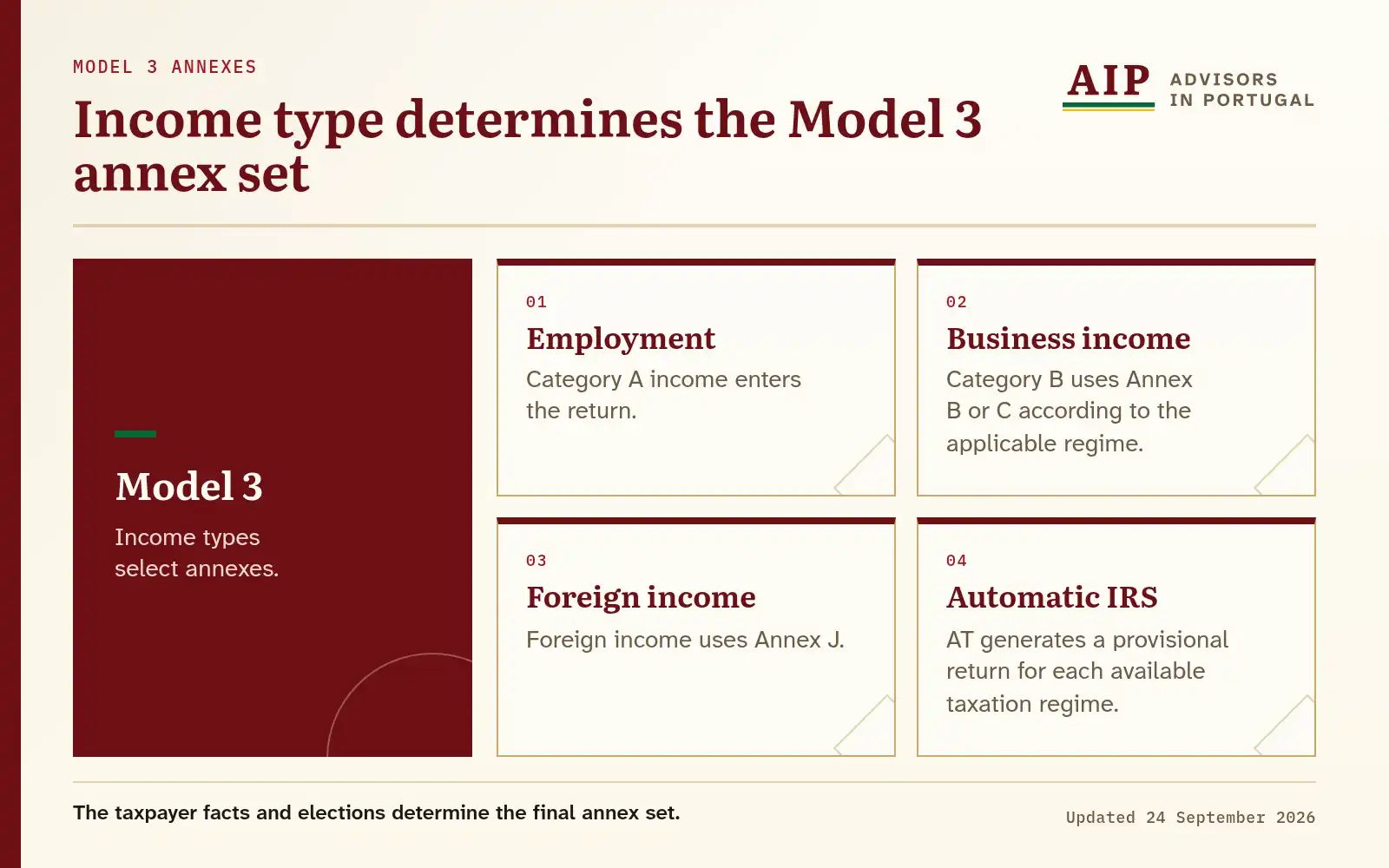
Diagram text version
Category A income enters the return. Category B uses Annex B or C according to the applicable regime. Foreign income uses Annex J. AT generates a provisional return for each available taxation regime.
Common questions
Does the annual return contain information besides income?
Does 30 June move when it is not a working day?
What is the next 2026 general IRS bracket after €8,342?
Which annex reports foreign income?
How much of dependants’ income enters each separate return?
When are category B advance payments due?
Your request is in
Your submission has been received.
Every enquiry is read in house, and the aim is a reply within one business day.
The information on this page is checked against official sources and reviewed regularly. It is corrected when the law or official guidance changes, as the Editorial Standards describe.