Accountant in Lisbon
An accountant in Lisbon prepares SNC accounts, bookkeeping records and tax filings for companies based in the city. Reserved accounting and tax-signature work requires a professional registered with the Ordem dos Contabilistas Certificados.
First conversation free Reply within one business day

Who Needs an Accountant in Lisbon
CIVA Article 77 assigns the competent Serviço de Finanças by registered office, principal establishment or domicile, and it assigns a non-resident without a Portuguese permanent establishment or representative to Lisboa 3. The AT's 2026 circular lists Lisbon's general municipal derrama for the 2025 IRC period at 1.50%, subject to the published exemptions and reduced-rate conditions.
- Your company needs SNC accounts, bookkeeping records and electronic tax filing support.
- You need the micro, small or medium SNC category applied to your balance, turnover and employee figures.
- Your finance staff need VAT, annual accounts, payroll and commercial-registration dates placed in one calendar.
- You need a registered Ordem dos Contabilistas Certificados professional for reserved accounting and tax-signature work.
A tax dispute, an audit opinion and a payroll-only request without the accounting records and filing work around it are outside the offer.
What's Included in Lisbon Accounting Services
The service defines the accounting, tax, reporting and registered-professional work your Lisbon company or tax position needs.
- OCC route. The title and reserved acts of a contabilista certificado depend on inscription in the Ordem dos Contabilistas Certificados (OCC). A certified accountant checks the OCC public register.
- SNC category and Lisbon derrama. SNC classifies companies as micro, small or medium based on balance-sheet total, net turnover and average number of employees; a certified accountant confirms which category applies using two of the three current legal thresholds for your entity. The AT's 2026 circular lists Lisbon's general municipal derrama for the 2025 IRC period at 1.50%, subject to its published conditions.
- VAT filing. Monthly VAT taxpayers with prior-year turnover of at least EUR 650,000 file electronically by the 20th of the second following month under CIVA Article 41(1)(a).
- Annual reporting. A certified accountant prepares the management report and accounts for three-month approval, or five months for consolidated or equity-method entities, then routes approved information to the competent commercial registry.
- Tax-signature work. A certified accountant enrolled with the OCC signs your declarations and financial statements as the certified accountant of record.
- Lisbon tax-office route, engagement and insurance. CIVA Article 77 assigns a non-resident without a Portuguese permanent establishment or representative to Lisboa 3. A certified accountant agrees a written service contract, confirms professional civil-liability insurance cover, and sets a fee for the complexity and responsibility of the work.
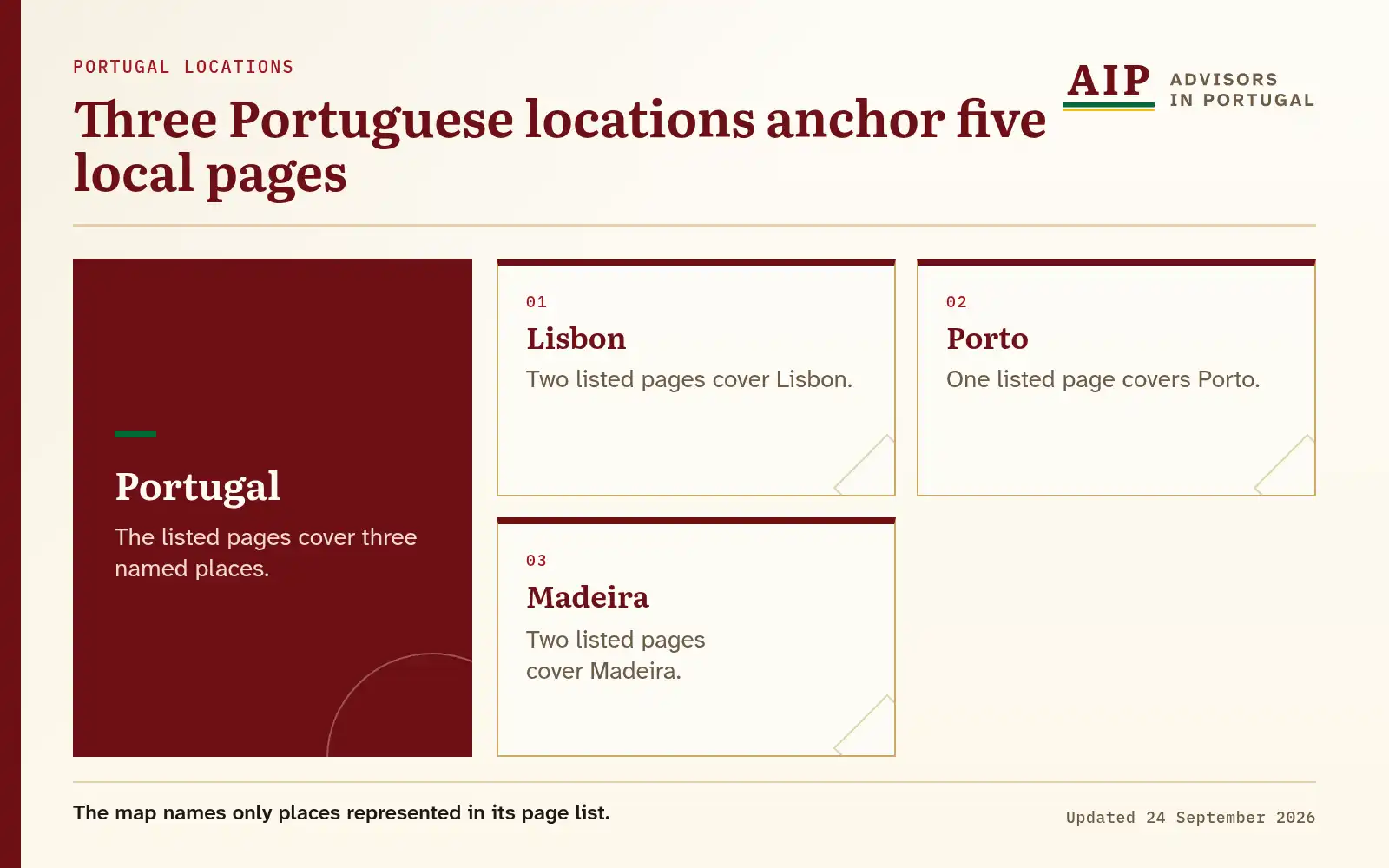
Diagram text version
Two listed pages cover Lisbon. One listed page covers Porto. Two listed pages cover Madeira.
What Your Accounts Need
- Entity and activity profile
- Legal form, registered office, activity, ownership, tax status and reporting period.
- Accounting records
- Invoices, bank statements, ledgers, payroll data, fixed assets and supporting schedules.
- Threshold figures
- Balance-sheet total, net turnover, average employees and prior-year SNC category.
- Tax and VAT records
- You provide VAT invoices, returns, tax notices, withholding information and Portal das Finanças access. A certified accountant uses the registered office, principal establishment or tax domicile to identify the competent Serviço de Finanças and checks whether the Lisboa 3 assignment applies.
- Annual reporting file
- Management report, annual accounts, consolidation material, approval records and registry history.
- Professional authority
- Power of attorney, OCC details, engagement terms and insurance confirmation for reserved work.
How Lisbon Accounting Starts
-
Map entity and SNC category
You provide the legal form, activity, year-end and balance, turnover and employee figures.
-
Set accounting records
A certified accountant organizes invoices, banks, ledgers, payroll, assets and supporting schedules.
-
Build the Lisbon VAT and tax calendar
The CIVA Article 41 return dates and the 1.50% general Lisbon derrama published for the 2025 IRC period are identified, subject to the circular's conditions.
-
Prepare annual accounts
A certified accountant prepares the management report, accounts, consolidation material and approval record.
-
Submit through the competent Lisbon route
A certified accountant files the applicable tax work through the Serviço de Finanças assigned by CIVA Article 77 and checks whether a qualifying non-resident is assigned to Lisboa 3. The accountant routes approved accounts to the competent commercial registry.
-
Close the reporting cycle
Submissions, notices, reconciliations, approvals and the next filing dates are retained.
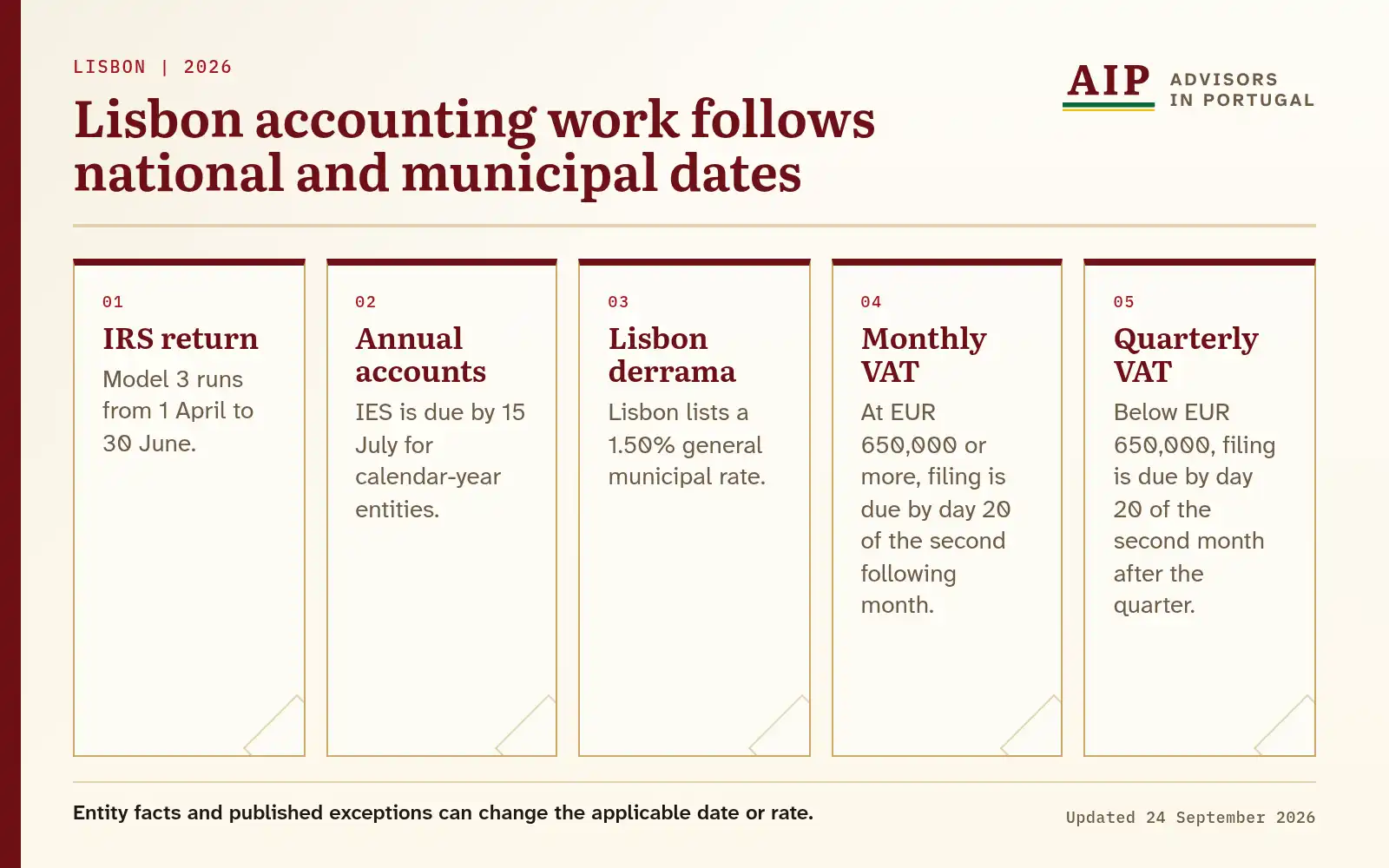
Diagram text version
Model 3 runs from 1 April to 30 June. IES is due by 15 July for calendar-year entities. Lisbon lists a 1.50% general municipal rate. At EUR 650,000 or more, filing is due by day 20 of the second following month. Below EUR 650,000, filing is due by day 20 of the second month after the quarter.
Timing and Possible Delays
Set case by case
The work is planned around the entity, transaction volume, SNC category, tax periods and year-end records.
What delays it
The work takes longer when records are incomplete, VAT data conflicts, payroll information is late or accounts require consolidation.
What to prepare now
You prepare invoices, banks, ledgers, payroll records, prior returns, tax notices and year-end material before the work begins.
Ongoing Lisbon Accounting Obligations
Records, categories and VAT sequence
A certified accountant compares the entity, activity, year-end and threshold data before the SNC category is selected. You provide invoices, bank records, payroll, assets and VAT evidence in the order each return requires. The CIVA deadline is kept beside the electronic submission receipt.
Annual accounts and registry route
A certified accountant assembles the management report, accounts, consolidation material and approval record before the annual filing is prepared. You provide board approvals and registered-office information for the competent Conservatória do Registo Comercial. The three- or five-month approval period and the registry response are tracked.
Professional signing and tax-address controls
A certified accountant checks OCC registration, insurance and the written service contract before signing reserved declarations. You provide the submission receipts for earlier returns so the current filing can be compared with the prior period.
Set out your Lisbon accounting needs
State your entity, activity, records, tax returns and reporting questions.
Common questions
Who may act as a certified accountant in Portugal?
Which SNC category applies to my company?
When is a monthly VAT return due?
When must annual accounts be approved?
When does CIVA Article 77 assign a taxpayer to Lisboa 3?
Can an accountant sign every tax declaration?
What insurance and engagement terms apply?
Which municipal rate and filing date apply to a Lisbon company's 2025 IRC reporting?
How the Service Works
-
One team for the whole case.
The accounts, VAT, tax, payroll and commercial-registration questions that follow stay with one case team.
-
English or Portuguese.
English or Portuguese, whichever you are most comfortable in.
-
A written quote before work starts.
You get a quote in writing before any work starts. Fees are set case by case.
-
A clear answer on scope.
You are told plainly if your case is outside the service.
Contact us
Your request is in
Every request is read in house. The requirements are assessed, and a reply by email sets out the appropriate next steps.
Every enquiry is read in house, and the aim is a reply within one business day.
The information on this page is checked against official sources and reviewed regularly. It is corrected when the law or official guidance changes, as the Editorial Standards describe.