Wills in Portugal: Forms, Forced Heirship and Notarial Execution
Wills in Portugal take a public or a closed form under the Código Civil. The reserved share, the legítima, limits what a will can leave to others and amounts to one half for a spouse alone and two thirds for a spouse with children.

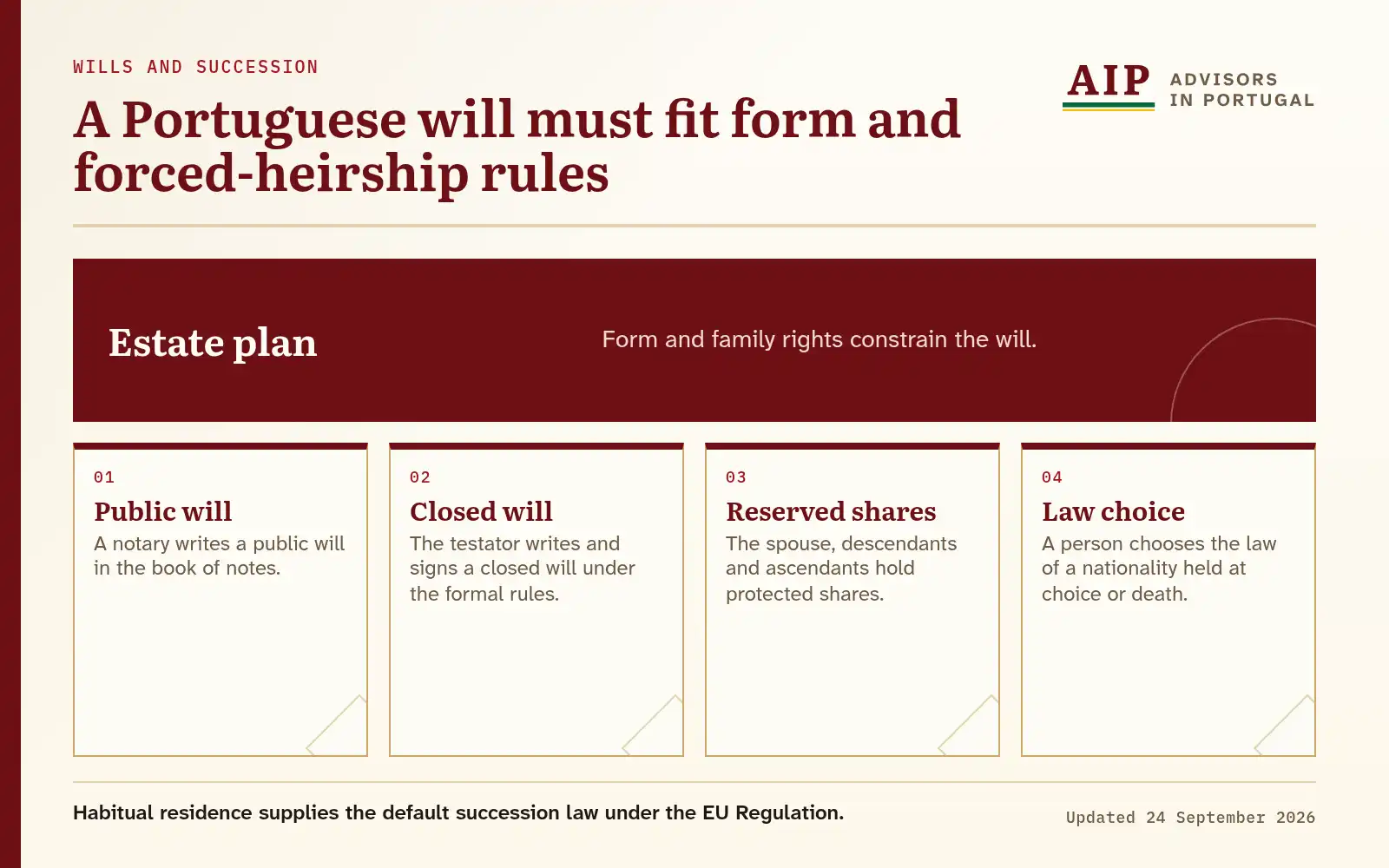
Diagram text version
A notary writes a public will in the book of notes. The testator writes and signs a closed will under the formal rules. The spouse, descendants and ascendants hold protected shares. A person chooses the law of a nationality held at choice or death.
What is a will under Portuguese law?
Article 2179 of the Código Civil treats a will as a unilateral act that the person can revoke. Through it the person disposes of all or part of their assets for after death, and the will may also carry non-patrimonial dispositions that the law permits in testamentary form.
Articles 2188 to 2190 allow anyone who has not been declared incapable to make a will. A minor or an adult under accompaniment is incapable only where the accompaniment judgment says so. A will made by an incapable person is void.
Which forms can a Portuguese will take?
The Código Civil provides for a public will and a closed will, and the Código do Notariado governs the notarial acts for wills.
- Public will. The notary writes a public will in the book of notes.
- Closed will. A closed will follows the signature, page-initial and approval formalities in Articles 2204 to 2206 of the Código Civil. The completed document may remain with the testator, with another custodian or at a notarial office.
Article 2209 sets the custody and presentation rule for a closed will. The section on what happens after a death describes it.
Who has a reserved share in a Portuguese estate?
Articles 2156 to 2163 of the Código Civil reserve a share of the estate, the legítima, for the spouse, descendants and ascendants. The reserved share limits what a will can leave to other beneficiaries.
| Surviving family | Reserved share |
|---|---|
| Spouse alone | One half |
| Spouse and children together | Two thirds |
The children’s share changes when there is no surviving spouse or when one child competes with two or more children (Article 2159). The other statutory combinations depend on which descendants or ascendants survive.
How does a cross-border estate choose its law?
A succession with links to more than one country brings habitual residence, nationality and any choice of law under Regulation (EU) 650/2012 into play.
Article 22 allows a person to choose the law of a state whose nationality they hold when making the choice or at death. The choice must be express in a disposition upon death or follow from the terms of that disposition.
How is a will revoked or replaced?
Articles 2311 to 2313 of the Código Civil allow express revocation by a later will or by a public deed. A later will revokes an earlier will to the extent that the two are incompatible.
Earlier wills, codicils, marital agreements and gifts can all affect a succession plan, because each may conflict with a later disposition.
How can someone check whether a person left a will?
IRN lists an online service for requesting information or a certificate about whether a named person has a will. The official fee for that information or certificate appears in the fee table below.
Which official fees apply?
Article 20 of the Regulamento Emolumentar dos Registos e do Notariado sets the notarial charges below. They were checked through the IRN costs page on 18 September 2026.
| Item | Official charge |
|---|---|
| Each public or international will | EUR 150 |
| Approval or opening instrument of a closed will | EUR 150 |
| Central Registry registration | EUR 9 |
| First certificate after a will | EUR 5 |
| Information or certificate about the existence of a deed or will | EUR 25 |
| Urgency surcharge | 50% |
What affects the timing of a will?
No fixed period applies. The timeline follows the family and asset information, the cross-border position and the notarial form selected.
A will takes longer when civil records come from another country, the asset list is incomplete, an existing will conflicts with the proposed dispositions or the choice-of-law question needs more evidence.
What happens after a death?
Presenting a closed will
The holder of a closed will must present it to the notary in the area where the document is located within three days after learning of the death (Article 2209 of the Código Civil).
Reporting the estate for Stamp Duty
The cabeça de casal or taxable beneficiary provides the declaration for Imposto do Selo by the end of the third month after the tax obligation arises (Article 26 of the Código do Imposto do Selo). The declaration needs the details of the deceased, the successor, the relationship between them and the asset.
Article 6(e) exempts spouses, descendants and ascendants from item 1.2 on gratuitous acquisitions. Item 1.2 of the official Stamp Duty table, checked on 18 September 2026, sets a 10% rate where that exemption does not apply. The inheritance tax guide covers the charge in more detail.
Heir identification and estate partition
Identifying the heirs, the death declaration, estate partition and registration of inherited property belong to probate. The probate guide describes those steps.
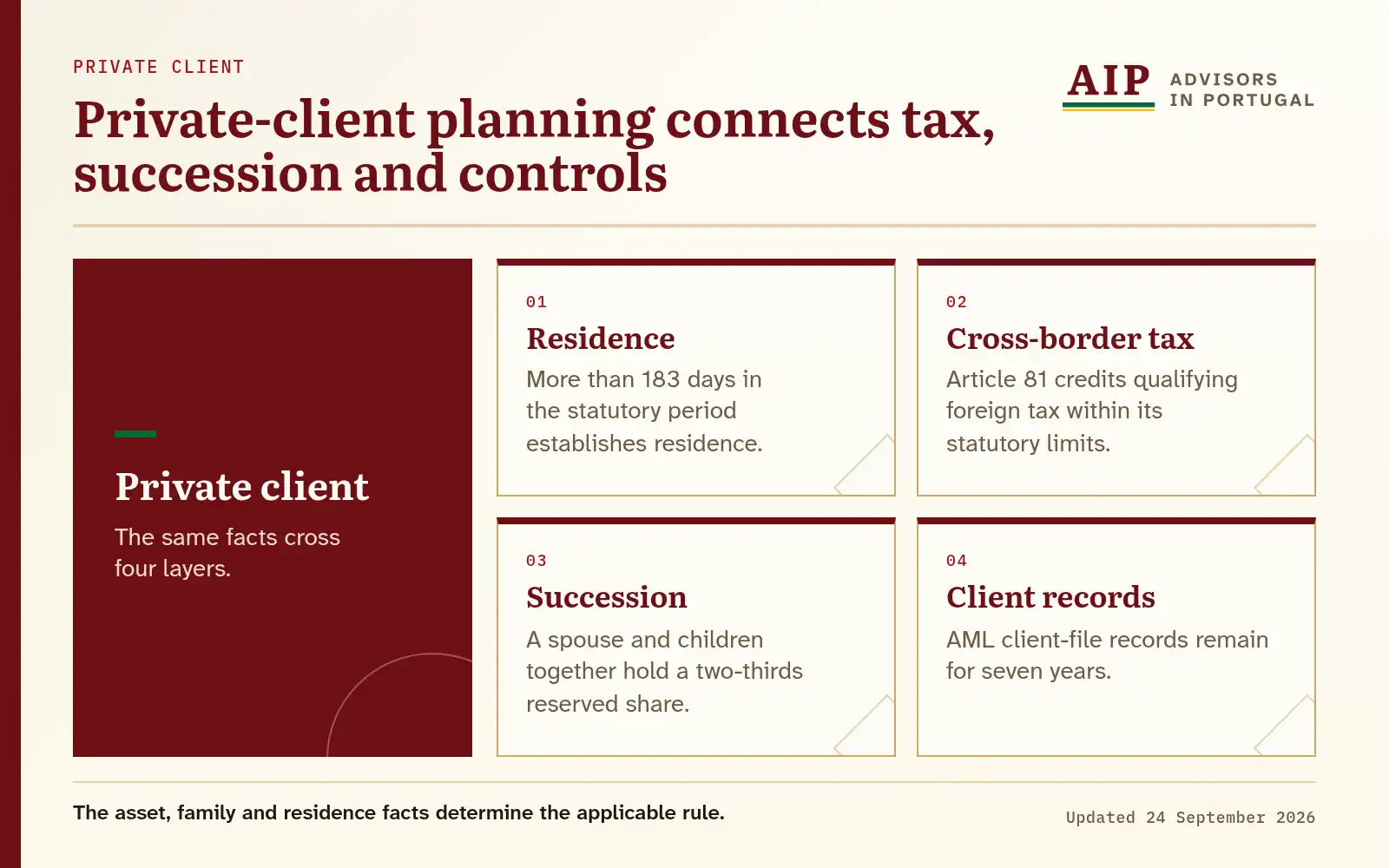
Diagram text version
More than 183 days in the statutory period establishes residence. Article 81 credits qualifying foreign tax within its statutory limits. A spouse and children together hold a two-thirds reserved share. AML client-file records remain for seven years.
Common questions
What does Portuguese law mean by a will?
Can any adult make a Portuguese will?
Who has a reserved share in a Portuguese estate?
How large can the reserved share be?
Can I choose the law of my nationality for my succession?
Can I revoke an earlier will?
Can someone check whether a person left a will?
What are the official notarial fees for a will?
Does Portugal charge Stamp Duty after death?
When must the holder of a closed will present it after a death?
Related guides
The information on this page is checked against official sources and reviewed regularly. It is corrected when the law or official guidance changes, as the Editorial Standards describe.