Trademark Registration in Portugal: Classes and INPI Filing
Trademark registration in Portugal begins with an INPI application, lasts ten years from filing and can be renewed. Third parties generally have two months from publication in the Boletim da Propriedade Industrial to file a complaint or observation.

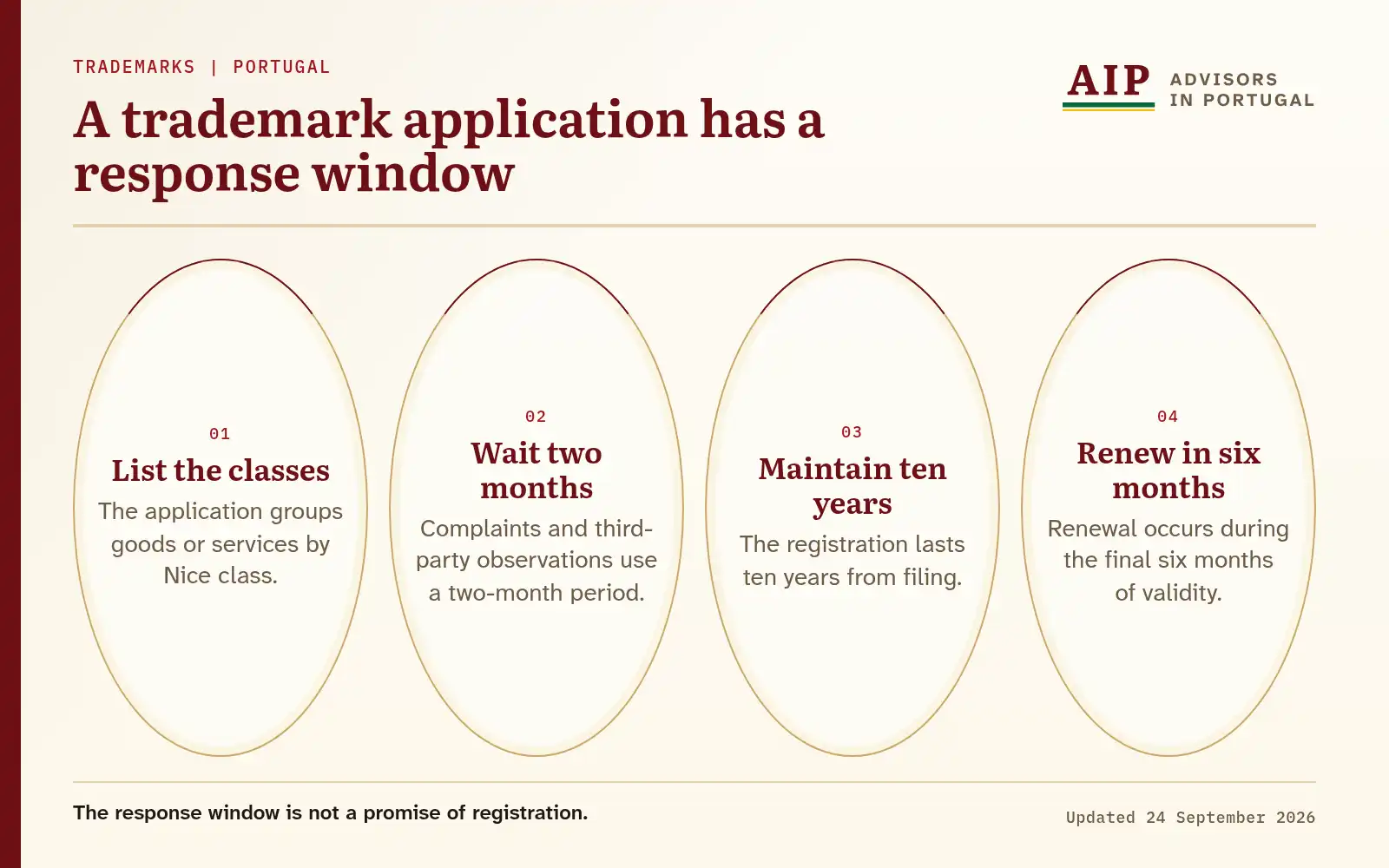
Diagram text version
List the Nice classes. Monitor two months. Maintain ten years. Renew in the final six months.
Código da Propriedade Industrial Articles 208 and 222 govern distinctive marks and the goods or services named in a Portuguese application.
What can be registered as a Portuguese trademark?
Código da Propriedade Industrial Article 208 permits a sign or group of signs to form a mark when it can be represented clearly and precisely and distinguishes one undertaking’s goods or services from another’s. Words, names, drawings, letters, numbers and product or packaging shapes can qualify. You should identify the sign exactly as customers will encounter it.
The representation submitted to INPI fixes what the applicant asks to protect. You should keep the artwork, wording and applicant identity consistent across the application. Article 208 applies to the proposed sign together with the goods or services it will identify. A change to a logo or name after filing may call for a separate analysis of what the registration covers.
A mark is a commercial identifier for selected products or services. You should identify the business that will own it and the activities for which it will be used. The owner, the sign and the class description are compared before submission. Distinctiveness is assessed against the goods or services named in the application.
Which grounds can prevent registration?
Código da Propriedade Industrial Article 209 sets absolute grounds including lack of distinctive character, descriptions of the goods or services and customary signs; Article 231 includes prohibited or public-order material. Articles 232 to 235 address conflicts with earlier marks and other third-party rights. You should compare the proposed sign with the relevant goods and existing rights before applying.
A descriptive word may have a different meaning for different products. The proposed class list and examples of the sign in use show whether the sign can identify a commercial source under the Article 208 test and whether an absolute ground applies under Articles 209 or 231.
An earlier similar mark can raise a relative-right objection even where the proposed sign is distinctive in isolation. You should keep any search results, earlier correspondence and ownership records. A relative-ground objection under Articles 232 to 235 turns on a comparison of the signs and the goods or services concerned.
How do Nice classes define the application?
Código da Propriedade Industrial Article 222(1)(b) requires the goods or services in an application to be grouped by the numbered classes of the international classification. The chosen wording defines the requested scope and the number of classes affects the fee. You should list the products and services the business will actually offer.
INPI publishes the applicable class lists and classification guidance. You should compare broad category names with the specific goods or services the sign will distinguish. The class description should match the intended commercial activity and the terminology in the class list. You should review a class number and its wording together before filing.
A business may expand its activities later. You should decide which goods or services are part of the present filing and keep that decision with the application. The selected classes are checked against the mark search and any earlier filings. You should estimate the official charge from the actual number of classes requested.
What information accompanies a filing?
Código da Propriedade Industrial Article 222 requires the applicant’s identity, a representation of the mark and a clear classification of the goods or services. You should provide the legal owner’s name, address and the final sign artwork or wording. Those details should match the company registration and the proposed class list.
Article 222 requires the supporting information for a priority claim. You should identify any earlier filing and obtain the underlying documents before submission. The claim identifies the first filing and ties it to the Portuguese application.
The submitted mark and class list become the reference point for examination and later use. You should keep a copy of the filing package, payment record and INPI acknowledgement. Any later INPI notice refers to the exact representation and goods or services that were filed.
Who receives and may submit the application?
Justiça identifies Instituto Nacional da Propriedade Industrial (INPI) as the body responsible for Portuguese trademark registration. The interested person or an authorised mandatary may submit the application under its guidance. You should identify the owner and the person signing for it before the filing is prepared.
You should use the same legal name and identification details as the company’s corporate records when the company is the applicant. You should provide any authority document for the signatory or representative. The mandate should cover the act of filing and the owner named in the application. You should retain INPI communications with the applicant’s record.
The filing channel supplies a receipt and reference for the requested mark. You should keep the dated acknowledgement and monitor INPI notices. An objection or formal request in a notice is read against the original application. You should ensure that the person filing on behalf of the owner has clear authority to act.
What does a trademark application cost?
Justiça’s current trademark-fee guidance states that the official application charge depends on the type of registration and the number of classes, and directs applicants to the current INPI fee table. You should identify the filing route and class count before budgeting the public charge. The fee schedule lists the charge for each application category.
A trademark search and any additional professional work have their own costs. You should separate those from the INPI charge and retain each official payment notice. You should match the amount paid to the owner, sign and class list submitted to INPI.
A later renewal or other act can carry a different official charge. You should keep the registration record and fee table version used at each stage. You should take the fee from INPI’s active schedule at the time of filing.
What happens after publication?
Código da Propriedade Industrial Article 17(1) generally gives third parties two months from publication of a mark application in the Boletim da Propriedade Industrial to file a complaint or observation. You should record the publication date and retain the bulletin reference. A third-party filing is assessed against the sign and the goods or services requested.
INPI may issue a notice or provisional refusal requiring a response within the period stated for that notice. You should keep the complete communication and its delivery date. The response addresses the specific ground raised. You should track the statutory opposition window and the applicant’s response deadline as separate periods.
An earlier right holder may rely on its own mark or another protected right. An earlier agreement or consent is relevant if a conflict is raised. The parties’ signs and class lists are compared in that situation.
How long does a registration last?
Justiça states that a Portuguese trademark registration lasts ten years from the filing date and can be renewed. You should keep the filing date, grant record and current owner details in a calendar for later maintenance. A company name or ownership change should be checked against the registration record.
Use of the sign matters under the Código da Propriedade Industrial’s revocation framework. You should retain examples of genuine use for the registered goods or services and the dates on which the mark was used. Actual use is compared with the class list if the registration is challenged.
An owner may change its branding during the term. You should identify whether the sign used commercially remains the registered sign and whether a new filing is needed for a materially different version. The artwork and wording are compared with the registration certificate. The ten-year term concerns the registered mark that INPI granted.
Which route protects a mark beyond Portugal?
INPI registration protects the sign in Portugal under the national Código da Propriedade Industrial. European Union protection can be sought through the European Union Intellectual Property Office (EUIPO), and international protection can be pursued through the Madrid System of the World Intellectual Property Organization (WIPO) under its designation rules. You should identify the countries where the business will use the mark.
A Portuguese registration and an EU or international filing have different territorial effects and fee structures. You should keep the proposed country list and class wording with the sign. The intended markets determine the filing route. A national filing is a choice about Portuguese protection, while another route may address wider commercial plans.
The current INPI classification and fee information was updated in 2026; the consolidated CPI identifies Decreto-Lei n.º 9/2021 as its latest listed amendment. You should use the current class list and tariff for the actual filing. Those administrative materials sit alongside the statutory application and opposition rules.
Common questions
Can a sound or colour function as a Portuguese mark?
Can an applicant use another person’s name or image?
Which details support a priority claim?
Does the first Nice class carry a separate surcharge?
When during the term can a mark be renewed?
Which professionals can act as an authorised mandatary?
Related guides
The information on this page is checked against official sources and reviewed regularly. It is corrected when the law or official guidance changes, as the Editorial Standards describe.