Portugal Startup Visa: Application and Residence Rules
The StartUP Visa in Portugal requires a certified incubator’s interest declaration before an entrepreneur applies to IAPMEI. IAPMEI acceptance gives no right of residence by itself, so the project evidence must also support a separate visa or authorisation decision under Lei n.º 23/2007.

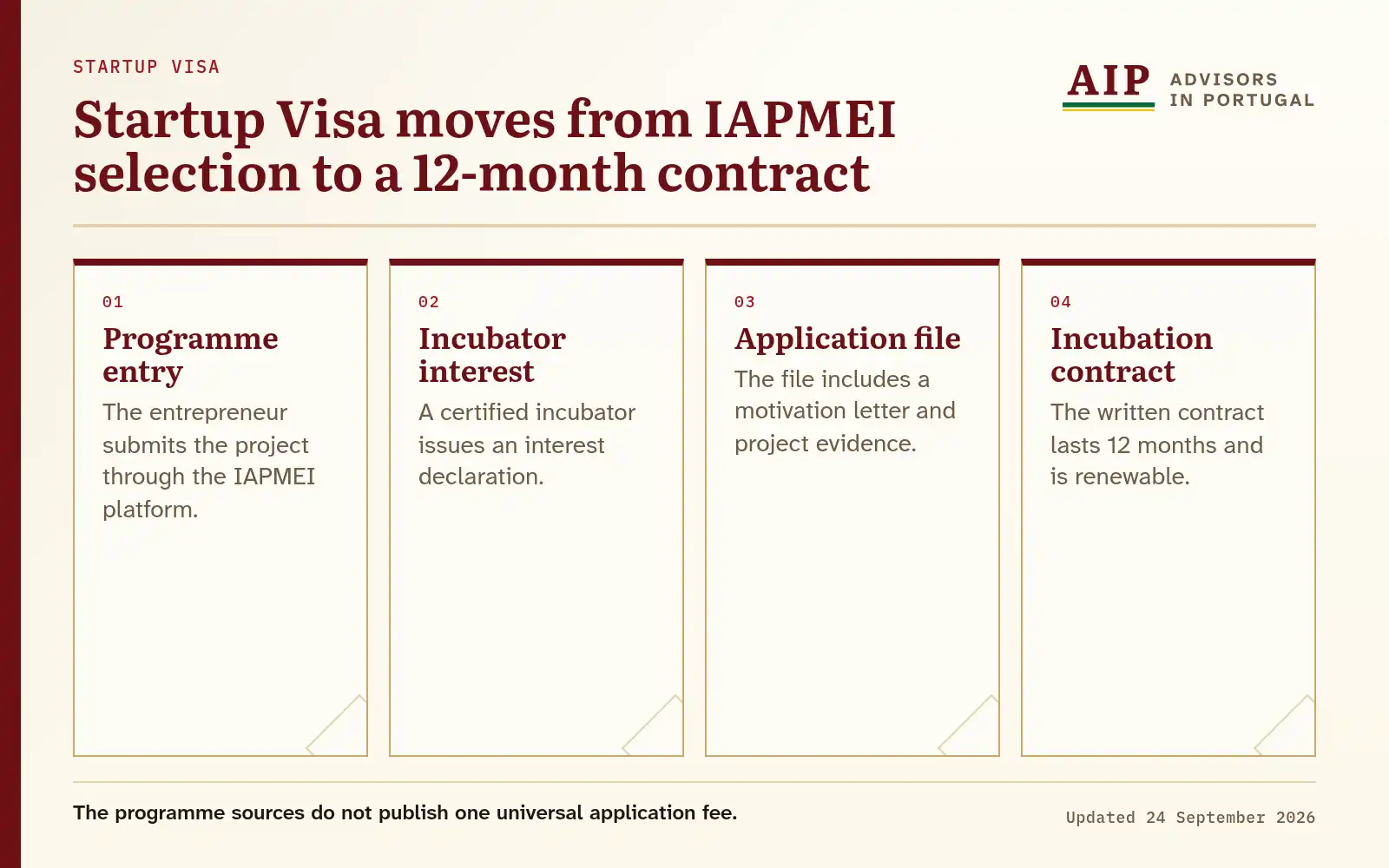
Diagram text version
The entrepreneur submits the project through the IAPMEI platform. A certified incubator issues an interest declaration. The file includes a motivation letter and project evidence. The written contract lasts 12 months and is renewable.
IAPMEI StartUP Visa programme, certified incubation, application evidence, visa fee and residence step.
What is Portugal’s StartUP Visa?
IAPMEI’s StartUP Visa programme supports foreign entrepreneurs who intend to develop an entrepreneurship or innovation project in Portugal under Despacho Normativo n.º 4/2018. The programme leads toward a residence visa or residence authorisation under Lei n.º 23/2007. You should identify the proposed project, the entrepreneur and the intended Portuguese activity before assembling the application.
Despacho Normativo n.º 4/2018 regulates the programme alongside the immigration-law route. You should distinguish acceptance into the programme from a later immigration decision. Lei n.º 23/2007 provides the entrepreneur residence-visa route, and Article 89(4) provides the residence-authorisation provision, which applies Article 77’s general conditions except Article 77(1)(a). Each provision addresses a different stage and decision maker.
IAPMEI’s current programme page describes a project developed in Portugal. You should set out the goods or services, the intended market and how the project will be carried out here. The project documents and the applicant’s personal immigration records should support the intended route. A project description should match the application and the proposed incubator arrangement.
Who runs the programme and selects incubators?
Despacho Normativo n.º 4/2018 Articles 6(7) and 6(12) give IAPMEI responsibility for analysing entrepreneur applications and for analysing, selecting and certifying incubators. You should identify a certified incubator for the proposed project before treating its expression of interest as programme evidence. The entity named in the declaration should match the published programme requirements.
An entrepreneur applies through IAPMEI’s online programme platform under Article 6(3). The platform application concerns the programme, while the residence visa and authorisation have their own legal basis in Lei n.º 23/2007. You should keep the submission, incubator correspondence and IAPMEI outcome as separate documents.
IAPMEI’s certification of incubators concerns the organisations eligible to participate in the programme. You should ask the incubator to describe the facilities and services relevant to your project. That description should match the written incubation contract before the entrepreneur signs it. The entrepreneur’s application still needs its own project and personal evidence.
What does the certified incubator provide?
Despacho Normativo n.º 4/2018 Articles 6(2) and 6(10) require an interested certified incubator’s declaration and then a written incubation contract. You should secure the declaration for the programme application and keep the later contract with the IAPMEI record. The parties and the project named in both documents should match.
Article 7(2) requires the written incubation contract to state, among other things, the entrepreneur’s obligations and the incubator’s services. You should read those terms against the actual facilities and support offered to the project. A mismatch between the declared interest and the later agreement should be resolved before the documents are used in an immigration application.
The incubation relationship is one part of the programme evidence. You should keep dated communications showing when the incubator expressed interest and when the contract was concluded. The project and entrepreneur named in each record should remain consistent. You should identify who will sign the contract for the entrepreneur and which incubator entity is the counterparty. Those names should match the interest declaration before an immigration application is prepared.
Which application channel and documents apply?
Despacho Normativo n.º 4/2018 Article 6(3) directs the entrepreneur to submit the StartUP Visa candidature through IAPMEI’s online platform. Article 6(5) calls for evidence of Article 5(1) eligibility, project identification and an interested certified-incubator declaration. You should prepare those records for the programme application under the applicant’s own identity.
You should keep copies of the submitted form, project description and incubator evidence. The dates, entity names and declared activity should match the later immigration papers. The programme application and the visa application have different purposes, so each should be tracked by its own acknowledgement and authority.
Lei n.º 23/2007 provides an entrepreneur residence-visa route, and Article 89(4) addresses the residence authorisation for a certified-incubation project, applying Article 77’s general conditions except Article 77(1)(a). You should identify which stage you have reached before relying on a document as permission to remain. The programme outcome leads to the applicable immigration provision and to the records needed at that stage.
Which immigration rule follows a programme decision?
Despacho Normativo n.º 4/2018 Article 6(9) gives IAPMEI a maximum of 30 working days from submission to decide the programme application, subject to its missing-elements and hearing provisions. Lei n.º 23/2007 provides an entrepreneur residence-visa route; Article 89(4) provides the related residence authorisation for an entrepreneurial project under certified incubation and applies Article 77’s general conditions except Article 77(1)(a). You should prepare the residence-stage personal records alongside the project evidence.
IAPMEI’s programme outcome speaks to the startup project. AIMA decides the residence-authorisation question under the immigration statute. You should preserve the incubator contract and project records with the identity, housing and other Article 77 evidence relevant to your case. The incubator contract evidences the Article 89(4) certified-incubation condition, and the identity and housing records evidence the Article 77 conditions.
You should record your travel, permit and application dates accurately. Either the entrepreneur residence-visa route or the Article 89(4) residence route applies, depending on the status the applicant actually holds. The legal basis should match the applicant’s documents and the certified-incubation relationship in the file.
What official and incubator costs apply?
The MNE national-visa fee page lists €110 for administrative processing of a national visa request. Incubator charges follow the signed incubation contract. You should budget for the official visa charge and the amount agreed with the incubator as different items.
The IAPMEI programme materials and Despacho do not set one universal application charge for every entrepreneur. You should use the current official visa-fee notice for the consular stage and the signed contract for the incubation price. Some payments belong to the programme relationship and others belong to the immigration procedure.
You should identify the act and applicant in an official payment notice before paying it. The notice should match the stage reached in the application. A project budget should keep the company, incubator, visa and residence components distinct.
How does family reunification relate to this route?
Lei n.º 23/2007 Article 89(4) sets the entrepreneur residence-authorisation rule by reference to Article 77 and certified incubation. Family reunification is governed by the separate family provisions of the same law. You should identify each relative and the status you hold before planning a family application.
The permit history, the family relationship and any earlier filing are tested against the family-reunification provision that applies at the relevant date. You should keep civil records and AIMA correspondence together with the entrepreneur application record. The programme decision concerns the entrepreneur’s project; the family application asks a separate statutory question.
The current consolidated text of the law should be used, since its provisions can change over time. You should preserve the date of each notice so the applicable version can be identified. A family member’s route follows from the actual residence and relationship records and from the application channel in force for that person.
What changed in IAPMEI’s 2026 information?
Despacho Normativo n.º 4/2018 Article 5(1)(e) uses 12 IAS units in the programme’s means criterion, and IAPMEI’s current page identifies the 2025-01 incubator-certification call as closed. You should use the IAS amount published for the application year. You should compare your evidence of means with the 2026 figure for the period of your application.
The closed incubator call concerns certification of incubators, not a new visa entitlement for an entrepreneur. You should identify an incubator with the status required for your application. The certification record and the entrepreneur’s own programme documents should be compared before an interest declaration is treated as sufficient for submission.
You should keep the dated IAPMEI programme notice that supplied the value used in your application. You should place it beside the bank or income evidence submitted for the means criterion so the file shows which year’s amount was applied. That value applies to the Article 5 criterion and the supporting financial documents. You should retain the applicant’s own evidence and the platform acknowledgment together, because the programme decision and later immigration decision concern different questions. Any later published value should be applied to the relevant application period, while the submitted file should show the figure used when it was prepared.
Common questions
How long does an incubation contract last?
Does the programme require a motivation letter?
What is the published 2026 IAS amount for the programme?
Can the entrepreneur form a company during the programme?
Does the incubator contract name its price?
Which Article 77 condition does the incubated-project route dispense with?
Related guides
The information on this page is checked against official sources and reviewed regularly. It is corrected when the law or official guidance changes, as the Editorial Standards describe.