Portugal D2 Visa: Entrepreneur Requirements
The D2 visa in Portugal is a residence visa for independent professionals and immigrant entrepreneurs under Article 60 of Lei n.º 23/2007. Applicants need evidence that matches their planned activity, whether they propose an independent practice, an investment or an incubated project.

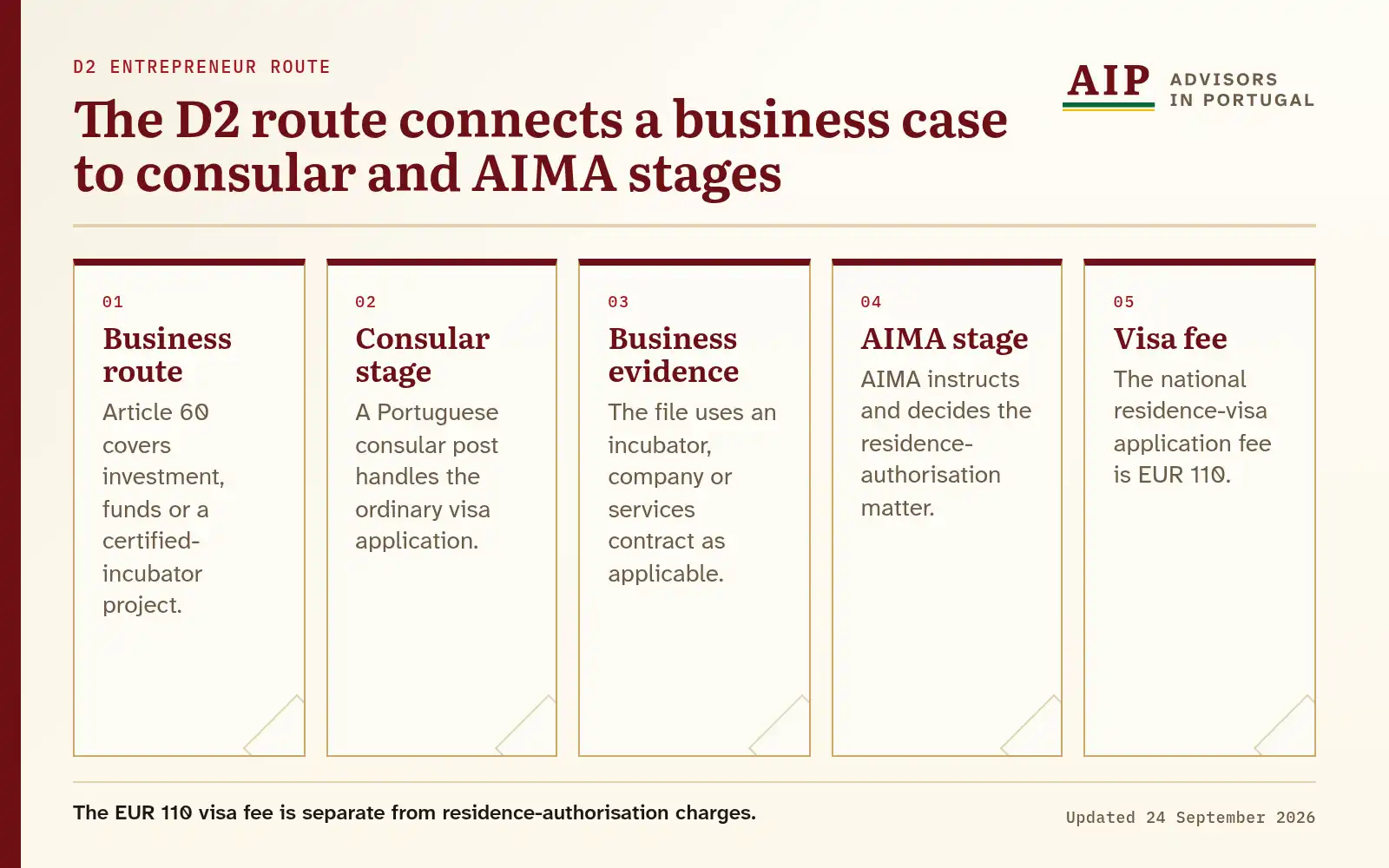
Diagram text version
Article 60 covers investment, funds or a certified-incubator project. A Portuguese consular post handles the ordinary visa application. The file uses an incubator, company or services contract as applicable. AIMA instructs and decides the residence-authorisation matter. The national residence-visa application fee is EUR 110.
Lei n.º 23/2007 Article 60 provides a residence-visa route for an independent professional or immigrant entrepreneur. Article 48 places the ordinary visa stage with a Portuguese consular post or section; Article 82 governs the later AIMA residence step. The applicant should identify which activity will actually be carried out, since an investment plan, an independent services practice and an incubated project require different evidence.
Who Can Apply for a D2 Residence Visa?
Lei n.º 23/2007 Article 60 identifies independent professional activity and immigrant entrepreneurship as the D2 purposes. The question under the law is the planned activity. The label an applicant gives a business idea does not decide it. The applicant should describe who will pay for the work, what company or professional arrangement will be used and which records already show the proposed activity. That evidence is compared with the Article 60 route before a consular application is prepared.
Article 60(2) addresses entrepreneurs who have carried out investment, have funds available in Portugal and intend to invest, or have an innovative project in a certified incubator under the applicable provision. Completed transactions are separate from planned transactions. The documents show which part of the statutory test the applicant meets.
The visa stage and the residence-authorisation stage are separate legal steps. The applicant should retain the consular application, decision and supporting records because AIMA later assesses the residence request under the relevant provisions of Lei n.º 23/2007. The applicant’s personal means, housing and immigration history remain part of the file.
What Entrepreneur Evidence Does Article 60 Require?
Lei n.º 23/2007 Article 60(2) recognises entrepreneur evidence based on investment already carried out, funds available in Portugal with intent to invest, or an innovative project linked to a certified incubator. The supporting papers should connect the proposed activity to one of those alternatives. Contracts, transfers, company records and project material should match the route claimed, so the application describes one coherent plan.
Decreto Regulamentar n.º 84/2007 Article 55(6) calls for evidence of a contract with a certified incubator in the residence request for the innovative-project route under Article 89(4). The contract is more specific than a pitch deck or an informal email from an incubator. The signed arrangement and the project description should be kept together. The incubator evidence may belong to the initial visa narrative, the later residence application or both.
A proposed purchase or future company expense differs from investment already performed. Article 60(2) lists alternatives, and each has its own factual record. A bank statement can show available funds, but it cannot by itself show what the applicant intends to do in Portugal. An investment chronology and the company documents let the consular post read how the proposed activity relates to the statutory route.
What Must an Independent Professional Show?
Decreto Regulamentar n.º 84/2007 Article 55(1) describes the residence evidence for an applicant who already holds a visa for the same independent-activity purpose. It includes information proving activity under a company contract, a services contract for a liberal profession, or independent activity. The applicant should bring the underlying agreement and client work records that fit the profession. This rule concerns the residence request; it should not be treated as an exhaustive consular checklist.
Lei n.º 23/2007 Article 60 supplies the visa purpose, while Article 55 of the implementing regulation helps document the later residence stage. The work should be described in terms a consular officer can compare with the contracts. A regulated profession, a professional registration question or an agreement that does not yet support the activity described each affect the file. A generic company title is less useful than the actual work, clients and contractual basis.
The current consolidated Decreto Regulamentar n.º 84/2007 marks its Article 25 revoked. An old checklist that cites it as a live D2 condition is out of date. Article 24 still refers the proof of means for professional residence visas to a ministerial ordinance. The current consular instructions for the filing location apply alongside the statutory framework.
Where Do You Submit the Visa Application?
Lei n.º 23/2007 Article 48 places ordinary residence-visa granting competence with Portuguese consular posts or consular sections. The applicant should identify the post responsible for the place of application and use its current submission instructions. The consular competence comes from the law.
The consular officer assesses the visa purpose and required documents before entry. The applicant should keep copies of every contract, corporate record, financial record and submission acknowledgment supplied. Inconsistent dates or names across documents can cause a request for clarification. The chronology deserves a check before filing, especially when an investment was made through a company while the visa applicant is an individual.
Article 82 addresses AIMA’s later residence-authorisation role in Portugal. A visa approval does not itself complete that application. The applicant should retain the visa and entry records for the residence stage. Evidence already supplied to the consulate differs from the evidence that Article 77 and the implementing regulation require for the residence request. The two authorities have different functions even when they review some of the same underlying facts.
What Means and Accommodation Must You Prove?
Lei n.º 23/2007 Article 77(1)(d) and (e) require means of subsistence and accommodation for temporary residence authorisation. Decreto Regulamentar n.º 84/2007 Article 24 delegates the proof of means for professional residence visas to a ministerial ordinance. Article 24 itself sets no universal D2 euro amount. The applicant should show the source, availability and continuity of the funds relied on. The applicable current ministerial and consular requirements govern the amount.
Article 77 also includes a valid residence visa and presence in Portugal. The applicant should obtain housing evidence that describes the place of residence and the period it covers. The accommodation document should match the intended entry and residence dates.
Company capital and personal living funds are not automatically interchangeable. The provisions address both the business purpose and the applicant’s subsistence. The file should show which account or commitment belongs to the company and which resources are available to the applicant personally. A clear explanation helps the authorities understand the proposed activity and the residence position without assuming that every entrepreneur must show the same documents.
What Happens After Entry to Portugal?
Lei n.º 23/2007 Article 82 gives AIMA the residence-authorisation function, including obtaining the information needed for its decision. Article 77 sets the general temporary-residence conditions. The applicant should retain the visa, passport, entry evidence, housing documents, means records and activity papers for the AIMA request. Each document maps to the condition it supports, and new evidence may be needed after arrival.
Decreto Regulamentar n.º 84/2007 Article 55(1) applies to the independent worker who holds a visa for the same purpose. It asks for the activity evidence relevant to the residence request. Article 55(6) addresses an incubated innovative entrepreneur project. One person’s document list is not a universal D2 checklist, since those provisions refer to different activity grounds.
The applicant should document the company or professional registration that applies to the activity. A separate accounting or tax question may arise from the work planned. AIMA decides the residence request and no decision date is guaranteed.
What Does the D2 Visa Cost?
Portaria n.º 91/2025/1 sets the official national-visa processing fee at EUR 110 from 11 March 2025. This is the visa charge, separate from document procurement and any later residence-card charge. The consular post where the applicant applies issues instructions on how and when that official fee is paid.
The applicant should retain proof of payment with the application copy.
When Must You Renew Residence?
Lei n.º 23/2007 Article 78(1) requires a temporary-residence renewal request up to 30 days before expiry. Article 78(2) addresses means of subsistence, accommodation, tax and Social Security compliance and disqualifying criminal convictions. The applicant should track the expiry date on the residence document and collect current evidence well before preparing the renewal. A change in activity may affect the purpose of the existing title.
The renewal rule is separate from the initial Article 60 visa and Article 77 residence decision. The applicant should retain tax, housing and activity records during the residence period, because those facts may be relevant later. A change between the original application and the current professional work can mean a different route applies. The statutory deadline for requesting renewal does not control when AIMA will issue its decision.
What Changed for Existing Work-Permit Holders in 2025?
Lei n.º 61/2025 Article 6 created a 180-day transitional conversion route for certain holders of residence authorisations for subordinate or independent work who satisfy Article 90(1)‘s conditions. The transition concerns an existing permit; it does not grant a new D2 visa to a person who has not yet obtained residence.
The permit already held and the date of any proposed conversion matter before Article 6 applies. The title, activity and Article 90 conditions are measured against that transitional period. An initial D2 applicant should instead start with the Article 60 visa purpose and the relevant consular requirements. Keeping the two routes separate prevents a work-permit conversion rule from being described as an entrepreneur-visa entitlement.
Common questions
Can the consular post seek information from other bodies?
Can AIMA request other authorities' opinions?
Are professional qualifications relevant to the residence file?
Must I show Social Security registration?
Which title can an eligible holder seek under the 2025 transition?
What is the official D2 visa processing fee?
The information on this page is checked against official sources and reviewed regularly. It is corrected when the law or official guidance changes, as the Editorial Standards describe.