Portugal D8 Visa: Remote Work and Residence Rules
The D8 visa in Portugal is a residence visa under Lei n.º 23/2007 Article 61-B for employees and independent professionals who work remotely for a person or entity based outside Portugal. Your contracts, work records and payment evidence must show that external link consistently.

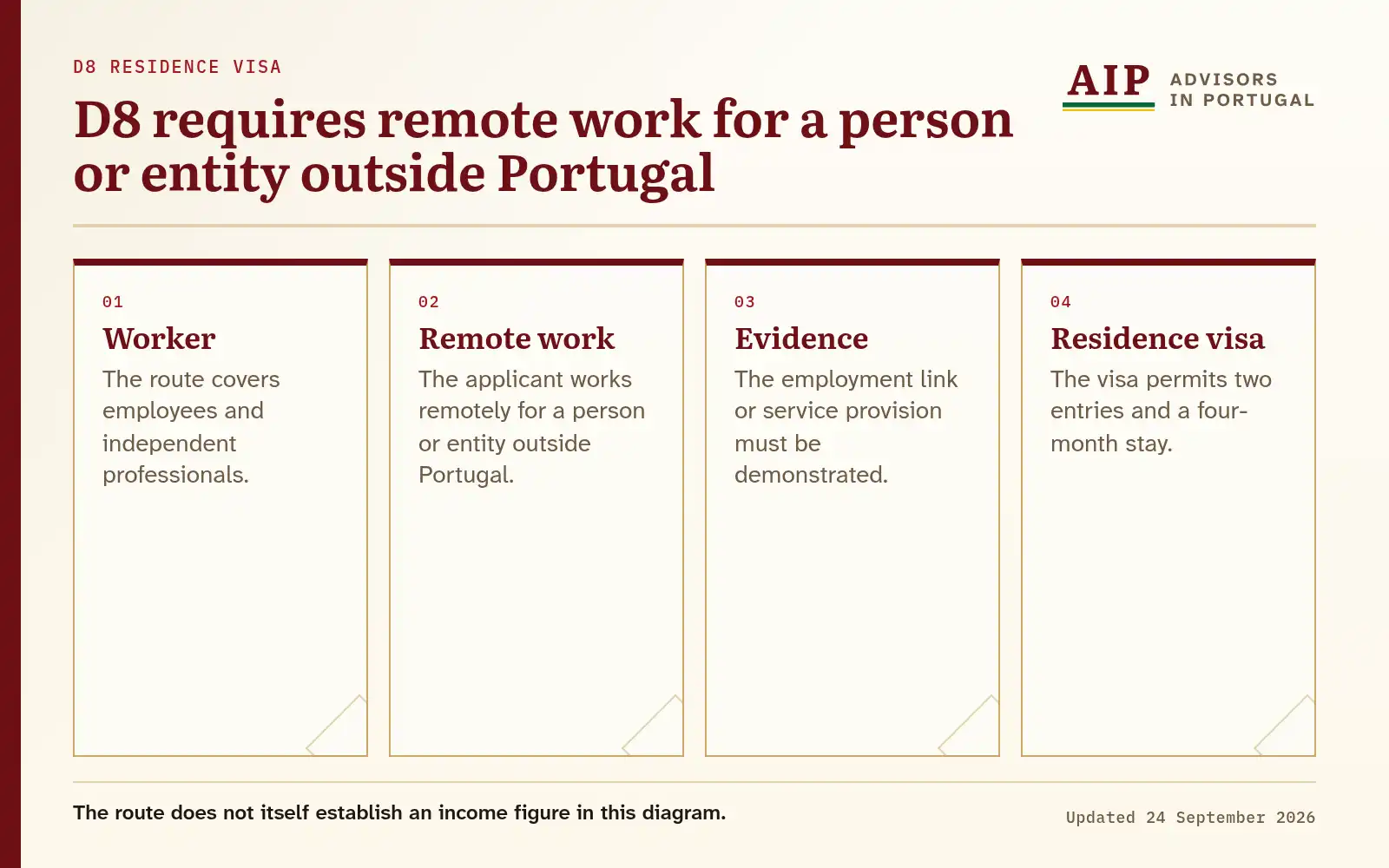
Diagram text version
The route covers employees and independent professionals. The applicant works remotely for a person or entity outside Portugal. The employment link or service provision must be demonstrated. The visa permits two entries and a four-month stay.
Lei n.º 23/2007 Article 61-B permits a residence visa for remote work carried out for a person or entity based outside Portugal. The rule covers an employee and an independent professional who can demonstrate the work relationship. You should establish where the employer or client is based, what work you perform and which visa and residence conditions apply to your own file before submitting an application.
Who Qualifies for Portugal’s Remote Work Visa?
Lei n.º 23/2007 Article 61-B covers professional activity performed remotely for a person or entity domiciled or headquartered outside Portugal. It includes subordinate employment and independent professional work, subject to proof of the employment link or services relationship. You should identify who legally receives your work and where that person or entity is based. The contract and the actual working arrangement are measured against the Article 61-B definition.
The route concerns the place of the client or employer and the remote character of the activity. A person paid from abroad may still need to show that the work is genuinely performed for an entity outside Portugal. You should bring signed contracts, current work records and payment evidence that tell the same story. A change in employer, a Portuguese client or a local branch may affect whether the work fits Article 61-B.
Article 61-B is a residence-visa rule; Article 77 supplies the general conditions for temporary residence after entry. You should keep the visa purpose distinct from the later authorisation requirements. A remote-work contract can support the first question but cannot replace housing, means or other personal conditions that apply at the residence stage. Both stages rely on the same factual chronology.
What Employment or Services Evidence Is Needed?
Article 61-B of Lei n.º 23/2007 requires the employment link or provision of services to be demonstrated, as applicable. An employee should provide the employment arrangement and evidence of the employer’s location. An independent professional should identify the services contract and the person or entity receiving the work. Contract dates, party names, scope of activity and current payment records should agree before a consular application is made.
You should show the connection between the named employer or client and the income on which you rely. A payment record with no clear contractual party may need explanation. A contract naming several entities may require evidence of which entity is actually outside Portugal and receives the services. Organising the documents by relationship lets the consular post read the employment or services basis without having to infer it from a bank deposit alone.
An independent professional should describe the activity performed remotely and the current clients. Article 61-B covers the legal relationship regardless of the job title chosen for the application. You should check any planned Portuguese customer or local employment against this route before relying on it. The position may change if the actual work after entry differs from the foreign relationship used for the visa request.
How Are Means of Subsistence Assessed?
Lei n.º 23/2007 Article 11 requires means of subsistence and refers the relevant amount to a ministerial ordinance. Article 11 sets no D8-specific monthly threshold or fixed evidence period. You should provide the current income and resources that support your application. The applicable consular instructions and ordinance for the filing set the figure. A figure used for a different visa route should not be presented as the Article 61-B amount.
The distinction matters for employees and independent workers. An employment contract can establish an income source, while invoices and service agreements may show an independent practice. You should connect each payment record to the work relationship on which the Article 61-B request relies. Irregular income, multiple clients or a recently started contract need an explanation supported by documents.
Article 77(1)(d) requires means again at the residence-authorisation stage. You should retain current records after the consular decision because the original income evidence may need updating. AIMA assesses the residence file under the conditions that apply when it decides. The financial position shown to the consulate can differ from the position after entry, especially if a contract has ended or changed.
Where Do You Apply and How Long Is the Visa Valid?
Lei n.º 23/2007 Article 48 gives ordinary visa-granting competence to Portuguese consular posts and consular sections. You should identify the competent post for your place of application and use its current documentary instructions. Article 48 sets no D8-specific appointment deadline or universal outside provider for every location. The applicant submits the application through the route that post requires.
The general residence-visa rule gives two entries and a four-month stay under Lei n.º 23/2007 Article 58. That period permits the holder to pursue the residence-authorisation step after entry; it is not the validity of the later residence card. You should keep the issued visa and travel record because they establish dates relevant to the AIMA file. The visa purpose and the work arrangement shown in the residence documents should match.
Article 58 sets a 60-day visa-decision period, subject to shorter statutory periods. That is the statutory decision period for the visa and gives no appointment date. You should plan travel only after you understand the status of your application and any consular document request. You should use the competent post’s fee instruction for the specific application you submit.
What Conditions Apply to Residence After Entry?
Lei n.º 23/2007 Article 77 lists the general cumulative conditions for temporary residence authorisation: a valid residence visa for an applicable purpose, presence in Portugal, means of subsistence, accommodation, Social Security registration where applicable and the statute’s security and criminal conditions. You should bring the visa, passport, housing record, work documents and current means evidence to the AIMA stage. Each record should be matched to the Article 77 element it supports.
The authority can request evidence relevant to means, work or another statutory element. You should respond to a document request with the record that proves the fact in question. A statutory condition is separate from a particular form of proof, especially where the applicant is paid by more than one foreign client.
The residence authorisation is a distinct decision from the consular visa. AIMA assesses the current personal and work position after entry. You should keep a record of changes in accommodation, employment, independent services or family circumstances between the two applications. Article 61-B remains the basis for the remote-work purpose, while Article 77 controls the general residence conditions.
How Long Does AIMA Have to Decide?
Lei n.º 23/2007 Article 82 gives AIMA 90 days to decide a residence-authorisation request. It permits an exceptional, justified extension of 30 days, including where the case is complex, with notice to the applicant. You should retain proof of submission and any later AIMA notice so the statutory period can be assessed against the actual case dates. A request for additional information may affect the procedural position.
Article 81 permits the person concerned, a legal representative or an employer to submit the request. The person acting on the file needs the relevant authority, and the contact details used for notices must be current. The ability to submit a request does not transfer AIMA’s decision-making power to the applicant or representative.
You should distinguish a statutory deadline from an expected appointment date or guaranteed approval date. Article 82 describes when the authority should decide and how an exceptional extension is notified. A late decision or a request for further documents is assessed from the actual acknowledgment and correspondence. No one should infer the result from the passage of a statutory period without examining the applicable procedural rule.
How Long Does Residence Last and When Is Renewal Due?
Lei n.º 23/2007 Article 75 gives a temporary residence authorisation two years of validity from issue and successive three-year renewal periods. Article 78 requires a renewal request 30 days before expiry. You should use the expiry date on the permit, keep current work and accommodation records and identify any change of purpose before filing a renewal. You should compare the original remote-work basis with your activity at renewal.
Article 77’s general conditions, including means, accommodation and Social Security registration where applicable, continue to apply at renewal, and Article 78 requires the renewal request 30 days before expiry. You should preserve the records generated during residence, including work agreements, invoices or employment evidence, housing papers and compliance documents. You should check for a gap between the foreign work relationship described on the first application and the activity now performed.
Article 85 contains absence limits and exceptions for temporary residence permits. You should keep your travel history if you spend significant time outside Portugal, because an absence question depends on the permit and the statutory exception. The two-year and three-year periods describe permit validity and give no assurance that every renewal will be granted.
Can Family Members Apply for Reunification?
Lei n.º 23/2007 Article 98 provides the family-reunification framework for a resident with a valid authorisation for at least two years, subject to the article’s exceptions and the family categories in Articles 99 and 100. You should identify each family member’s relationship, age, residence and dependency facts before planning a request. Those facts are compared with the statutory category, and a remote-work visa alone does not decide a relative’s application.
Article 101 requires accommodation and sufficient means for the family-reunification request. You should gather civil records and housing documents that establish the relevant facts. The two-year rule is subject to exceptions that depend on the particular family situation.
You should keep the remote worker’s residence record, family civil records and evidence of the intended shared household together. A family member may be abroad or already present in Portugal, which can affect the filing route and evidence. The family provisions contain their own conditions; they should be read with Article 61-B without being collapsed into the remote worker’s work test.
What Changed in September 2026?
Lei n.º 62/2026 amended parts of the immigration framework and took effect on 11 September 2026, the day after its publication. The current consolidated Lei n.º 23/2007 marks Article 77 among the amended provisions. Article 61-B remains the statutory remote-work route that was added by Lei n.º 18/2022. You should use the current Article 77 text for a new residence request, particularly when an older checklist predates the 2026 amendment.
The applicable version of the law for an application already pending at the effective date needs checking against the 2026 law. The 2026 law changes many immigration provisions, but its presence on the consolidation does not create a new income figure or D8-specific fee in Article 61-B. You should distinguish the rule that defines remote work from the general residence conditions that AIMA applies after entry.
Common questions
Does Article 77 require a Portuguese bank document?
Can an employer submit the residence request?
Is there a separate D8 minimum stay?
Must both partners be adults for family reunification?
Who may use the title of lawyer in Portugal?
Does Article 11 set a D8 monthly income threshold?
How long does AIMA have to decide a residence-authorisation request?
Related guides
The information on this page is checked against official sources and reviewed regularly. It is corrected when the law or official guidance changes, as the Editorial Standards describe.