Portugal Crypto Regulation: MiCA Authorisation
Portugal crypto regulation requires crypto-asset service providers to obtain MiCA Article 59 authorisation, and the Portuguese transitional permission ended on 1 July 2026. Registering a Portuguese company does not itself authorise a regulated crypto-asset service.

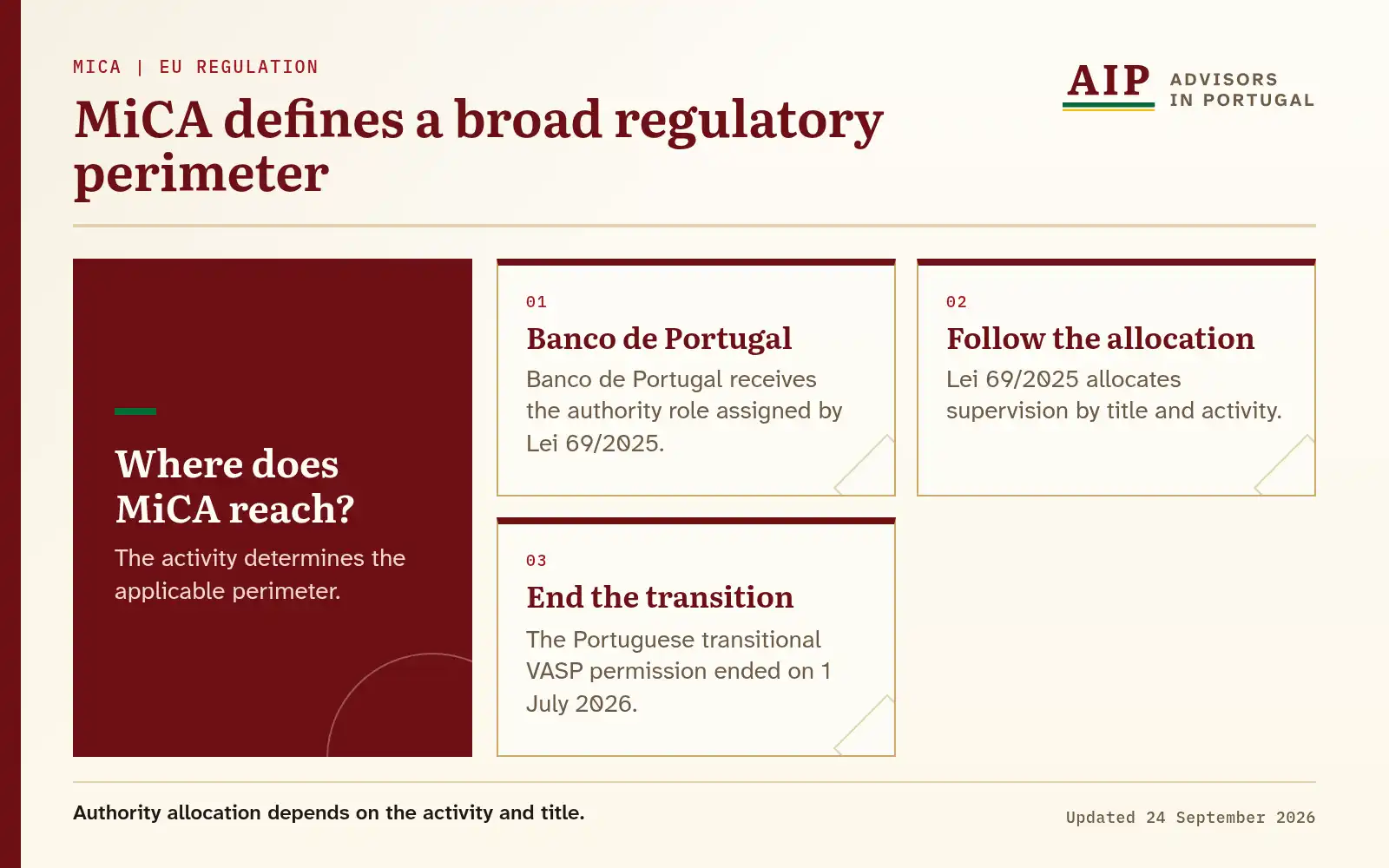
Diagram text version
Banco de Portugal covers its assigned role. CMVM supervises its assigned activities. The transitional VASP permission ended on 1 July 2026.
MiCA service categories, Portuguese supervisors, authorisation and the expired transitional period.
Which crypto activities does MiCA regulate?
Regulation (EU) 2023/1114, known as MiCA, covers offers and admissions to trading of crypto-assets and the provision of crypto-asset services under Article 1. The legal character of the asset and the activity decides the analysis. The facts that matter are what a client receives, what rights the token carries and who controls the service, because those facts determine which MiCA title applies.
MiCA Article 3 defines custody and administration, operation of a trading platform, exchange for funds or other crypto-assets, execution of orders, placing, reception and transmission of orders, advice and portfolio management. Each actual customer journey maps to these definitions. The contracts, interface and operating model decide which service applies, and the product name is only supporting context.
A project may offer a token and provide a service involving it. MiCA treats those as separate regulated activities with different requirements. The issuer, the service provider, the client assets and any third-party operator are documented separately. The relevant provision for each activity is identified before an authorisation application or disclosure route is chosen.
Who supervises a Portuguese crypto business?
Lei n.º 69/2025 allocates Portuguese MiCA supervision between Banco de Portugal and Comissão do Mercado de Valores Mobiliários (CMVM). Article 2 gives Banco de Portugal competence for Titles III and IV of MiCA, and the law also assigns other MiCA matters to CMVM. The authority that applies to a given activity is confirmed before a firm contacts a regulator.
Banco de Portugal remains the domestic authority for the Article 112.º-A virtual-asset registration under Lei n.º 83/2017. Any existing registration is held by one authority and covers a defined activity, and its scope can be compared with a proposed MiCA service. Each authorisation applies under its own legal basis and scope.
CMVM’s market role matters when an offer, admission or conduct requirement falls within its allocated part of MiCA. The token terms, white paper and service agreements show which part applies. A firm with several activities may have more than one regulatory question, and Article 2 sets out which authority receives each matter.
When is MiCA authorisation required?
MiCA Article 59 governs authorisation of crypto-asset service providers, and Article 149 generally applied the service regime from 30 December 2024. A firm that provides an Article 3 crypto-asset service must establish the appropriate MiCA basis before operating. The contracting entity, the service location and the client activity are the facts that matter, and the dated client terms and any record showing which company offered each service evidence them. Dated evidence of each service launch and of the customers to whom it was offered completes the record. These facts are compared with Article 59 and the territorial rules. Incorporating a Portuguese company through the ordinary registry, tax and beneficial-owner steps does not itself authorise a regulated crypto-asset service.
Titles III and IV of MiCA have a distinct application date under Article 149. These titles concern asset-referenced tokens and e-money tokens. A proposed issuer therefore needs a token analysis before assuming that a service-provider application resolves the issuer’s obligations. The token documentation and the intended issuance route are assessed separately.
Article 112.º-A addressed specified domestic virtual-asset activities before MiCA. A registration certificate is compared with the intended MiCA services to find any gap in authority. The application should reflect the activity the business actually plans to perform.
What happened to the Portuguese transitional permission?
Lei n.º 69/2025 allowed specified registered entities that began and communicated activity by 30 December 2024 to continue until 1 July 2026. That transitional endpoint has passed. MiCA Article 59 now governs the firm’s authorisation position for each service.
The transitional rule was confined to entities meeting its starting and communication conditions. It did not create a general permission for new entrants. The Banco de Portugal registration and communication record is the evidence for a firm that operated during the transitional period, and historical activity is related to that period and current activity to the authorisation decision.
Lei n.º 69/2025 implements the Portuguese supervisory and transitional structure for MiCA. It did not convert every anti-money-laundering registration into a MiCA authorisation. The dates of any application, decision and change in services are kept together, because the firm’s regulatory status at each date determines which activity it can support.
What did domestic virtual-asset registration require?
Lei n.º 83/2017 Article 112.º-A required prior Banco de Portugal registration for its specified virtual-asset activities. The application identifies the entity and contacts, corporate purpose, intended activities and jurisdictions. It identifies the managers who conduct the activity. An earlier filing is checked against the business as it actually operated.
Banco de Portugal assessed the suitability and professional competence of relevant persons under Article 112.º-A. The governance, identity and background records used in that assessment are compared with the persons now responsible for a proposed MiCA service, and changes need explanation.
A registration entry is evidence of a domestic procedure under the provision that created it. MiCA requires a separate assessment of the token, service and provider. The registration record and the current operating model are both presented, and historical compliance is kept apart from the new permission the proposed service requires.
How should a crypto service be classified?
MiCA Article 3 names specific services, including custody, trading-platform operation, exchange, order execution, placing, order reception and transmission, advice and portfolio management. The customer contract and technical control determine which description fits. The questions are who holds keys, who receives orders, who executes trades and who has discretion over assets.
A platform may display prices while another company executes the exchange. Each legal entity and the contractual path of an order are identified, and the Article 3 service definitions apply entity by entity. A single brand can contain several regulated actors. The contracts and system facts identify each actor’s service.
A product can change classification when its features change. Versions of the client terms, technical flow and asset documentation show the change. The proposed features are compared with the activity covered by an existing authorisation. The relevant MiCA provision is identified before the firm presents the service as available to Portuguese clients.
Which documents support the regulatory analysis?
MiCA Article 59 authorisation turns on the provider and the crypto-asset services it will carry out. The supporting documents are an entity chart, client terms, service descriptions, custody and execution arrangements, and any previous Banco de Portugal record. Each document maps to an Article 3 service and to the regulator allocated by Lei n.º 69/2025 Article 2.
A token white paper and its rights matter where the activity includes an offer or admission. The current version and the proposed distribution plan are the relevant documents. An issuer obligation under MiCA Article 1 differs from a service-provider obligation under Article 59. The description of the asset should match the rights clients receive.
The domestic Article 112.º-A record remains relevant for the history of Portuguese virtual-asset activity. The registration number, filed activities and any notices are preserved. Those details are compared with the service that began after MiCA applied and with any authorisation decision. This record makes the dates and scopes of the two regimes clear.
What costs and timing should a firm plan for?
MiCA Article 149 set 30 December 2024 as the general application date with a different date for Titles III and IV. Lei n.º 69/2025 set 1 July 2026 as the end of Portugal’s specified service-provider transition. These dates are legal milestones for the applicable regimes. The date of the proposed launch and any current authorisation are fixed before a firm commits to client activity.
The relevant authority and procedure determine the applicable charge. The official charge shown in the relevant procedure is budgeted separately from any other cost. The authority’s own notice states its charge for the application.
A service change can change the application analysis. The full launch plan, including later custody, exchange or transfer functions, is the basis of the analysis. The present authority covers a defined Article 3 service, and a change beyond it requires another regulatory step.
Which AML and travel-rule duties apply?
Anti-money-laundering and counter-terrorist-financing duties apply to in-scope providers. Regulation (EU) 2023/1113 governs the information that accompanies certain crypto-asset transfers. The controls and the information flow are mapped to the firm’s services, custody arrangements and transfer process.
MiCA also imposes organisational and prudential requirements on authorised crypto-asset service providers. The applicable requirement depends on the service class, so the business is classified first.
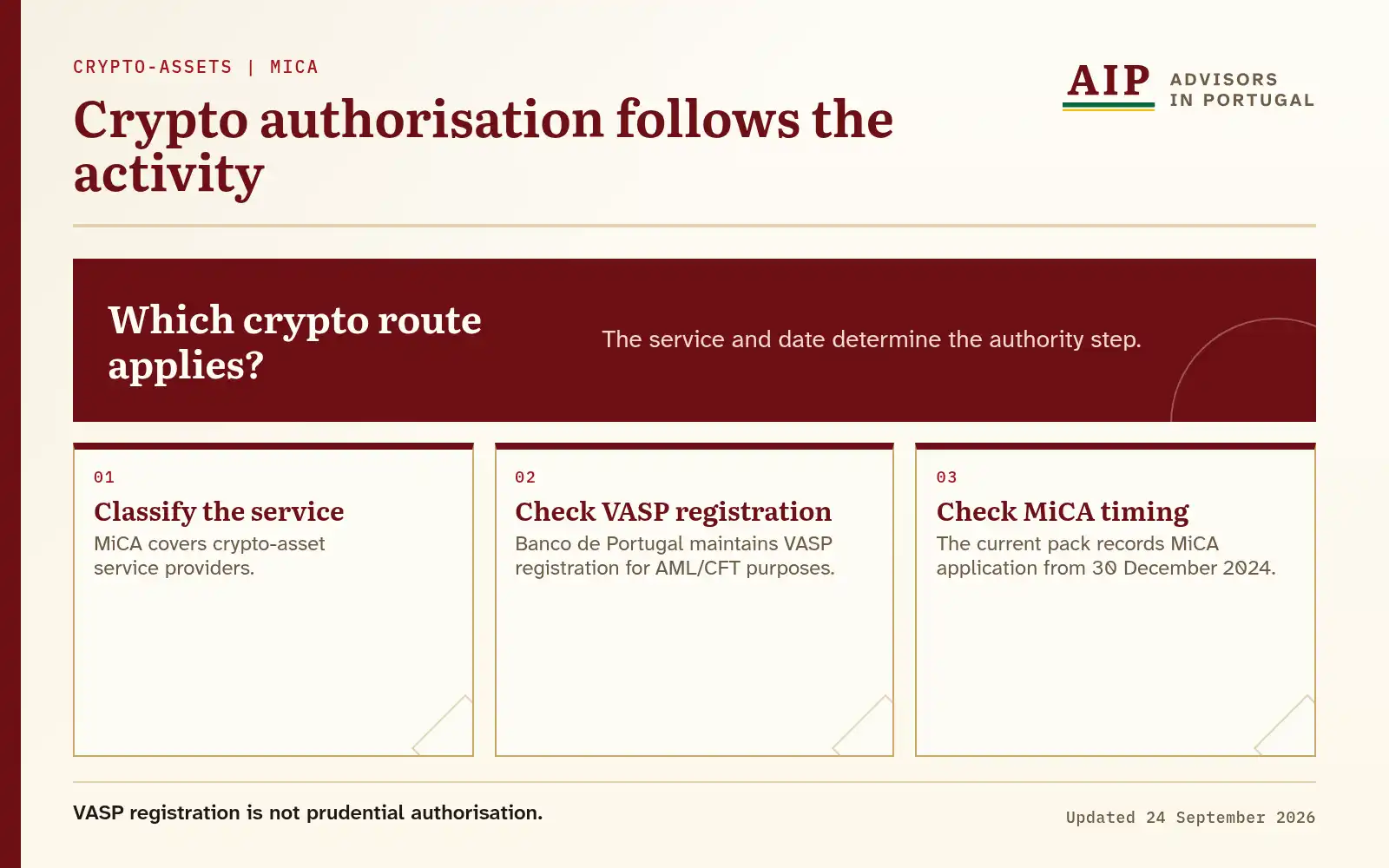
Diagram text version
Classify the service. Check VASP registration. Check the MiCA application date.
Common questions
Does a Banco de Portugal AML registration count as MiCA authorisation?
Can a firm rely on the Portuguese transition after 1 July 2026?
Does MiCA include transfer services?
What ownership information accompanies domestic VASP registration?
Is there a single Portuguese government fee for every crypto authorisation?
When did the main MiCA service rules start applying?
Related guides
The information on this page is checked against official sources and reviewed regularly. It is corrected when the law or official guidance changes, as the Editorial Standards describe.