Health Insurance in Portugal: Residence Evidence and Cover
Health insurance in Portugal can meet AIMA's general residence checklist, which accepts a policy or SNS proof and states no universal minimum insured capital. You should confirm that the product is insurance, because a health plan that offers only access or discounts is not.

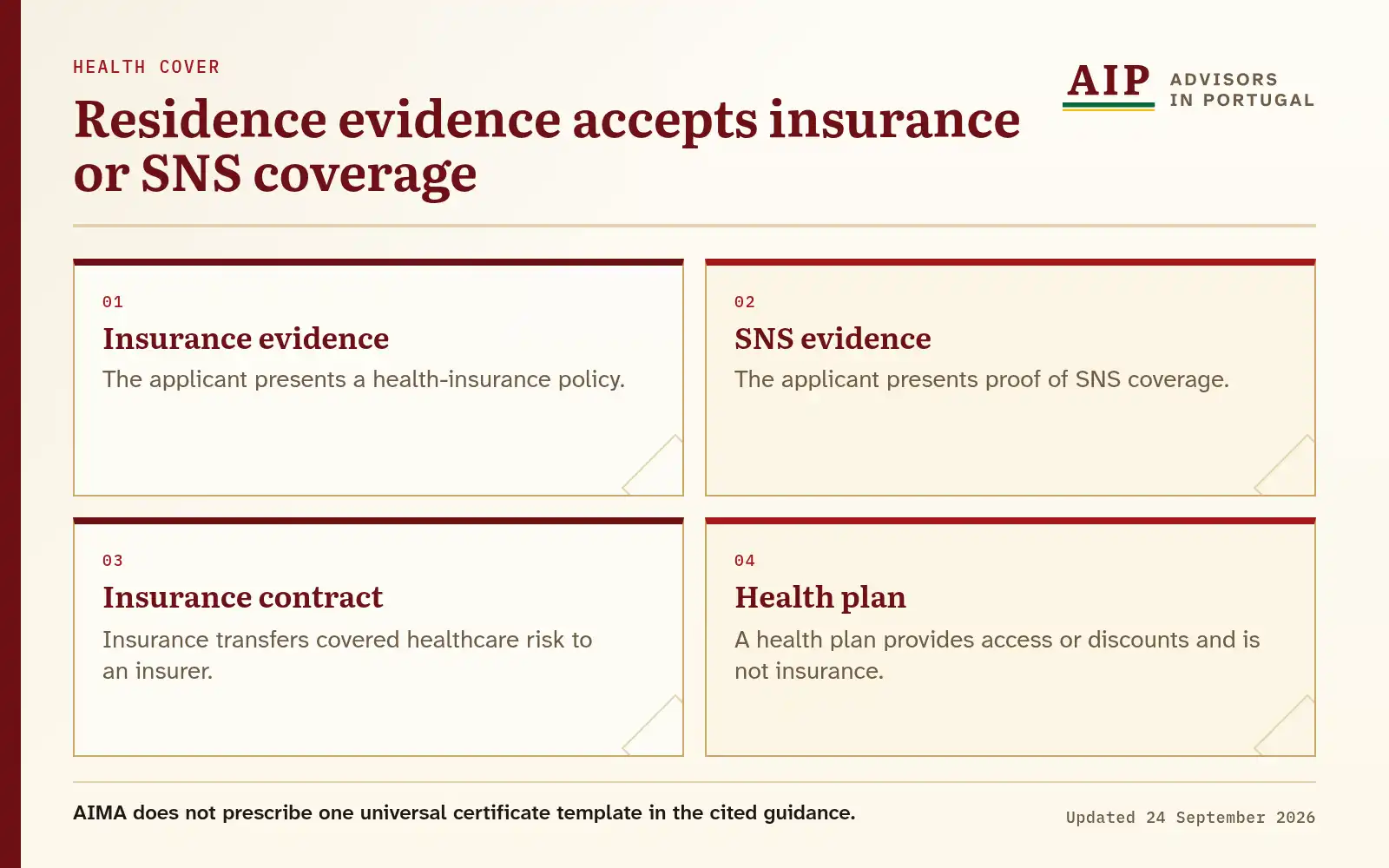
Diagram text version
The applicant presents a health-insurance policy. The applicant presents proof of SNS coverage. Insurance transfers covered healthcare risk to an insurer. A health plan provides access or discounts and is not insurance.
AIMA’s current general-residence checklist asks for a health-insurance policy or proof of SNS coverage; Article 77 sets the general cumulative residence conditions, and special categories or implementing guidance may add evidence requirements.
When does a residence applicant need health-cover evidence?
AIMA’s current general-residence checklist asks for a health-insurance policy or proof of SNS coverage; Article 77 sets the general cumulative residence conditions, and special categories or implementing guidance may add evidence requirements. You should identify the residence category and the document you will present before submission.
Article 77 states general cumulative residence conditions, and special categories or implementing guidance can add evidence requirements. You should preserve the AIMA request or appointment notice that applies to your category. The health-cover document should relate to the same applicant and period as the residence request.
You should keep a complete copy of the policy schedule or SNS proof with the application. AIMA decides the residence application; the insurer or SNS record supplies evidence of the applicant’s health-cover position at the relevant time.
What should the insurance or SNS document show?
AIMA’s general Article 77 guidance accepts evidence that the applicant holds health insurance or is covered by SNS. You should present a document that connects the applicant to the stated cover and period.
A policy schedule may identify the insurer, the person covered, the territory and the validity dates. You should retain the full conditions with the short certificate so the scope can be understood.
SNS evidence and private insurance are different forms of proof accepted in the general checklist. You should use the document that reflects the cover you actually have. The application file should include the evidence AIMA currently requests for that route.
How does health insurance differ from a health plan?
ASF guidance distinguishes an insurance contract that transfers covered healthcare risk to an insurer from a health plan that provides contractual access or discounts. Lei n.º 7/2019 and the insurance-contract framework apply to the insurance product and its distribution. You should read the contract title and issuer before relying on it for residence evidence.
A plan’s network and discount terms may look similar to an insurer’s provider list. The two products differ. You should identify who bears the covered cost, what claims can be made and which regulator supervises the issuer.
ASF supervises insurance undertakings and authorised insurance distribution. You should keep the insurer’s name, policy number and cover schedule where an insurance policy is used.
Which policy terms affect usable cover?
Regime Jurídico do Contrato de Seguro Articles 214 and 216 govern health-insurance conditions, while the policy specifies the insured risks, exclusions and waiting periods. You should read the full conditions before purchasing a policy for healthcare or residence evidence.
The policy may set co-payments, reimbursement rules, provider-network limits and insured capital. You should identify what the insurer pays, what you pay and where the cover operates. A dated schedule of benefits helps you compare the certificate with the operative contract.
A pre-existing condition may be treated under a specific exclusion or acceptance term. You should keep any disclosure and insurer response with the contract. The insurer decides claims under the contract. The amount and waiting period depend on the policy issued to the applicant.
Who may sell or advise on an insurance contract?
Lei n.º 7/2019 Article 8 governs the entities authorised to distribute insurance, including insurers and authorised insurance distributors under ASF’s registration and conduct framework. You should identify the legal entity selling or recommending a policy before accepting its offer.
You should compare any distributor details with ASF’s public register. You should keep the distributor’s name and the product information given before purchase. Advising on residence conditions and distributing an insurance contract are separate activities.
You should ask the distributor for the cover schedule and full conditions, including renewals and exclusions. An insurance-distribution authorisation concerns the sale of the policy; the residence authority determines whether the resulting proof satisfies its checklist.
How can a policyholder complain?
ASF guidance directs an insurance policyholder to use the insurer’s complaint route and request a written response before escalating an insurance-conduct issue. You should keep the policy, claim decision and dated correspondence together.
The insurer’s complaints book or formal complaints-management process gives a further record of the issue. You should state the event, policy number and outcome sought clearly in the submission. The evidence should show what the insurer knew and when it responded.
ASF provides complaint and information channels for matters within its insurance-supervision remit. You should preserve the insurer response and any new evidence before using those channels. The applicable route and any deadline follow the policy and complaint procedure involved.
What renewal and cancellation terms need attention?
Regime Jurídico do Contrato de Seguro Articles 214 and 217 govern aspects of health-insurance contracts, while the issued policy states its period, renewal and premium mechanism. You should record the renewal date, notice rule and any premium-review term when the policy begins.
Benefits or provider networks can change under the policy’s terms. You should keep each version of the cover schedule and the date on which it applies. You should obtain current evidence when the earlier policy document is out of date.
A cancellation or non-renewal may affect both healthcare access and the residence evidence previously supplied. You should keep insurer notices and any replacement-cover document together. The contract’s actual renewal terms determine the policyholder’s position.
What changed in the 2026 insurance rules?
Decreto-Lei n.º 79/2026 added post-termination information duties for specified health-insurance non-renewals, including a 30-day disease-notification condition. The affected rules also address remaining insured capital. You should keep the insurer’s non-renewal notice and the policy schedule when considering a claim.
The amended framework concerns the insurer’s information after the specified non-renewal situation. You should identify the policy end date, the event and the date on which the insurer received notice. A general expectation of continued cover should be checked against the actual contract and amended rule.
You should request the current policy terms and any post-termination statement from the insurer. The change affects the insurance contract; the residence application still follows the health-cover category and document request stated by AIMA.
Can health-insurance premiums affect IRS?
Código do IRS Article 78-C allows a 15% deduction for qualifying health expenses, subject to its conditions and overall limit. Its insurance-premium rule applies only where the premium exclusively covers health risks for the taxpayer or dependants and meets the statute’s payment and tax-treatment conditions. You should keep the premium invoice and policy description for the tax year claimed.
A policy can combine health cover with other benefits. You should identify the insured risks and the person covered before treating the premium as a health expense. The tax treatment of a premium is a separate question from whether AIMA accepts the policy as residence evidence.
You should retain any insurer statement that separates premiums or benefits. The tax calculation follows Código do IRS Article 78-C and the actual premium paid.
Common questions
Is a health plan necessarily supervised as insurance?
Does AIMA prescribe a minimum insured capital?
What disease-notification period appears in the 2026 non-renewal rule?
Where can a buyer check distributor registration?
Where can an unresolved insurance complaint go?
What is the health-expense deduction ceiling?
The information on this page is checked against official sources and reviewed regularly. It is corrected when the law or official guidance changes, as the Editorial Standards describe.