Debt Collection in Portugal: Injunção, PEPEX and Enforcement
Debt collection in Portugal depends on proving the debt, because enforcement needs a título executivo and an amount traced to the contract, invoices and payments. A creditor without a title may need an injunção before using PEPEX or another enforcement route.

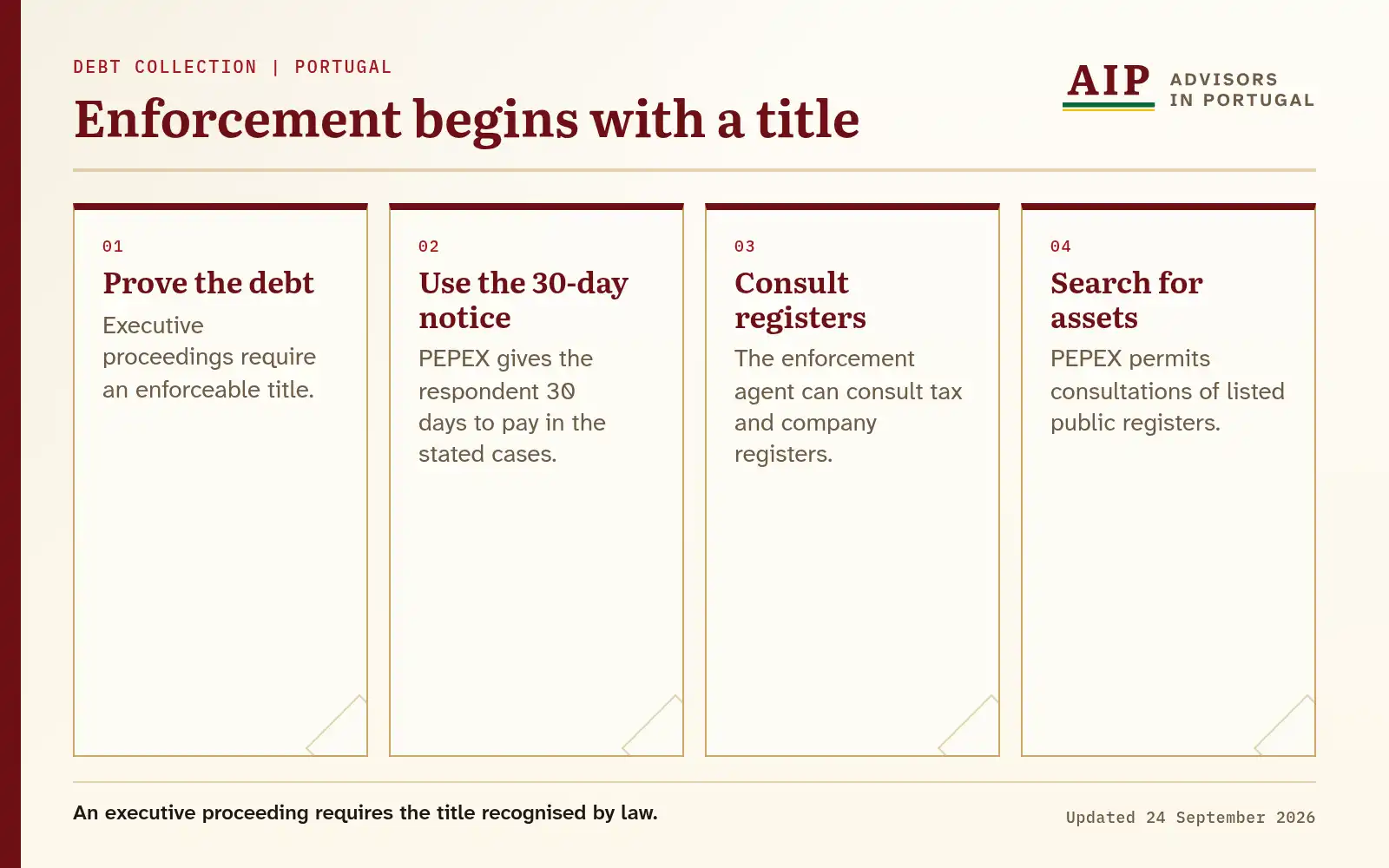
Diagram text version
Prove the debt. Use the 30-day notice where PEPEX applies. Consult the listed registers. Search for assets.
Lei n.º 32/2014 Article 3 lets a creditor use PEPEX only with an enforceable title for a certain, due and liquid debt that meets its other conditions. A creditor without a title may need an injunção or another legal step before enforcement. You should identify the debt instrument, amount, due date and debtor before paying for a procedure.
What Must You Prove Before Collecting a Debt?
Portuguese enforcement requires a título executivo, an instrument that the law treats as sufficient to support an executive proceeding. Justiça lists judgments, an injunção bearing a fórmula executória, authenticated acknowledgments of debt and certain credit instruments as examples. You should gather the signed contract, order, delivery record, invoices, payment history and correspondence, then identify whether one document already has the legal status of a title.
The claimed amount must be established from the underlying obligation. You should show principal, contractual interest, payments received, credit notes and any disputed deduction separately. A total stated in a demand letter may be difficult to enforce if the arithmetic cannot be traced to the documents.
You should identify the actual debtor, including the legal name and number of a company or the identity of an individual. Any separate liability of a guarantor, parent company or director needs separate verification. Accurate party details matter in an injunção, PEPEX search and later enforcement.
When Can You Use Injunção?
Decreto-Lei n.º 269/98 and the Justiça injunção service provide a simplified route for a monetary claim meeting that procedure’s conditions. The Balcão Nacional de Injunções processes the application and notifies the debtor. You should describe the debt and attach or retain the contract, invoices and payment calculation that support it.
The debtor may pay or oppose after notification. Justiça says the fórmula executória is placed on the injunção application when the notified debtor does not tell the Balcão Nacional de Injunções that the debt is disputed.
You should preserve the exact application and all evidence of notification. A debtor may dispute the amount, the contract or the person named; those facts change the procedure and the proof required. The injunção route can be efficient when the creditor can support the amount and parties named.
What Does a Fórmula Executória Do?
The Justiça injunção guidance says a fórmula executória turns an unopposed injunção into a título executivo. That title can support an executive proceeding for the identified debt. You should obtain the document carrying the formula, not just the original payment request or an acknowledgment that the injunção was submitted.
The formula is a procedural result, not a judgment resolving every possible defence. You should retain the underlying agreement, due-date proof and notification record in case the debtor raises a claim about payment, identity or limitation later. A title supports the route; the actual recovery still depends on procedure and assets.
You should distinguish the amount shown in the formula from later interest and costs. Each component needs a basis and calculation. An agent de execução may then take steps under the applicable enforcement rules, but that comes after the title is available.
Who Can Use PEPEX?
Lei n.º 32/2014 Article 3 makes PEPEX available when the applicant has an enforceable title suitable for the summary form of ordinary enforcement, the debt is certain, due and liquid, and both applicant and debtor have Portuguese tax numbers. The procedure is optional under Article 2. You should check each condition before filing.
Article 5 requires the initial application to identify the parties, debt components and title. You should reconcile the amount against payments and interest before the form is completed. A missing tax number or a document that is not an enforceable title affects PEPEX eligibility.
PEPEX is a preliminary procedure, not a substitute for contested litigation over whether a debt exists. A debtor objection, payment agreement or insolvency issue changes whether PEPEX is the right step. The creditor’s decision to use PEPEX should be informed by the title, the debtor’s known position and the likely next step if assets are found.
What Can a PEPEX Asset Search Show?
Lei n.º 32/2014 Article 9 lets an agent de execução consult specified databases to identify potentially attachable assets. The authorised databases include tax, civil and company records, land and commercial registers, the execution information register and SISAAE, subject to the statutory access rules. You should give the agent accurate debtor identifiers.
A database result can point to property, a vehicle, company interests or another relevant record, but PEPEX does not itself attach an asset. You should distinguish information about an asset from ownership, priority and practical recoverability. You should assess the available asset information before incurring the next enforcement cost.
You should keep the search report with the debtor’s response and the original title. The combination helps decide whether to proceed to enforcement, negotiate or stop.
How Long Does the Debtor Have to Respond?
Lei n.º 32/2014 Article 12 gives a notified debtor 30 days to pay, agree a payment plan, identify attachable assets or oppose in the circumstances the article describes. You should use the actual notice and service date when assessing the response period.
Article 12 requires the notice to identify debt components, interest, taxes and enforcement-agent fees. You should compare those amounts with the application and title before the notice goes out. An unsupported extra charge can create a dispute even where the principal debt is documented.
Limitation is a separate question under the Código Civil and depends on the claim type and events that may interrupt or otherwise affect the period. The date the debt fell due, any debtor acknowledgment and any formal notices or proceedings all bear on limitation. Article 12’s 30-day PEPEX response period is not a universal limitation period for every debt. A claim can require urgent action before a PEPEX application is ready.
When Does Court Enforcement Follow?
An enforceable title can support a Portuguese executive proceeding under the Código de Processo Civil. A creditor may use the applicable enforcement application and an agent de execução, with the competent court involved where the rules require it. The enforcement application relies on the title, the debt calculation, the debtor identifiers and any PEPEX result. The enforcement route depends on the title and the procedural position, not simply on whether the debtor has ignored informal demands.
You should decide what outcome you seek from a settlement offer, payment plan or attachment before further costs arise. The title defines the claim being enforced; a later agreement should record how payments affect principal, interest and costs.
What Costs Must You Consider?
Lei n.º 32/2014 Article 5 requires payment of applicable procedural amounts for PEPEX submission. Articles 12, 18 and 20 govern notices, subsequent steps and costs within the procedure. The debtor’s notice identifies the components claimed, including interest, taxes and agent fees. You should separate the principal debt from procedural spending and ask for the applicable official fee calculation before filing. The amount depends on the claim value and procedural act.
The claim value, chosen route and fee schedule affect the amount paid. An injunção, PEPEX search and executive proceeding are different procedural acts, so one published price should not be carried across them. Reimbursement of a cost from the debtor is not guaranteed.
You should retain payment references and receipts with the title and application. Those records help calculate the balance and explain any remaining fee or interest when the debtor pays only part of the claim. A decision to incur additional enforcement cost should consider the available asset information and the importance of the debt to your business.
Can You Recover a Cross-Border Debt?
Regulation (EC) No 1896/2006 establishes the European order for payment procedure for uncontested cross-border civil and commercial claims within its scope. You should identify the debtor’s location, the agreement’s governing and jurisdiction terms, and where assets may be enforced against before choosing a court or order route.
An order obtained in one state may require enforcement where the debtor or assets are located under the applicable EU and national rules. You should separate obtaining a title from locating assets and collecting payment.
You should preserve translated contracts, debtor identification and cross-border correspondence where relevant. A foreign address can affect notice and service, while a foreign asset can change the enforcement step. Regulation 1896/2006 offers one route for qualifying uncontested claims; a disputed claim or another type of title may require a different procedure.
Common questions
Can the creditor complete a paper PEPEX application?
What must accompany the initial PEPEX application?
Can the agent search vehicle records in PEPEX?
What must accompany a PEPEX debtor notice?
Can the agent consult Social Security data?
How long does a notified debtor have to respond to a PEPEX notice?
Related guides
The information on this page is checked against official sources and reviewed regularly. It is corrected when the law or official guidance changes, as the Editorial Standards describe.