Divorce in Portugal: Mutual Consent, Court Procedure and Documents
Divorce in Portugal goes to a civil registry (Conservatória do Registo Civil) when spouses agree and to the family court when one spouse applies on an Article 1781 ground. Spouses with foreign marriage or divorce documents may need them translated, recognised or registered before filing.

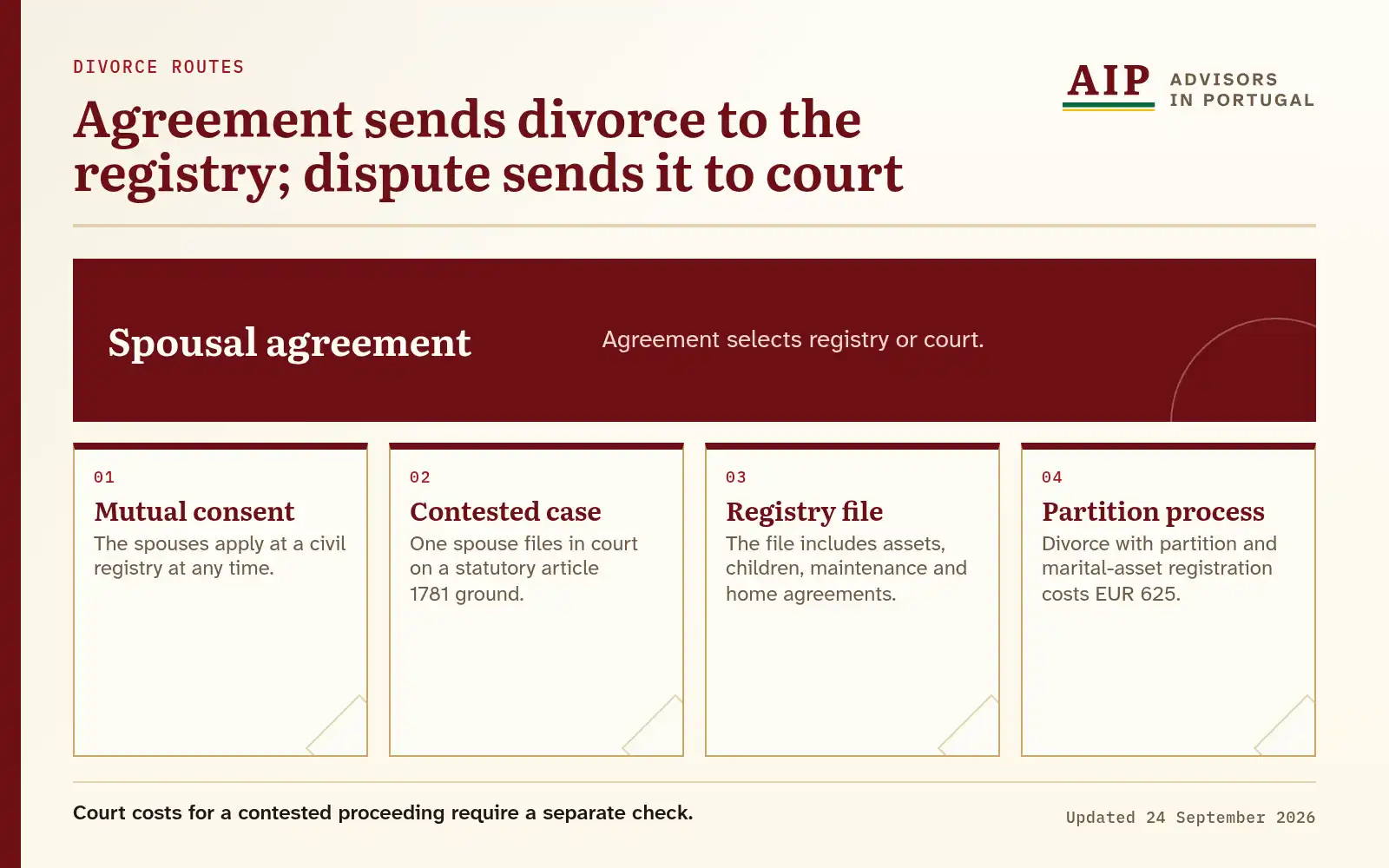
Diagram text version
The spouses apply at a civil registry at any time. One spouse files in court on a statutory article 1781 ground. The file includes assets, children, maintenance and home agreements. Divorce with partition and marital-asset registration costs EUR 625.
Which route does a Portuguese divorce take?
A divorce in Portugal follows one of two routes. Spouses who agree can request a mutual-consent divorce at a Conservatória do Registo Civil. A spouse who applies against the other on an Article 1781 ground goes to the family court.
The mutual-consent route needs the statutory agreements: an asset list, the child arrangements, a maintenance agreement, the destination of the family home and any antenuptial convention. The contested route applies the Código Civil grounds, and the family-court territorial route follows the current judicial-organisation rules.
The facts of the marriage add to either route. Children, maintenance, the family home, business interests and creditors each bring agreements or registrations into the file. Foreign marriage or divorce documents may need translation, recognition or registration before filing.
How does a divorce proceed step by step?
- Map the agreement and family facts. The marriage, children, maintenance, home, assets and the spouses’ position on agreement set the starting point.
- Choose the registry or court route. A mutual-consent divorce goes to a conservatória. The contested Article 1781 route goes to the competent forum.
- Prepare the child and home agreements. Parental responsibilities, maintenance and family-home documents are organised for approval.
- Review the regime and asset division. The matrimonial regime, titles, creditors, international assets and partition limits are mapped.
- File and register the divorce. The spouses or their lawyer submit a mutual-consent file to the conservatória. The applying spouse or that spouse’s lawyer files a contested case at the family court. The spouses or their lawyer identify the registrations needed for the judgment and the assets.
- Close the foreign-document tasks. Certified translations, recognition evidence, decisions, receipts and unresolved registration questions are kept with the file.
Documents the authority asks for
A mutual-consent file includes an asset list, the parental-responsibility arrangement or a court certificate, a maintenance agreement where relevant, the family-home destination and any antenuptial convention.
Foreign marriage or divorce records generally need certified Portuguese translations, although some EU public documents may qualify for an exception. Apostille or legalisation material is required where the issuing country and the document call for it. The IRN publishes guidance on translating foreign documents.
How are children and maintenance handled?
Article 1905(1) subjects the parents’ maintenance agreement to approval. The court or the conservator refuses approval where the arrangement does not protect the child’s interest.
Article 1905(2) continues maintenance to age 25 when it was fixed during the child’s minority. The exceptions are completed education or training, voluntary interruption and an unreasonable demand.
How are the matrimonial regime and assets treated?
The default Portuguese regime is comunhão de adquiridos where no effective antenuptial convention applies. Article 1790 caps the partition at what that regime would have provided to each spouse.
International assets need an asset-by-asset review of titles, creditors and registration effects.
Which official fees apply?
| Route | IRN fee |
|---|---|
| Mutual-consent divorce or separation | EUR 280 |
| Divorce that integrates partition and registration of marital assets | EUR 625 |
Contested court costs and additional property-registration amounts need separate confirmation.
How long does a divorce take?
No fixed period applies. The timeline depends on agreement between the spouses, children, assets, foreign documents, the court route and registry requirements.
A divorce takes longer when the spouses disagree, asset ownership is layered, a child arrangement needs revision or foreign documents require further authentication. Marriage and identity records, child documents, asset schedules, debts, foreign certificates and existing notices are gathered before the application is filed.
Ongoing Family and Property Obligations
Agreements, children and home
Birth, income, housing and care records support the child arrangement submitted for approval. Any revision the conservator or court requests is kept with that evidence.
Matrimonial estate and creditor file
Company interests, account balances and liabilities go into a partition schedule. Creditor notices, foreign ownership records and registration evidence document each asset.
Foreign documents and post-divorce registration
Certified copies, apostille material and existing registry decisions support the file. The judgment, receipts and registrations required after the divorce is concluded close the record.
Common questions
Can we request divorce by mutual consent at any time?
What must a mutual-consent file include?
When does a divorce go to court?
What does Article 1905 require for child maintenance?
Can child maintenance continue after age 18?
How are international marital assets divided?
What are the official divorce fees?
How are foreign marriage or divorce documents handled?
The information on this page is checked against official sources and reviewed regularly. It is corrected when the law or official guidance changes, as the Editorial Standards describe.