NIF in Portugal: What It Is and How to Request It
A NIF in Portugal is a nine-digit tax number assigned by the Autoridade Tributária e Aduaneira. You need one when you enter a Portuguese tax relationship, such as owning Portuguese property, working as an employee or starting self-employment.

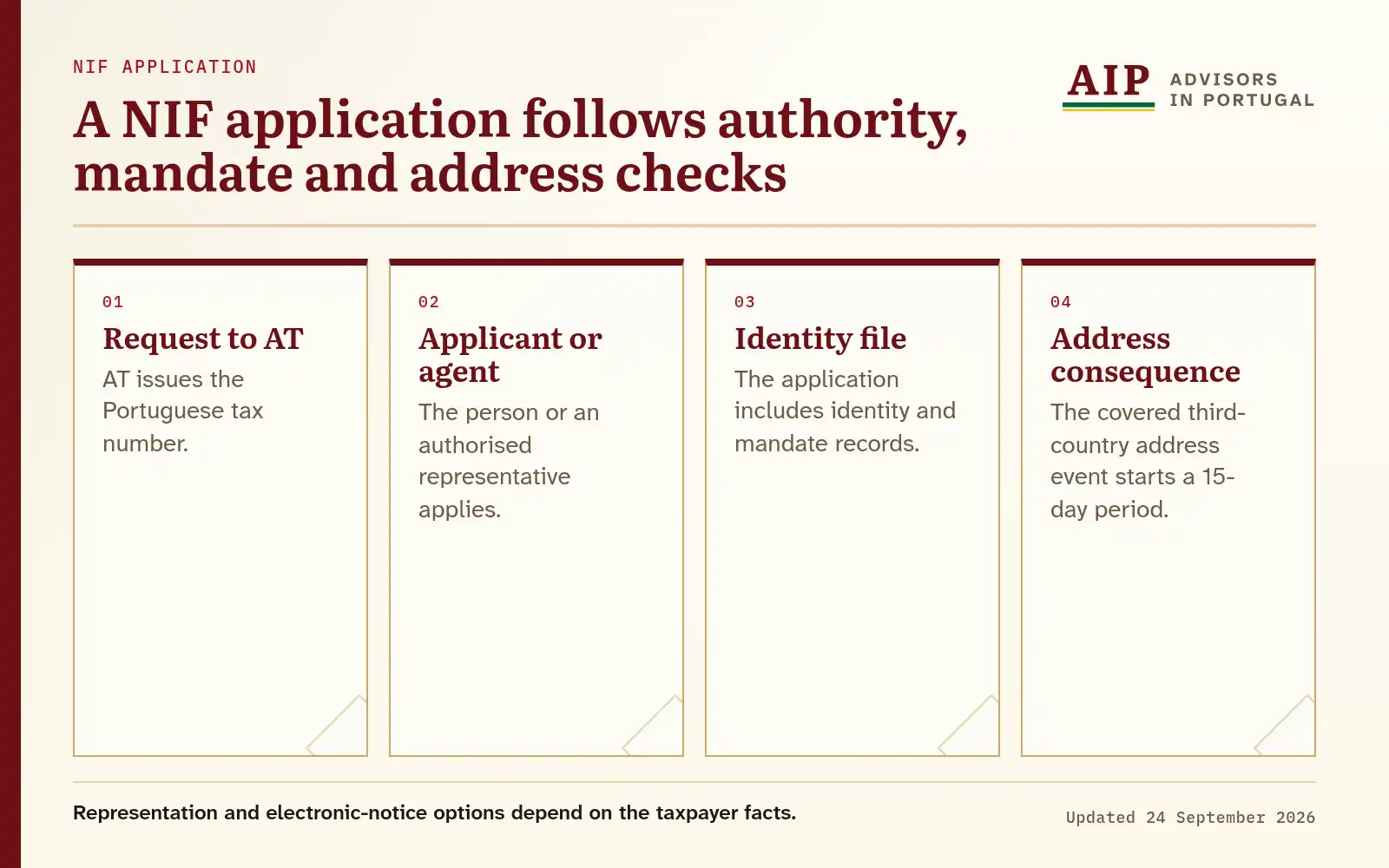
Diagram text version
AT issues the Portuguese tax number. The person or an authorised representative applies. The application includes identity and mandate records. The covered third-country address event starts a 15-day period.
What a Portuguese NIF is, who assigns it, when a non-resident needs representation and how the electronic-notification alternative works.
What is a Portuguese NIF?
Decreto-Lei n.º 14/2013 Article 4 defines an individual Número de Identificação Fiscal as a nine-digit number, used in Portuguese tax records. The NIF identifies the person in Portuguese tax records. You should use the same identifier consistently in tax, property and employment documents.
A NIF is an identifier, not a decision about residence, nationality or entitlement to a service. The tax record can be compared with the identification documents used in a transaction. You should check the recorded name and address when the number is issued so later records refer to the same person.
Article 5 assigns competence for individual NIF allocation to the Autoridade Tributária e Aduaneira, or AT. You may deal with an authorised channel or a representative, but AT allocates the number. Your file should preserve the allocation notice and the identification supplied with the request.
Who may request a NIF?
Decreto-Lei n.º 14/2013 Article 6 allows the interested person, a representative or a gestor de negócios to request an individual NIF. You should identify which capacity the requester uses.
The requester may need to show authority to act for the person concerned. The mandate and identity documents should match the request route. You should keep the exact identity details supplied to AT, because the NIF record becomes the reference for future Portuguese tax dealings.
The individual whose number is assigned remains identified in the AT record. A one-off request made under Article 6 differs from the continuing role of a fiscal representative where another provision requires one.
When do you need a NIF?
AT describes a Portuguese tax relationship through events such as owning Portuguese property, working as an employee or starting self-employment. You should identify the transaction or activity that brings you into the tax system before requesting the number. The NIF allows the related record to identify the correct taxpayer.
You may need the number for a property deed or a tax registration connected with employment. You should check which step needs a NIF and what residence information AT should hold at that time. You should avoid using another person’s identifier or an old number with inconsistent personal details.
Decreto-Lei n.º 14/2013 Article 9 addresses registration information, including fiscal domicile and taxpayer status. You should ensure the address and status in the NIF file correspond to your actual circumstances. Later changes in residence or activity may require the tax record to be updated.
What counts as a Portuguese tax relationship?
AT gives property and employment or self-employment as examples of a tax relationship. You should identify the date when the relevant right or activity begins, because that date can affect representation duties for a non-resident. A planned purchase and an acquired property are different facts.
You should check which Article 6 capacity the requester uses: the person concerned, a representative or a gestor de negócios. You should disclose any other Portuguese assets or activity so the request and address information are accurate.
The relationship can continue after the first transaction. You should keep records of the acquisition, work start or tax registration and note when it ends or changes. Those facts can be compared with the fiscal-domicile and representative fields in the AT record.
When is a fiscal representative required?
Decreto-Lei n.º 14/2013 Article 10 addresses representation information for a non-resident when Portuguese law requires a representative. Código do IRS Article 130 and Lei Geral Tributária Article 19 supply the governing conditions and exceptions. You should identify your residence country, Portuguese tax relationship and electronic-notification choice before appointing anyone.
AT explains that a person resident outside the EU or EEA can face a fiscal-representation duty after forming a Portuguese tax relationship, subject to the legal exceptions. The dates and your accepted notification channel determine how the rule applies. You should preserve the mandate if a representative is appointed.
The representative’s role concerns Portuguese tax communications and the specified obligations. You should keep your own address details current even where another person receives tax notices on your behalf.
What is the 15-day rule?
AT’s representation FAQ gives a general 15-day period for a third-country non-resident after the foreign address is communicated or a Portuguese tax relationship is formed, whichever occurs later. It says a person starting self-employment must meet the representation requirement before that activity starts. You should compare the address and activity dates before using the general period.
A property purchase, a move abroad and the start of self-employment can put the relevant events in a different order. The later event sets the general period, and the self-employment rule may change the sequence. You should keep evidence of address communication and the beginning of the Portuguese relationship.
The 15-day period concerns the taxpayer’s duty, not the time AT promises to allocate a NIF or process a change. You should avoid treating an intended transaction date as an administrative completion guarantee. Your file should show when the relevant event actually occurred.
Can electronic notifications replace a representative?
Decreto-Lei n.º 44/2022 allows the specified taxpayer to avoid appointing a fiscal representative by joining an accepted electronic notification channel, and the related change to Lei Geral Tributária Article 19 took effect for the paragraph 14 electronic-mailbox exemption on 1 January 2023 under Article 3(2). You must opt in; the alternative does not arise merely because you have internet access.
The law lists accepted electronic notification channels. You should check which channel you have actually joined and whether it applies to your tax position. You should keep the enrollment confirmation and monitor the chosen channel.
You should examine the consequences for tax notices before leaving an electronic channel. The electronic choice changes how official tax notices reach you; your underlying tax residence and liability follow their separate legal tests.
Which documents and identity details matter?
Decreto-Lei n.º 14/2013 Article 10 requires identification for a non-resident, including the civil identification document and, where representation applies, the mandate. You should assemble those records before a request or change to the AT file. Names and numbers should match across the documents.
Article 9 requires registration of details that include fiscal domicile and status. You should give AT the address that reflects your actual residence and keep proof of any later address communication. An address used only for convenience can distort the representation analysis and notices.
A representative mandate should identify the person and the tax role being accepted. The document should be checked against the Article 10 fields. You should preserve the original identification and the AT confirmation together so a later update can be traced to the correct person.
How do address changes affect the record?
Decreto-Lei n.º 14/2013 Article 9 includes fiscal domicile in the individual registration data. AT’s representation FAQ connects communication of a foreign address to the general 15-day rule for the relevant third-country taxpayer. You should record when the foreign address was communicated and when a Portuguese tax relationship arose.
A change of address can alter the representative question even though the NIF itself remains the same. The old and new residence, any Portuguese activity and electronic-channel enrollment all bear on the question. You should retain the AT confirmation showing the new address.
Decreto-Lei n.º 44/2022 Article 3(2) delayed the paragraph 14 electronic-mailbox exemption until 1 January 2023. You should apply the current legal text to your actual address and activity dates.
You should keep the dated notice that shows your current fiscal domicile and any earlier AT acknowledgment of a different address. These documents can be compared with the property, employment or self-employment record that created the Portuguese tax relationship. You should keep the evidence of your chosen communication route with the same file, so the dates and the person responsible for receiving notices remain clear.
You should separate three dates in your records: when AT allocated the NIF, when your Portuguese tax relationship began and when you communicated a foreign address. Those dates can be compared with your enrollment in an electronic notification channel or the representative mandate. You should retain each AT acknowledgement. The number stays the person’s identifier while the registered address, activity and communication route can change as the person’s circumstances change.
Need a NIF or fiscal representation?
State your residence country, your Portuguese tax relationship and any NIF or representative already recorded.
Common questions
How are the nine individual NIF digits arranged?
Can a tax substitute request a NIF for someone outside Portugal?
Can vehicle ownership create a Portuguese tax relationship?
What happens if the electronic notification channel is cancelled?
Which electronic channels can replace appointment?
Which identifiers are needed for a fiscal representative?
Contact us
Your request is in
Your details have been received.
Every enquiry is read in house, and the aim is a reply within one business day.
The information on this page is checked against official sources and reviewed regularly. It is corrected when the law or official guidance changes, as the Editorial Standards describe.